Category Archives: Literature

It’s Still Summer

Labor Day may have come and gone, but technically it’s still summer, and at 93 degrees it certainly feels like. While I’ve put away my white pants for the season, summer lingers on in poetry and pool romps. Here’s a poem by one of my favorite writers, Mary Oliver, extolling the continuation of the sunny days:


LITTLE SUMMER POEM TOUCHING THE SUBJECT OF FAITH


Every summer

I listen and look

under the sun’s brass and even

into the moonlight, but I can’t hear


anything, I can’t see anything

not the pale roots digging down, nor the green stalks muscling up,

nor the leaves

deepening their damp pleats,


nor the tassels making,

nor the shucks, nor the cobs.

And still,

every day,


the leafy fields

grow taller and thicker

green gowns lofting up in the night,

showered with silk.


And so, every summer,

I fail as a witness, seeing nothing

I am deaf too

to the tick of the leaves,


the tapping of downwardness from the banyan feet —

all of it

happening

beyond any seeable proof, or hearable hum.


And, therefore, let the immeasurable come.

Let the unknowable touch the buckle of my spine.

Let the wind turn in the trees,

and the mystery hidden in the dirt


swing through the air.

How could I look at anything in this world

and tremble, and grip my hands over my heart?

What should I fear?


One morning

in the leafy green ocean

the honeycomb of the corn’s beautiful body

is sure to be there.

~ Mary Oliver

Continue reading ...

When the Mockingbird Sings

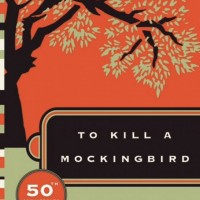
Every once in a great while, a book comes along that makes you slow down and savor each page, forcing you to devour it as quickly as you don’t want it to end. The great literary conundrum – when you enjoy something so much you rush through it because you can’t stop, but at the same time you do everything in your power to prolong the pleasure, earmarking pages and underlining passages and revisiting favorite parts before it’s even over. Such was the power of ‘To Kill A Mockingbird’ by Harper Lee – a classic that had somehow escaped my vision in the course of four decades. I just finished it, and what a wonderful read it was. In many ways, I’m glad I waited. This sort of jewel might have been wasted in my youth. Instead, I am still moved by its last few chapters, and it’s been haunting me since I finished it. The best books do that. They stay with you long after you’ve read them, inhabiting a place inside the soul that enriches and emboldens – a place that you don’t let everyone see, because it means too much, and too many people might sully it. Instead, you hold it close and secret and safe, and you hope the world doesn’t rock you too much to dislodge it.

“Mockingbirds don’t do one thing but make music for us to enjoy. They don’t eat up people’s gardens, don’t nest in corncribs, they don’t do one thing but sing their hearts out for us. That’s why it’s a sin to kill a mockingbird.”

“People in their right minds never take pride in their talents.”

“I wanted you to see what real courage is, instead of getting the idea that courage is a man with a gun in his hand. It’s when you know you’re licked before you begin but you begin anyway and you see it through no matter what. You rarely win, but sometimes you do.”

“A steaming summer night was no different from a winter morning.”


Continue reading ...

Master of Words

John Irving is one of my favorite authors. He consistently delivers spellbinding prose, and every novel he crafts manages to conjure the aching resilience and hope of the human spirit with wildly varying settings and characters. The one constant is a gentle examination of the brutalities we inflict on one another, and the notion that no matter how impossible it may seem, we always have the capacity to change, to become someone new, someone better.

While I’ll probably always favor ‘A Prayer for Owen Meany’ over everything else (you never forget your first time), I was also quite enamored of ‘In One Person’. Perhaps upon perusing the following quotes, you may be tempted to give it a try. I’d certainly encourage it.

“You shouldn’t guess about someone’s past; if you don’t see any evidence of it, a person’s past remains unknown to you.” ~ John Irving

“That moment when you are tired of being treated like a child – tired of adolescence, too – that suddenly opening but quickly closing passage, when you irreversibly want to grow up, is a dangerous time. In a future novel (an early one), I would write: “Ambition robs you of your childhood. The moment you want to become an adult – in any way – something in your childhood dies.” ~ John Irving

“You can’t force children to become something they’re not. You can’t simply tell a boy not to play with dolls.” ~ John Irving

“What’s the point of having a love of your life, if he’s not always with you?” ~ John Irving

Continue reading ...

Returning to the Floating World

I must say I find it hard to understand how any man who values his self-respect would wish for long to avoid responsibility for his past deeds; it may not always be an easy thing, but there is certainly a satisfaction and dignity to be gained in coming to term with the mistakes one has made in the course of one’s life. In any case, there is surely no great shame in mistakes made in the best of faith. It is surely a thing far more shameful to be unable or unwilling to acknowledge them.” ~ Kazuo Ishiguro, An Artist of the Floating World

For indeed, a man who aspires to rise above the mediocre, to be something more than ordinary, surely deserves admiration, even if in the end he fails and loses a fortune on account of his ambitions… if one has failed only where others have not had the courage or will to try, there is a consolation – indeed, a deep satisfaction – to be gained from this observation when looking back over one’s life. ~ Kazuo Ishiguro, An Artist of the Floating World

I suspect the reason I couldn’t celebrate the floating world was that I couldn’t bring myself to believe in its worth. Young men are often guilt-ridden about pleasure, and I suppose I was no different. I suppose I thought that to pass away one’s time in such places, to spend one’s skills celebrating things so intangible and transient, I suppose I thought it was all rather wasteful, all rather decadent. It’s hard to appreciate the beauty of a world when one doubts its very validity

But I’ve long since lost all such doubts… When I am an old man, when I look back over my life and see I have devoted it to the task of capturing the unique beauty of that world, I believe I will be well satisfied. And no man will make me believe I’ve wasted my time. ~ Kazuo Ishiguro, An Artist of the Floating World

I have learnt many things over these past years. I have learnt much in contemplating the world of pleasure, and recognizing its fragile beauty. But I now feel it is time for me to progress to other things… it is my belief that in such troubled times as these, artists must learn to value something more tangible than those pleasurable things that disappear with the morning light. It is not necessary that artists always occupy a decadent and enclosed world. My conscience tells me that I cannot remain forever an artist of the floating world. ~ Kazuo Ishiguro, An Artist of the Floating World

Continue reading ...

A Wonderful World

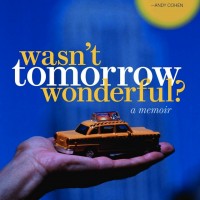
In this Age of the Internet, it’s easy to think that we know everything about everyone, particularly someone who has an immensely popular blog. Kenneth M. Walsh, of Kenneth in the (212) fame, is one of those online-celebrities who in many ways feels like an old friend, at least for those of us who have followed him religiously since he exploded onto the scene. Yet you never really know someone until you read their memoir, and Mr. Walsh offers scintillating tidbits of the humorous and twisting tale that brought him to the enchanting metropolis of New York in last year’s ‘Wasn’t Tomorrow Wonderful?’

Struck-through with world-weary wiseass remarks that only a fellow social anxiety-sufferer could love (“I don’t even like to be touched when I’m having sex”) there is much to laugh about and love in his engaging recounting of nights with one-armed men, terrorized toothbrushes, and an almost-unhinged Thomas Roberts. Yet for every hilarious occurrence (and there are many) there is an equally-poignant and touching moment of melancholy. Such depths give this memoir a gravity that grounds the more outrageous wanderings of the occasionally wayward protagonist.

The most audacious and memorable character in the book is Mr. Walsh’s own mother, the indomitable and unsinkable Molly. She is perhaps the mother of all mothers, pulling no punches and delivering every blow with brilliant comic madness and sometimes unbearable pathos. Walsh digs deep with his family memories, and the years-long dance his Mom somewhat awkwardly performs regarding his sexuality is one to which many of us can relate. We want so badly to be loved, and we will forgive almost-all parental transgressions because we have but one mother.

Most moving is Walsh’s own coming to terms with his coming-of-age, especially the exact moment his childhood innocence departed. Not all of us can pinpoint the exact moment that innocence is shattered, but Walsh has it down to a date and time. It was during the Johnny Carson Show, when that evening’s guest introduced a film clip from a gay love story. The audience’s reaction – jeers and boos and open hostility – was what rang in young Kenneth’s ears, and suddenly the notion of shame was born. It’s something that resonates with most gay boys and girls, and this is the part of the book that struck me most deeply.

“My ability not to be painfully-self-conscious around people ended that night,” he writes. “My self-doubt and increasing sense of worthlessness – the whole nation would turn hostile and boo me if they knew who I really was – became who I was. All a stranger had to say to me was “Hi,” and I’d instantly turn beet red and my heart would start racing out of control.”

When Walsh revisits the clip years later, he is struck both by his somewhat overblown recollection of the audience response, but also by something more: “Despite the fact that it wasn’t “as bad” as I remembered, it still made me sick all over again, thinking about that isolated fourteen-year-old boy watching television that night and getting booed over his shameful secret. If it seems like almost nothing now, that’s just further proof that it’s the little things that can affect people so much, especially children. Things are hardly perfect for gay youths today. Still, I’m glad something this blatant would be unlikely to happen again.”

As in Andy Cohen’s recent diary, New York City comes alive as Kenneth’s ultimate true love and salvation, and their decade-long-and-going-strong relationship evolves from distant admiration to rocky-rodent courtship to torrid yet stalwart sustenance. The final post-Studio-54-party scene is the stuff New York dreams are made of ~ wistful, romantic, and sweeter than expected. It ties up the long and winding way Walsh wound up in the city of his dreams, and leaves things full of promise and further adventure – the way the best books always end.

Continue reading ...

Painted with Words, Brought to Life with Imagination

I have told you that I was reluctant to describe him as an artist pure and simple, and indeed that he declined this title with a modesty touched with aristocratic reserve. I might perhaps call him a dandy, and I should have several good reasons for that; for the word ‘dandy’ implies a quintessence of character and a subtle understanding of the entire moral mechanism of this world; with another part of his nature, however, the dandy aspires to insensitivity…

The dandy is blasé, or pretends to be so, for reasons of policy and caste. He is a master of that only too difficult art – sensitive spirits will understand – of being sincere without being absurd.

To be away from home and yet to feel oneself everywhere at home; to see the world, to be at the centre of the world, and yet to remain hidden from the world – such are a few of the slightest pleasures of those independent, passionate, impartial natures which the tongue can but clumsily define. The spectator is a prince who everywhere rejoices in his incognito. The lover of life makes the whole world his family, just like the lover of the fair sex who builds up his family from all the beautiful women that he has ever found, or that are – or are not – to be found; or the lover of pictures who lives in a magical society of dreams painted on canvas. Thus the lover of universal life enters into the crowd as though it were an immense reservoir of electrical energy. Or we might liken him to a mirror as vast as the crowd itself; or to a kaleidoscope gifted with consciousness, responding to each one of its movements and reproducing the multiplicity of life and the flickering grace of all the elements of life…

And the external world is reborn upon his paper, natural and more than natural, beautiful and more than beautiful, strange and endowed with an impulsive life like the soul of its creator. The phantasmagoria has been distilled from nature. All the raw materials with which the memory has loaded itself are put in order, ranged and harmonized, and undergo that forced idealization which is the result of a childlike perceptiveness – that is to say, a perceptiveness acute and magical by reason of its innocence!

~ Charles Baudelaire, The Painter of Modern Life

Continue reading ...

The Painter of Modern Life

Charles Baudelaire wrote a great many wonderful essays, of which ‘The Painter of Modern Life‘ is one. In the opening portion on ‘Beauty, Fashion and Happiness’ he makes a play for my own heart. I have forgotten which literature course listed this as part of its required reading, but I’m grateful it did. Hopefully I don’t betray my old-man curmudgeon status by stating that this speaks to a generation that likely won’t listen, but needs to hear it.

“The past is interesting not only by reason of the beauty which could be distilled from it by those artists for whom it was the present, but also precisely because it is the past, for its historical value. It is the same with the present. The pleasure which we derive from the representation of the present is due not only to the beauty with which it can be invested, but also to its essential quality of being present.” ~ Charles Baudelaire

Is there a place in this fast-paced selfie-obsessed world for such thoughtful reflection on our social condition, or is all that simply lost in the speed of everything today? I’d like to believe that such nuances, and such subtlety, are still able to be gleaned and understood, that some of us are capable of holding our focus and attention to have a succinct conversation and experience, uninterrupted and not chopped up by other distractions. Enough with the multi-tasking and light-speed-shifting social plate tectonics.

“The idea of beauty which man creates for himself imprints itself on his whole attire, crumples or stiffens his dress, rounds off or squares his gesture, and in the long run even ends by subtly penetrating the very features of his face. Man ends by looking like his ideal self. These engravings can be translated either into beauty or ugliness; in one direction, they become caricatures, in the other antique statues.” ~ Charles Baudelaire

What will last? What aspects of beauty are we preserving? What will survive the test of time, and what will fall by the wayside? When we look back at all these selfies years from now, assuming that we even do, what is it that we will see and remember? Will any of it linger beyond this fleeting second? I’m not convinced much of it will. You need to do something different, something daring. You need to make your mark and make it stick. Otherwise you’ll get swept away, lost and indistinguishable in the massive wave of self-promotion that social media has crafted and fostered. In a sense, social media is fashion. Baudelaire would, I’d guess, be quite taken with Instagram and Twitter.

The selfie is the modern-day artistic statue, erected with far less permanence, yet far greater reach.

I also want to believe, given that I’m writing this in a blog (the modern-day printing press, the current means of presenting work to the world), that even in this raw and rough method of transmission, there is the possibility for something beautiful, for something meaningful, for something that might last. A lot of sifting may be required, some searching and weeding through all the fluff, but in some select posts I have to believe there is something more.

“Beauty is made up of an eternal, invariable element, whose quantity it is excessively difficult to determine, and of a relative, circumstantial element, which will be, if you like, whether severally or all at once, the age, its fashions, its morals, its emotions. Without this second element, which might be described as the amusing, enticing, appetizing icing on the divine cake, the first element would be beyond our powers of digestion or appreciation, neither adapted nor suitable to human nature. I defy anyone to point to a single scrap of beauty which does not contain these two elements.” ~ Charles Baudelaire

And so I seek to find such beauty, to bring it to light, to give it a chance to embed itself within the continuum of human history. It’s getting more and more difficult to make something that sticks, and in my heart of hearts I think I may have failed thus far – but that’s the very thing that keeps this site going. There is the possibility of beauty, the potential for greatness. It’s just out of reach, but on my best days I’ve tasted it, I’ve felt it, and I know I’ve come close.

“…even in those centuries which seem to us the most monstrous and the maddest, the immortal thirst for beauty has always found its satisfaction.” ~ Charles Baudelaire

Continue reading ...

The Words of Ms. Hamilton

A friend was perusing some of my books the other evening, and she happened upon ‘The Short History of a Prince” by Jane Hamilton. Perhaps better-known for her book ‘A Map of the World’ I have always found more of an affinity to ‘The Short History of a Prince.’ You’ll have to read it for yourself to understand why – or just read a few of my favorite quotes from it:

His was an ordinary tragedy, he knew. he had been happy as a child and had not realized it. But happiness was spent so quickly, he thought, and identifying it, feeling it, trying to hang on to it, made him nervous. maybe it was better to be ignorant of bliss, unselfconscious, and later have the sense to recognize its traces. ~ Jane Hamilton 

You have to live wildly, every now and then, so you can sleep at night, and have interesting material for your dreams. Don’t you? I figure it’s for the dream life that we have to really live. ~ Jane Hamilton

Continue reading ...

My Favorite Things

You might be expecting a wish list for the holiday season, and I’d be lying if I said another one wasn’t on the way, but it turns out that my most favorite things in the world aren’t colognes or messenger bags or shoes, but far simpler: words. Here are a few of my favorite strings of them:

You do anything in the world to gain a reputation. As soon as you have one, you seem to want to throw it away. It is silly of you, for there is only one thing in the world worse than being talked about, and that is not being talked about. ~ Oscar Wilde, The Picture of Dorian Gray

Better to reign in Hell, than serve in Heav’n. ~ Milton, Paradise Lost

“When the times are a crucible, when the air is full of crisis,” she said, “those who are most themselves are the victims.” ~ Gregory Maguire

Another thing they knew and shared and believed was that no one could really help anyone else, that sadness is solitude, but you could love someone, without reservation or fanfare, just love them, without expecting anything in return and, sometimes, it would be enough. ~ Whitney Otto

There were moments when he looked on evil simply as a mode through which he could realize his conception of the beautiful. ~ Oscar Wilde, The Picture of Dorian Gray

“People who claim that they’re evil are usually no worse than the rest of us.” He sighed. “It’s people who claim, that they’re good, or anyway better than the rest of us, that you have to be wary of.” ~ Gregory Maguire

It was about wanting something that you have idealized to the point that, when you have it, you are still longing for it. Something can be yours and not yours in the same breath. ~ Whitney Otto

Continue reading ...

Bathroom Briefs

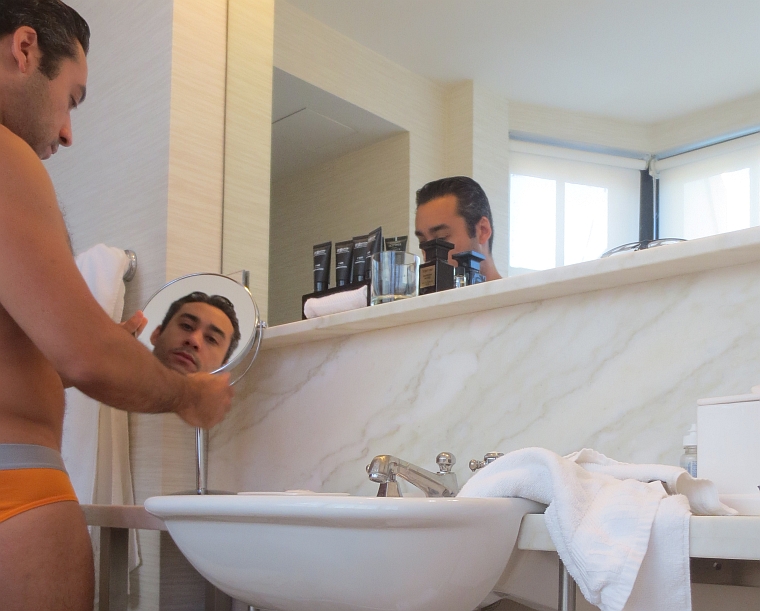
Continuing our New York adventures, I present The Solitude of a Hotel Bathroom. In a city teeming with millions of people, pockets of solitary secrecy still survive, places where the mood can be sullen or celebratory and no one is any the unhappier. But as Levar Burton once put it, ‘You don’t have to take my word for it.’ And who is better at words and navel-gazing than Balzac?

“When no relationships exist which call for minor concessions in dress and deportment, we lose the habit of accepting inconvenience for the sake of others and a deterioration sets in which affects our inner and outer selves.” ~ Honore de Balzac

“Indeed, ridicule is most often incurred by the carrying of fine sentiment, good point and special ability to extremes. A haughtiness which is not toned down by intercourse with polite society takes on a certain rigidity when it can only find outlet in trivialities instead of expanding in contact with people capable of lofty feeling.” ~ Honore de Balzac

“Which of us has not observed the eccentricities peculiar to polite society, the capriciousness of its judgements and the extravagance of its demands? To some persons everything is permissible; their conduct may go far beyond the bounds of reason; all their actions are seemly; they are justified by all and sundry. But there are others to who society is incredibly severe: they must make no mistakes, never falter or even utter a foolish remark. They are like venerated statues which are removed from their pedestals once the winter frost has nipped off a finger or chipped a nose; they are allowed no human feelings and must for ever remain god-like and perfect.” ~ Honore de Balzac

“This young man is characteristic of our times. When one has no particular aptitude for anything, one takes to the pen and poses as a talented person.” ~ Honore de Balzac

“Strike a pose, there’s nothing to it.” ~ Madonna

Continue reading ...

A Poem of Roses

The Poet Visits the Museum of Fine Arts

by Mary Oliver


For a long time

I was not even

in this world, yet

every summer


every rose

opened in perfect sweetness

and lived

in gracious repose,


in its own exotic fragrance,

in its huge willingness to give

something, from its small self,

to the entirety of the world.


I think of them, thousands upon thousands,

in many lands,

whenever summer came to them,

rising


out of the patience,

to leaf and bud and look up

into the blue sky

or, with thanks,


into the rain

that would feed

their thirsty roots

latched into the earth –


sandy or hard, Vermont or Arabia,

what did it matter

the answer was simply to rise

in joyfulness, all their days.


Have I found any better teaching?

Not ever, not yet.

Last week I saw my first Botticelli

and almost fainted,


and if I could I would paint like that

but am shelved somewhere below, with a few songs

about roses: teachers, also, of the ways

toward thanks, and praise.

Continue reading ...

Another Alan In the Line of Beauty

The pursuit of love seemed to need the cultivation of indifference. The deep connection between them was so secret that at times it was hard to believe it existed. He wondered if anyone knew – had even a flicker of a guess, an intuition blinked away by its own absurdity. How could anyone tell? He felt there must always be hints of a secret affair, some involuntary tenderness or respect, a particular way of not noticing each other… He wondered if it ever would be known, or if they would take the secret to the grave.

– Alan Hollinghurst, The Line of Beauty

There was nothing this man could do to help him. None of his friends could save him. The time came, and they learned the news in the room they were in, at a certain moment in their planned and continuing day. They woke the next morning, and after a while it came back to them…

He seemed to fade pretty quickly. He found himself yearning to know of their affairs, their successes, the novels and the new ideas that the few who remembered him might say he never knew, he never lived to find out. It was the morning’s vision of the empty street, but projected far forward, into afternoons like this one decades hence, in the absent hum of their own business. The emotion was startling.

– Alan Hollinghurst, The Line of Beauty

It was a sort of terror, made up of emotions from every stage of his short life, weaning, homesickness, envy and self-pity; but he felt that the self-pity belonged to a larger pity. It was a love of the world that was shockingly unconditional. He stared back at the house, and then turned and drifted on. He looked in bewilderment at number 24, the final house with its regalia of stucco swags and bows. It wasn’t just this street corner but the fact of a street corner at all that seemed, in the light of the moment, so beautiful.

– Alan Hollinghurst, The Line of Beauty

Continue reading ...

He’d Like To Put You In A Trance

Erotica‘ – the new collection of stories by Brian Centrone – is being released as an e-book today (paper version to come.) It’s a special thrill to see a work that combines words and images. Having been bombarded with gay porn and videos since the advent of the internet, it’s a welcome throwback to something that’s somehow more engaging, more meaningful, and in many ways more of a turn-on. There is nothing sexier than one’s own imagination, and that’s exactly what comes into play when words are involved.

Published by New Lit Salon Press, this is a compilation of gay erotic short stories penned by Mr. Centrone. The seven scintillating tales, one for every deadly sin, are accompanied by artwork from Terry Blas, luke kurtis, Rob Ordonez, and the name-sake for this very blog. As amazing as the work of my fellow art contributors is (and it is pretty damn amazing, handily putting my photos to slight shame,) it has always been the words that resonate most deeply, as noted in the press release:

Brian Centrone has been publishing erotic literary fiction since 2007. “Mates,” “Lost,” and “Team Player” are the three works Centrone published with Alyson Books. “These three stories were the start of my writing career,” claims Centrone. “They were my first major published pieces of fiction, and my first paid writing gig.” Erotica also features the previously published “Making the Grade,” Centrone’s only story with Cleis Press, and the online-only story, “Boracay,” which was featured in the now defunct THIS Literary Magazine. Rounding out this collection are two new stories, never before published: “Getting What He Wants” and “Chubstr.”

Beyond the sexy stories, Centrone’s works showcase that erotica can be literary. These stories are written with the same attention to detail, construction, and quality which readers have come to expect from traditional short stories. Centrone is a writer at heart, and whether he’s writing about a religious zealot who decides to run for small town political office (“The Life and Times of Biddy Schumacher,” I Voted for Biddy Schumacher: Mismatched Tales from the Mind of Brian Centrone) or a young man seeking to mend his broken heart and broken sex life all the way around the world (“Boracay,” Erotica), he does so with such honesty, depth, and understanding that every reader can appreciate and relate.

New Lit Salon Press is an independent publisher that subscribes to the belief that Words and Art can and should coexist. NLSP injects new life into an old-world ideal by publishing essays, stories, poems, novels and art in digital format.

‘Erotica’ by Brian Centrone is available in e-book form starting today, with a hard copy version being release at a later date. Mr. Centrone has a website, and can be found on FaceBook and Twitter as well.

Continue reading ...

The Outer Majesty of The Mount

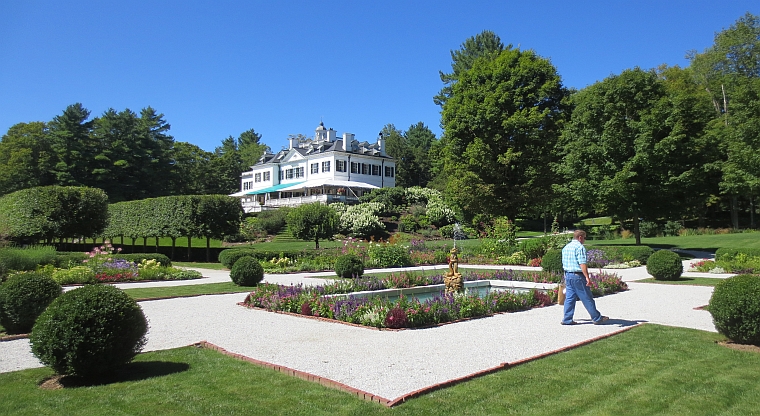
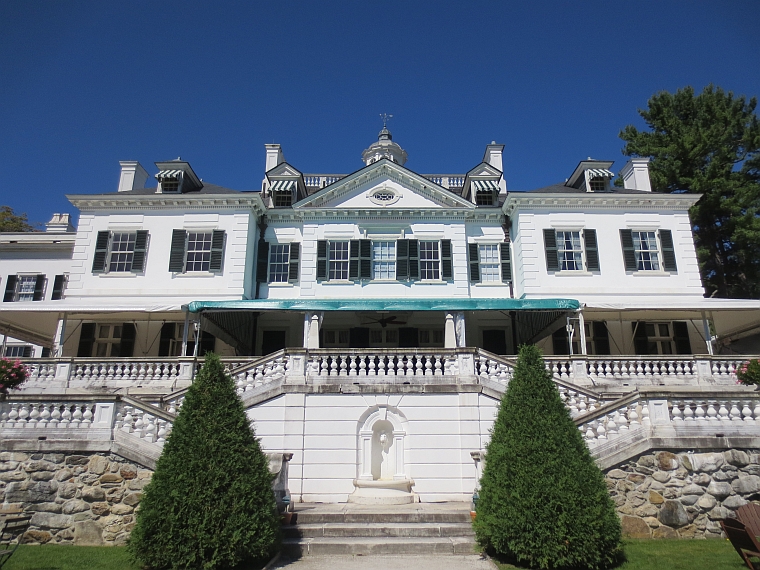
While the inside of The Mount is magnificent, the majesty of the outside slightly dwarfs it. With its tiered terraces leading down to the formal gardens, and the view of a lake, I can imagine being perfectly content here, if a little lonely. Beauty only goes so far in alleviating that kind of loneliness. But to visit, it’s exquisite, and I imagine grand weeks were spent here between Wharton and her friends.

I can say this since I don’t operate the lawnmowers: though grand, it is certainly not imposing in scale. Expansive yes, and I can’t imagine a single person, or even two, could properly manage such grounds, yet it still feels cozy and intimate, its formal structure not in the least bit cold or constrained. With larger spaces like this, such formality works to organize the vastness of what’s at hand, each section becoming like a little room, connected by corridors of trees and shrubs. It creates secret nooks for stolen kisses, quiet corners for hushed conversations, and hidden opportunities for adoring lovers.

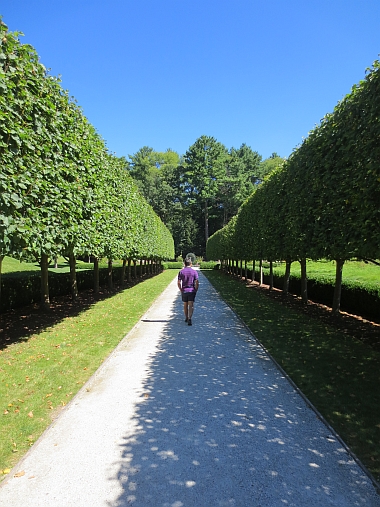
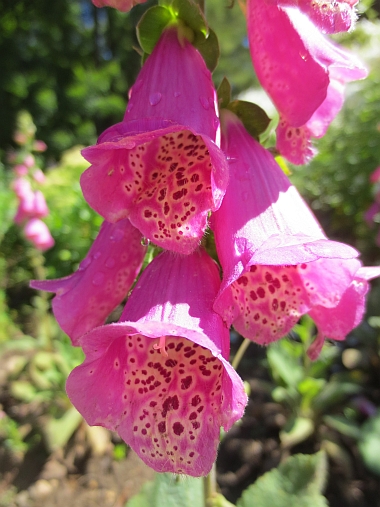
The gardens are just at the end of their summer glory, but the Japanese anemones keep it all fresh, and most of the annuals are still putting on a splendid show. Crowds of cleome, clouds of hydrangea, and a full phalanx of phlox soften the stiff angles of the layout. A long twin row of carefully-manicured trees forms the border of the main walkway, a leafy promenade that called for something much more fanciful than my shorts and sneakers.

A fountain of fish and the accompanying cadence of falling water lend a soothing and cooling aspect in spite of the mid-day sun that beats down relentlessly. It reminds me of how important a water feature is to the garden, and how we may have to implement one next year. There are ways to incorporate ideas from a garden this grand into one decidedly less-so.

A woodland walk leads into the forest to the right of this sculptural focal point, a seamless segue into the wilder environs of the grounds, and a chance to be shaded and hidden. If there hadn’t been so many bugs I would have allowed the forest to close more completely behind me.

This corner of the premises offers the most striking view of the house, perched upon its namesake, resplendent in the early afternoon sunlight and framed by ancient pine trees. The soft splashing of the fountain and the calls of a few birds are all that break the tenuous silence – though silence here seems to carry more substance, more lasting power than other places.

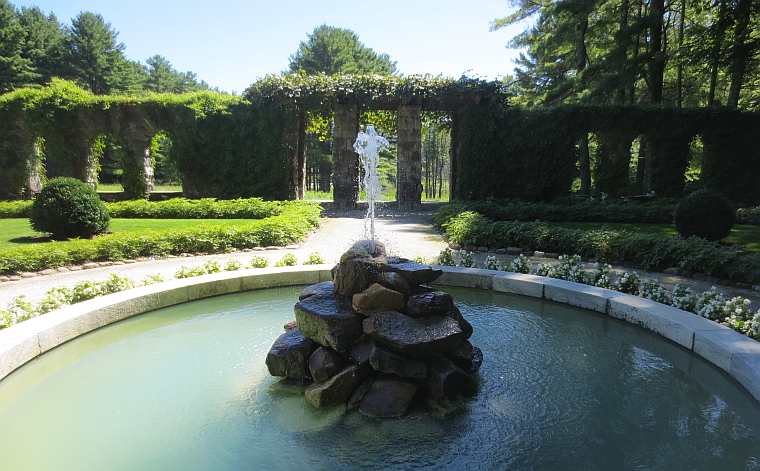
The fountain in the West garden (seen below) mirrors the one in the East garden (above), though in a more informal manner – its grouping of rocks more aligned with the shadier, wilder aspect of this part of the land, the circular shape softer and gentler than the rigid angles of the East.

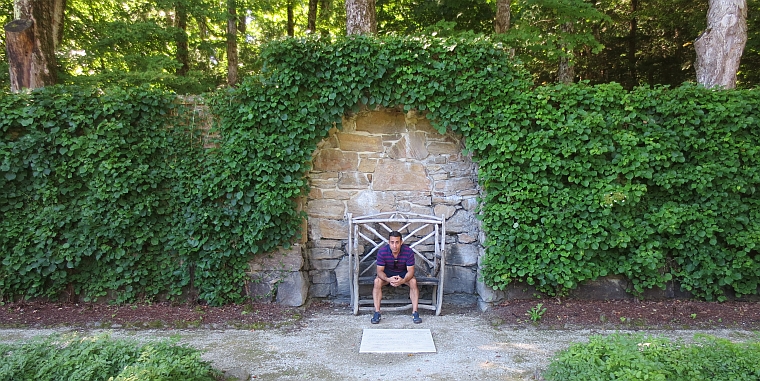
An enormous wall of climbing hydrangeas must have been quite the sight in full bloom – for now just the white begonias and hostas are sharing their subtle blossoms. This garden is more hidden, sunken down slightly lower than the rest of the grounds, tucked deeper into the hillside. Its plants are fit for the shade, less showy with their flowers, more focused on the verdant surfaces of its leaves.

I like the quieter feel of this area. It’s the perfect place to finish up our tour of The Mount. As we walk back towards the house, a large tour group is just traversing the promenade. Our little pocket of stillness and quiet has come to its close, the morning of my birthday easing into the afternoon as we make our way back to New York.

Continue reading ...

The Innermost Rooms of The Mount

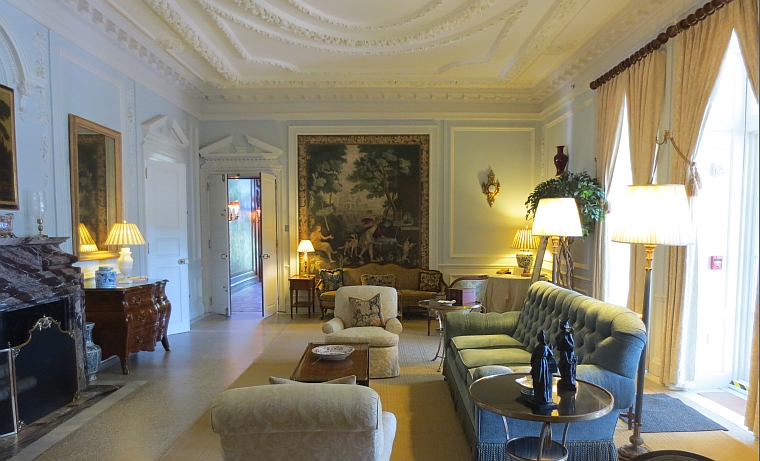
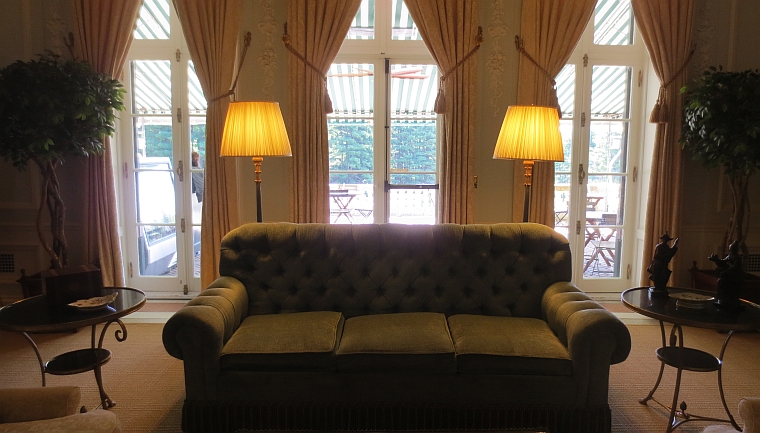
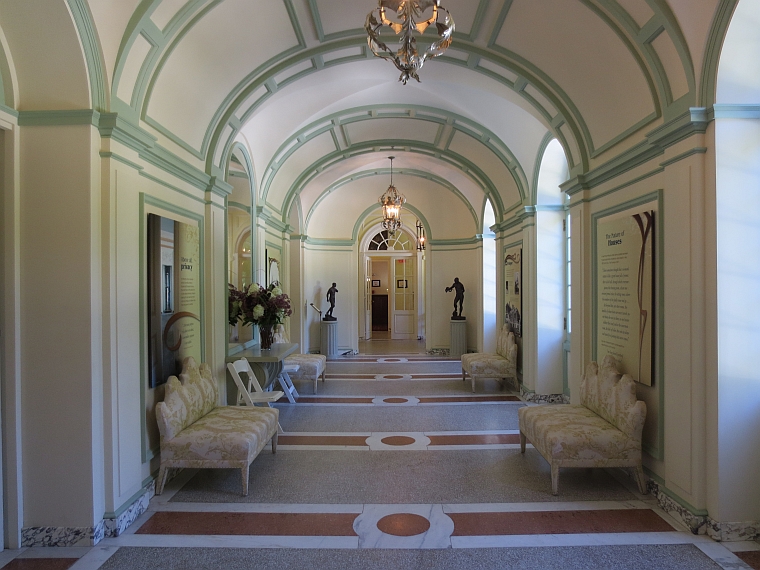
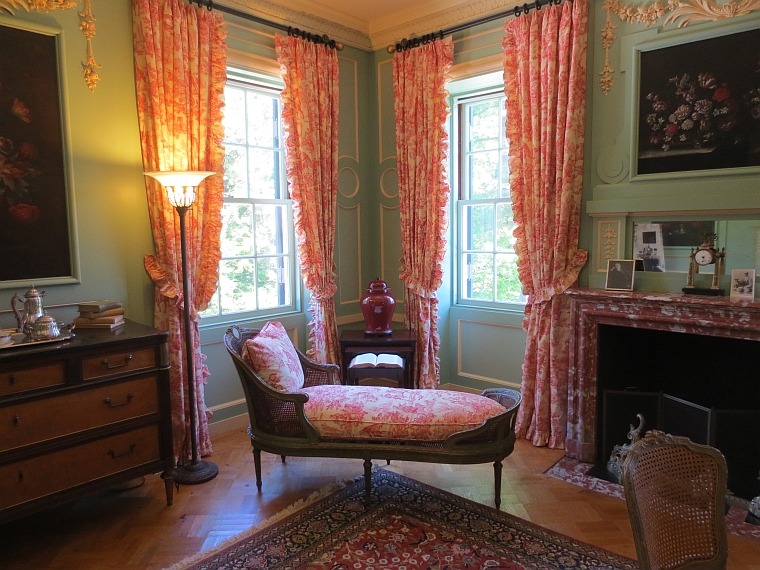
Sometimes there is no more intimate glimpse into a person than in seeing their home. It’s where the inner-sanctums of our lives take place, when the unguarded moments of solitude or intimately-shared living occur. It’s almost painfully revealing, particularly when the person in residence is not present.

Whenever I find myself in a friend’s home, either waiting for their arrival, or hanging out until their return, I feel like I’ve been given a privileged peek at what they hold most dear. I usually read too much into it – wondering at the choice of a pillow (that they probably got as a gift) or the placement of a bookshelf (that probably came with the house).

I know if someone scrutinized my home that way I’d be saddled with all sorts of unfair attributes. (The slate entryway was not my idea, and that shoddy, torn, on-its-last-legs leather sofa is all Andy, all the way.) So I realize the insanity of placing so much stock in the surroundings, but part of me feels it is an accurate representation of who someone is at their most unguarded.

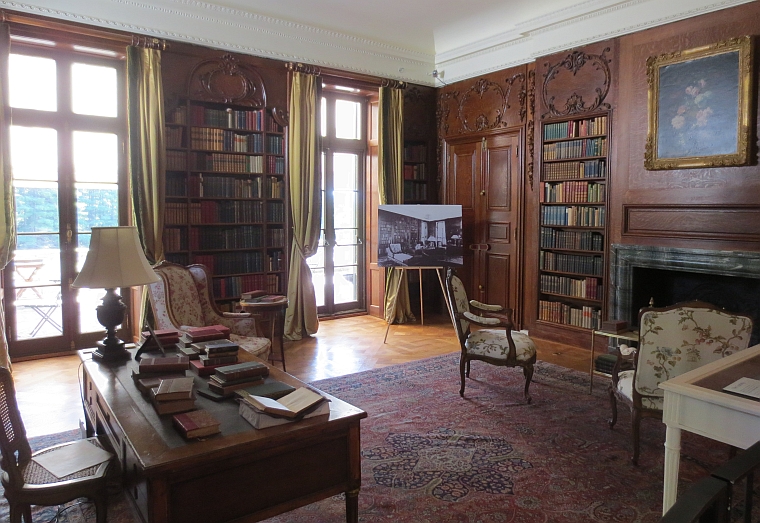
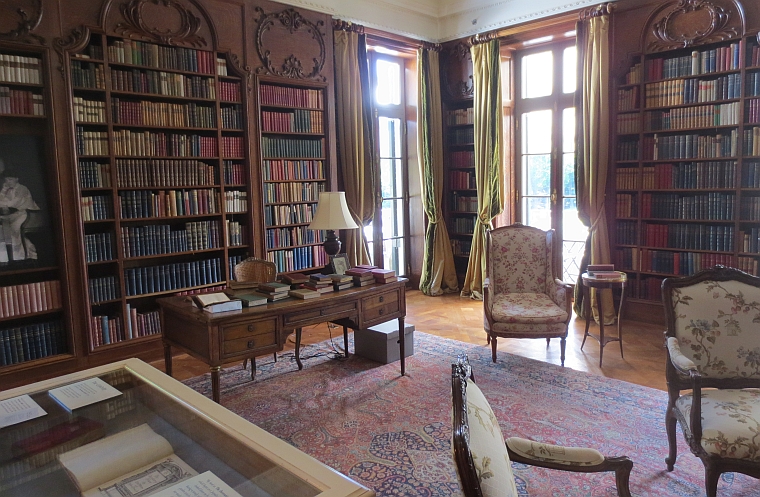
You can also tell a lot about a person by the books one reads. A lot, yes, but certainly not everything, especially with a library as big as the one seen here. No doubt Ms. Wharton read a great deal, but she surely didn’t read everything here. Some books belonged to her husband, some to friends, and some were probably just shelf-filler to balance an empty row out. The mere fact that she held a library in such high-esteem says more than her choice of books.

Simply being in the same space that someone once occupied can give little clues as to what they were like, or at least give an idea of what they might have seen, or how the light may have moved them. Those are the intimate details I crave about the people I love and admire. To see where someone whose words so moved me actually lived and worked and wrote can be as telling as any biography, or autobiography for that matter.

Because sometimes what is unsaid and unwritten is more meaningful and impactful than what we choose to reveal.

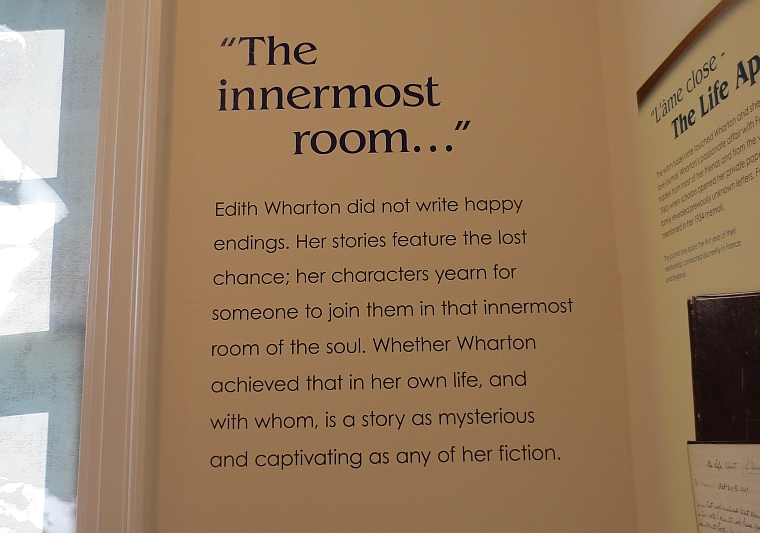
But I have sometimes thought that a woman’s nature is like a great house full of rooms: there is the hall, through which everyone passes in going in and out; the drawing-room, where one receives formal visits; the sitting-room, where the members of the family come and go as they list; but beyond that, far beyond, are other rooms, the handles of whose doors perhaps are never turned; no one knows the way to them, no one knows whither they lead; and in the innermost room, the holy of holies, the soul sits alone and waits for a footstep that never comes. ~ Edith Wharton

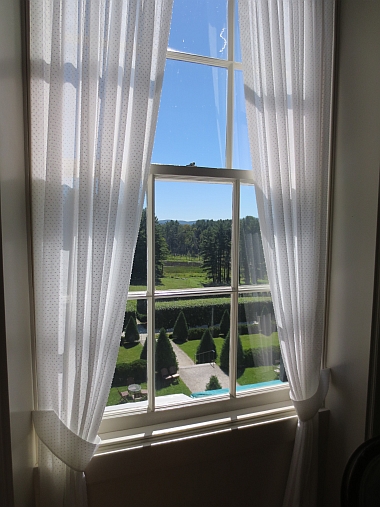
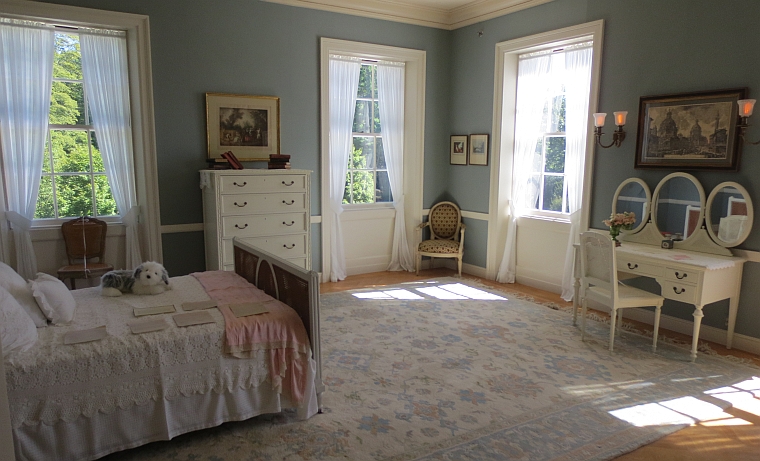
The master bedroom suite was divided into these two rooms, which Ms. Wharton occupied on her own, for the most part. Though the furniture is not original, it gives an idea of what it might have looked like. The light, and the windows, were as she would have experienced them, and that’s what matters. She would have looked out over the same expanse of green, the same trees in the distance, and the same lake. A similar sky would have appeared countless times, and the exact same sun would have shone as it did on this day, traveling the same trajectory across the floor, molding the same shadows.

Continue reading ...