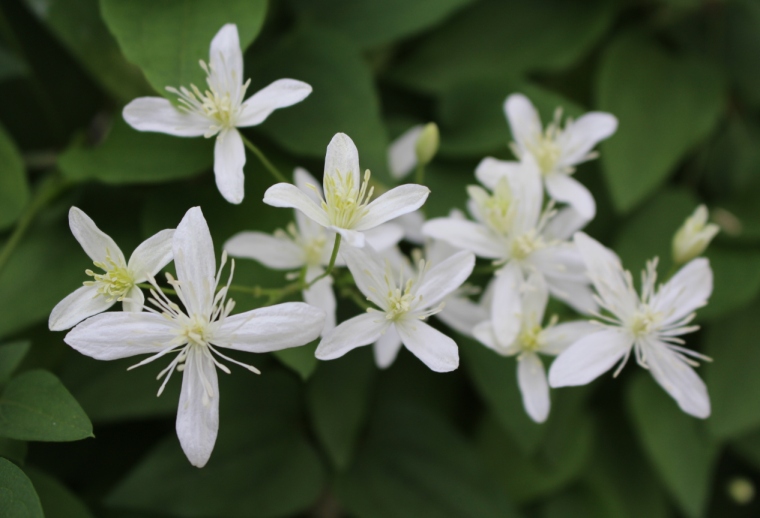
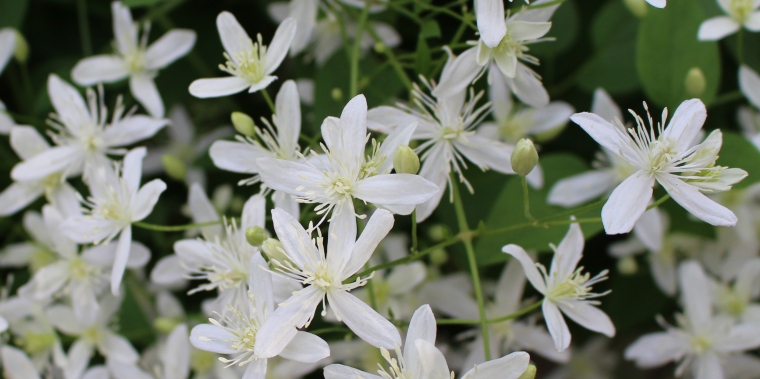

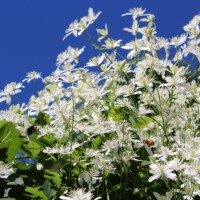
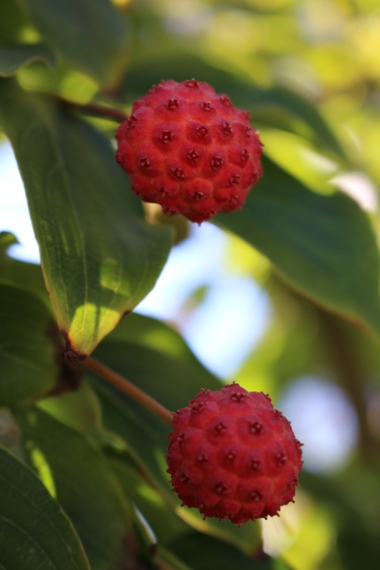
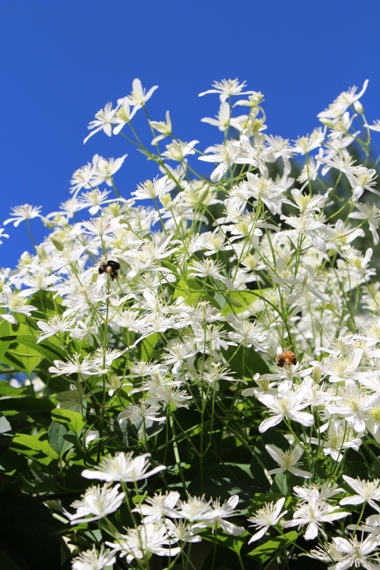
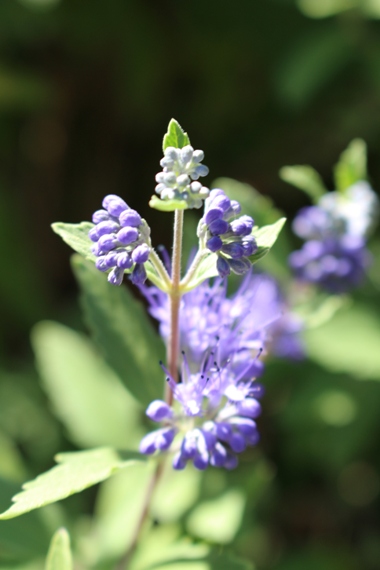
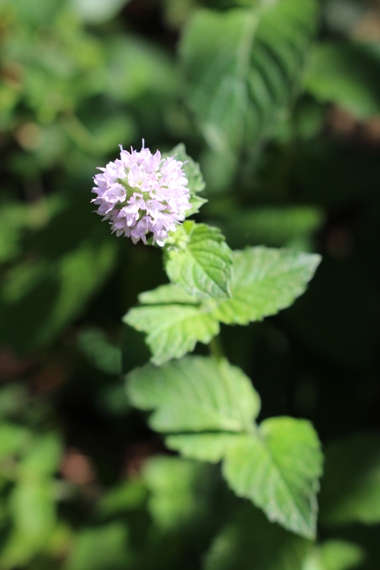
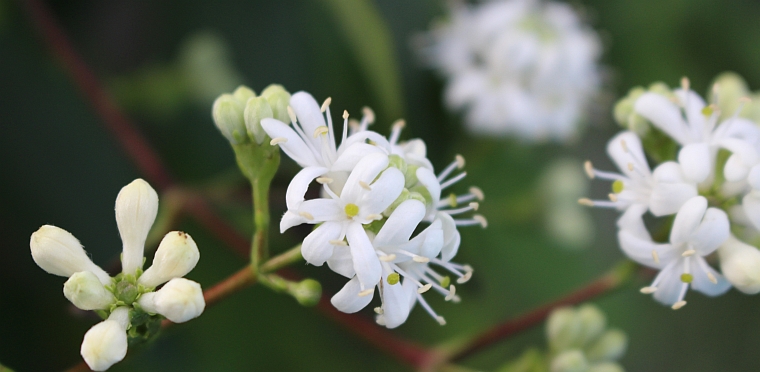
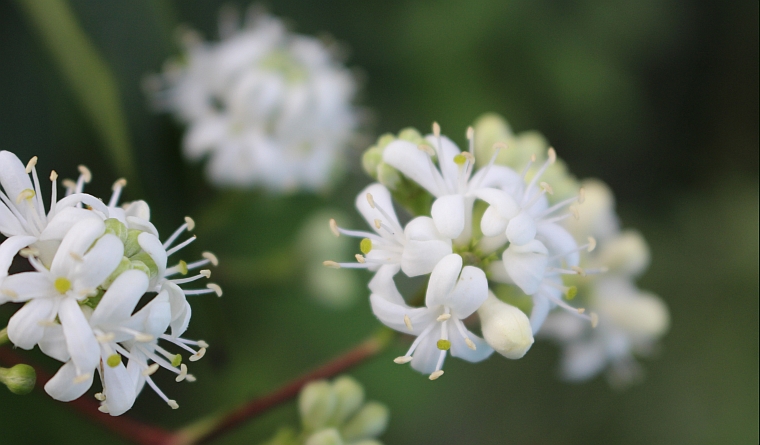
These are the flowers of fall – the Sweet Autumn Clematis and the bluebeard, given supporting ornamentation by the fruit of the Chinese dogwood and the flowering of a grapefruit mint. Some gardeners, myself included, tend to neglect this part of the year, when we should actually be embracing and enjoying each day before the chill begins to settle. Flowers like this remind me of that.
Behold the seven sons’ flower, which is actually the name of the small tree that carries these delicate blooms. In their third or fourth year, the two specimens we have in our backyard now tower above me (like so much else) and their bark is just beginning to peel off in the enchanting manner that first drew me under their influence.
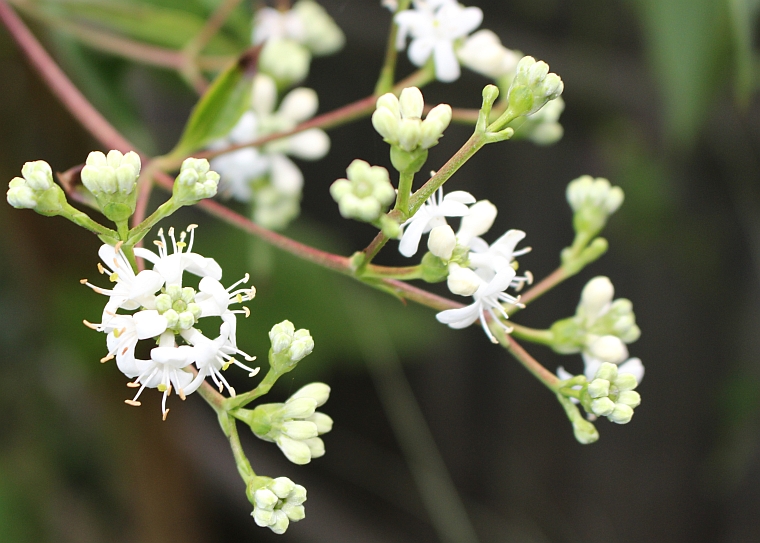
The flowers, which just started blooming last week, appear at the end of summer, but the exact date is wildly variable. Some years they’ve begun as early as July, others as late as late September. Regardless, their sweet perfume is more than welcome at this time of the year, because it’s often a slow time in the garden. As much as I love gardening, I find my drive and excitement waning around now. My focus tends to turn inside, back to clothing and cologne, and away from the out of doors. I lose my interest in the start of the dying season, which is why I’ve never been very ambitious as far as fall bulb planting goes (and why I’m so often kicking myself in the barren spring).
It’s the same sort of thing that happens on the last day of a trip. I just want to cut my emotional losses and go. Why drag out the inevitable end? Yet lately part of me has been wanting to hold on, to make the most of the last moments of a vacation or trip, or even a season. It’s like the last-minute saving grace of a pear cocktail in Las Vegas – a final 11th hour appeal to hold onto the ticking of the clock – a plea to slow and still what cannot be stopped.
The seven sons’ flower blooms regardless of all this, always near the end of summer, just before the long slumber to winter commences. It doesn’t feel regret or remorse, doesn’t think ahead to its last gasp before a hard frost – it will bloom until it can’t, and then it will start all over again next year.
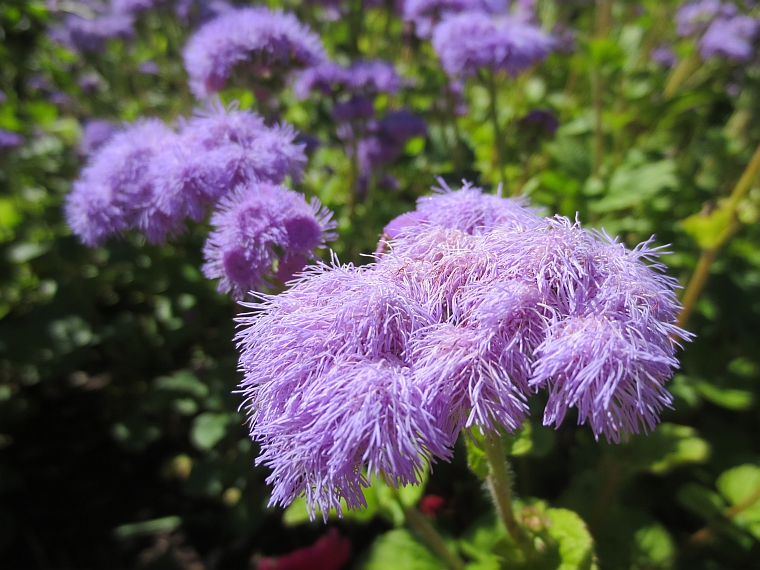

“Their voices rose and fell, like the murmuring of two fountains answering each other across a garden full of flowers.
At length, with a certain tender impatience, he turned to her and said:
“Love, why should we linger here?
All eternity lies before us.
Let us go down into that beautiful country together and make a home for ourselves on some blue hill above the shining river.””

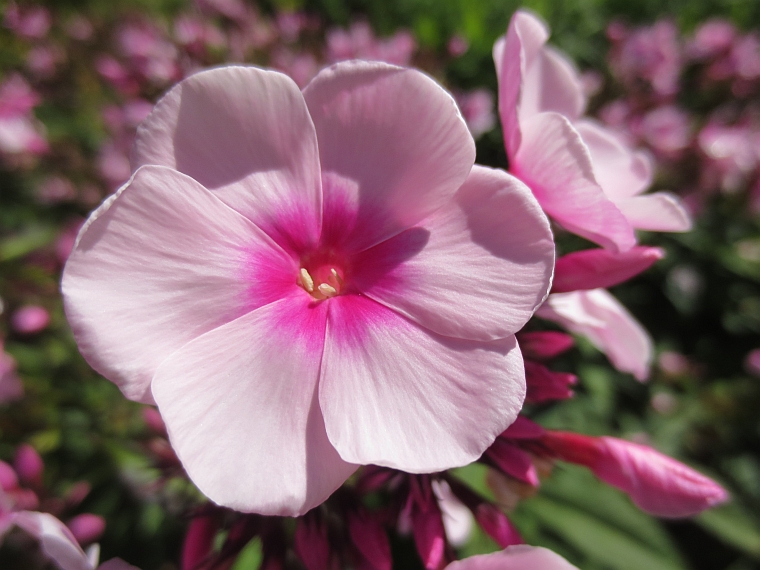
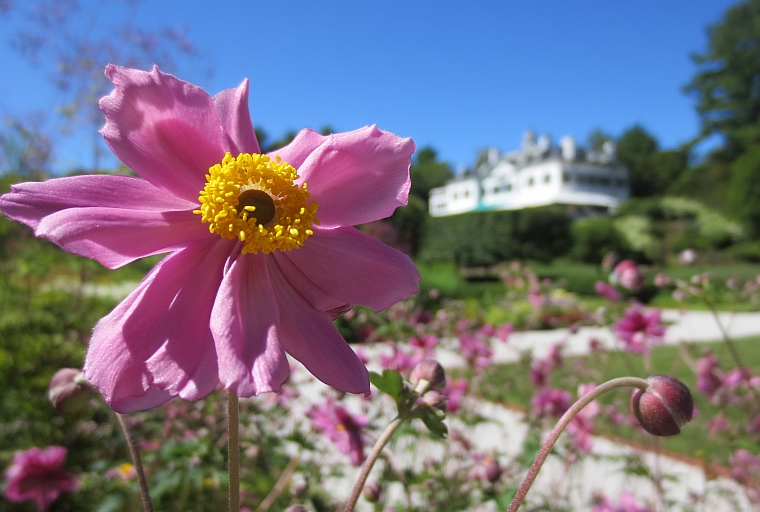
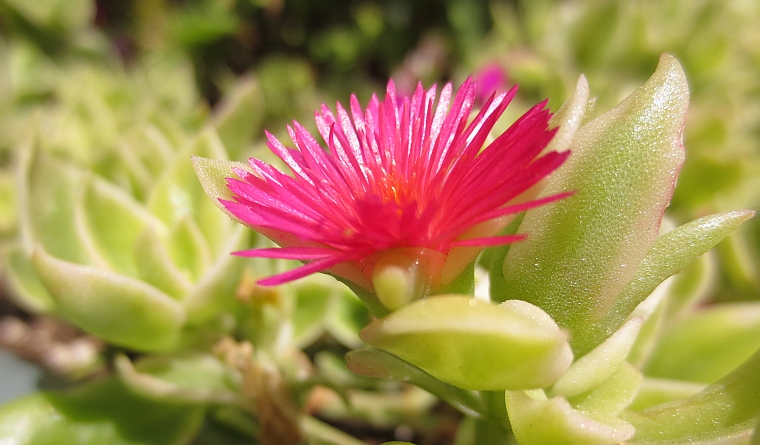
These unassuming little rock plants made their home on the other side of the Charles River, in a park in Charlestown. On the day I passed through, the sun shone brightly in the blue sky – the kind of blue reserved for August and September, and that you never quite see the same way until the end of summer returns again. They softened the circumference of a fountain, where fish spat out water in arching rivulets, and the soothing sound of the splash drowned out any distant traffic. After crossing over from Boston, it was like another world – quieter, more serene, less busy and frantic. Here, there was peace. Here, there was beauty. Here, there was joy. It was a sort of oasis, afforded when the heart was most in need – of what, I could not right off tell, I would only know it when I found it, when it was time for the universe to deliver what had been lacking. Some things cannot be forced, like the blossoms on these tiny plants, which would only be coaxed into bloom by the fullness and the heat of the sun.
The prospect of a weekend in Boston is always a happy one, particularly if one is fortunate enough to make it a very long weekend, starting on Thursday and ending on Sunday night. Such was the case last week, but thanks to the pre-programmed nature of this blog, I’m only getting to the recap now.
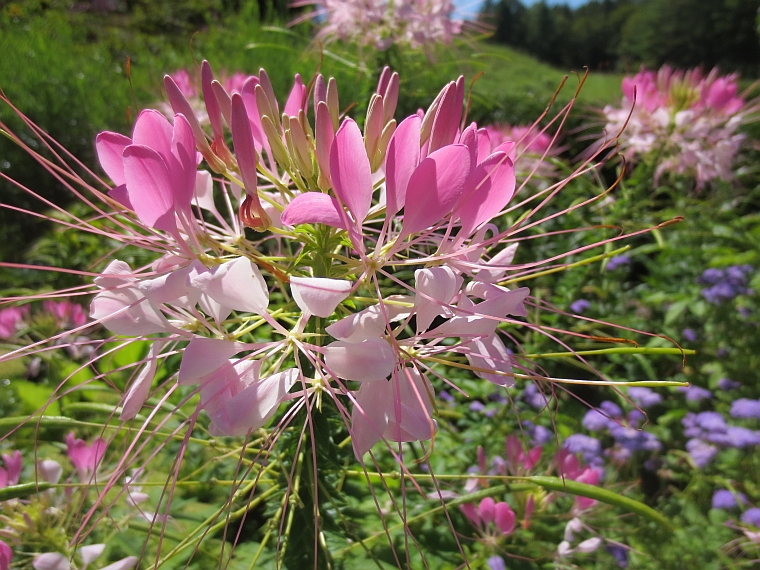
It begins, as all good things do, with a collection of flowers. As we enter the final stretches of summer, their colors are stronger, deeper in the lower afternoon sunlight. It’s as if they are preparing for the final send off, especially since the ones you see here are annuals; they will not live beyond the first hard freeze. But oh what color and beauty before that sad fall.
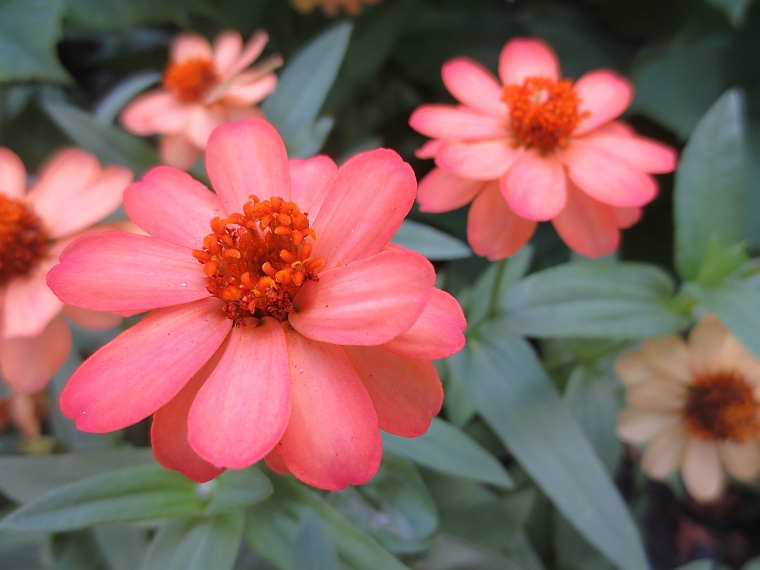
There is something to be said for such a riotously-exuberant blaze of glory, this brilliant bit of fire before the final burn. Perennials can hold their passion, subsisting in softer fashion, muted through the heat of summer in their efforts to last through to the next year. For the most part I tend to be perennial in nature, keeping things quiet and stable so as to last through another year – but every once in a while something will shake me up, and shake me to the core, and I’ll go all annual on your ass, throwing caution to the wind, defying sense and sanity, and gleefully giving in to every animal impulse.
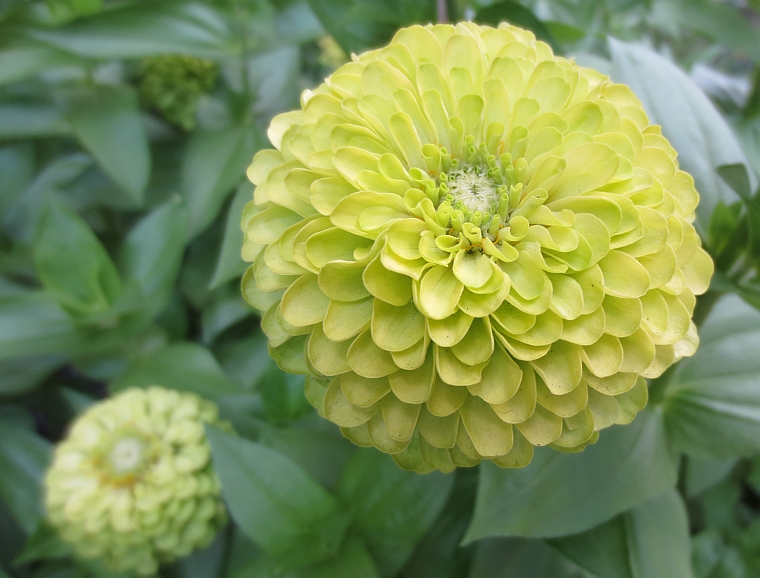
And once or twice in a lifetime, if we’re lucky, some of us are able to combine the two – the short-lived excitement of a colorful cacophony coupled with the enduring life-sustaining and quiet stability of something that lasts, something that will go on. It’s a tricky balancing act, but a worthy one. You don’t give up on that kind of beauty, or the chance of having it endure.
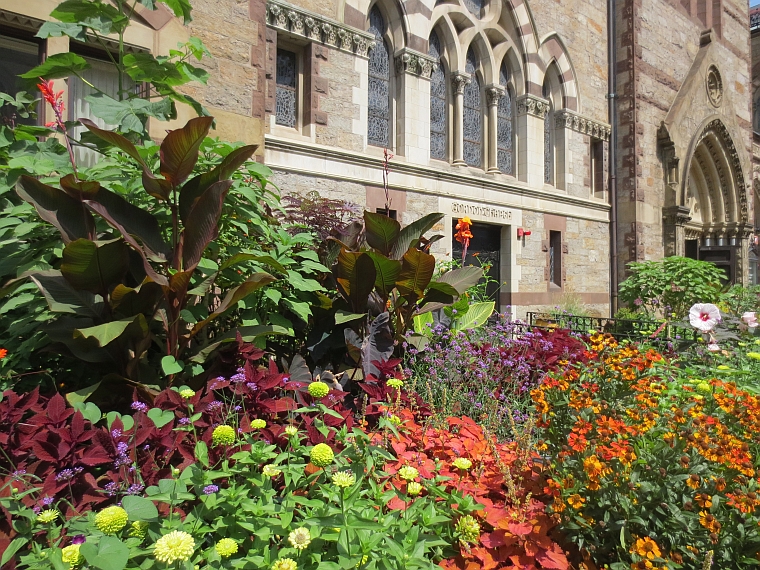
It’s something that is exquisite and tender, but in the best circumstances also hardy enough to last – and if you can harness the vivid but finite with the lasting but stalwart, itâ’s a magical bit of alchemy that is too rare to let go.
And so we hold these August flowers a little closer to the heart, shielding them from impending frosts, hoping that somehow, some way, they will survive the winters to come. We are more protective of them, and love them just a little more because of it. Life is too fragile to be so careless.
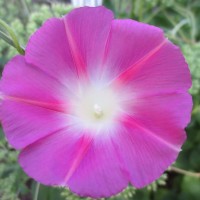
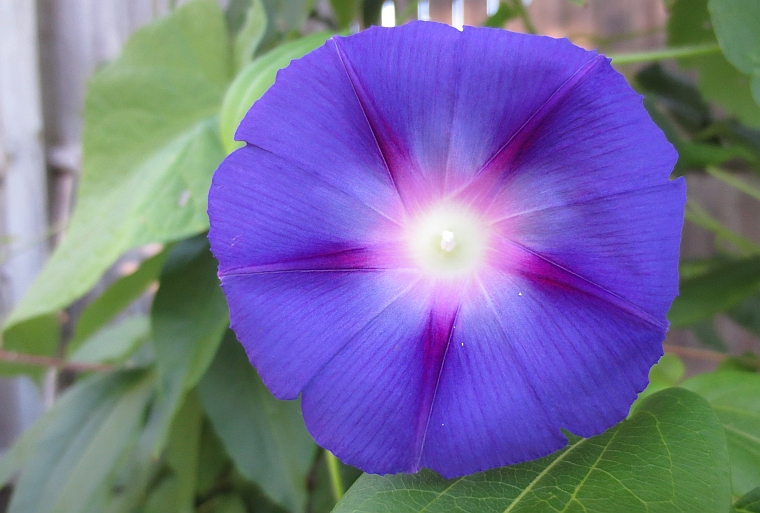
The morning glory. One of the simplest plants to grow, and of course it’s one of those that gives me some trouble. Not that it can’t be done, but every now and then there is an off year and they just don’t produce or grow the way I know they can. This year is not one of those years, as many (too many) have re-seeded themselves. (I actually haven’t planted a new batch of seeds in about five years.) I’m partial to the old-fashioned common blue variety (which is one of the elusive ones that has yet to show its face in the garden), but I’ll take these smaller, and more vibrantly-hued hybrids, as a reasonable substitute.
These plants seem to enjoy a simpler, unamended soil – in richer ones they make more leaf growth than flower power – and perhaps that is the reason for their hit-and-miss nature in my own garden. I remember coming upon a large expanse of morning glories covering a chain link fence in Chicago many years ago – and they seemed to be growing out of cracks in the sidewalk and a small patch of dry barren earth. Some things like a challenge, and perform all the better for it.
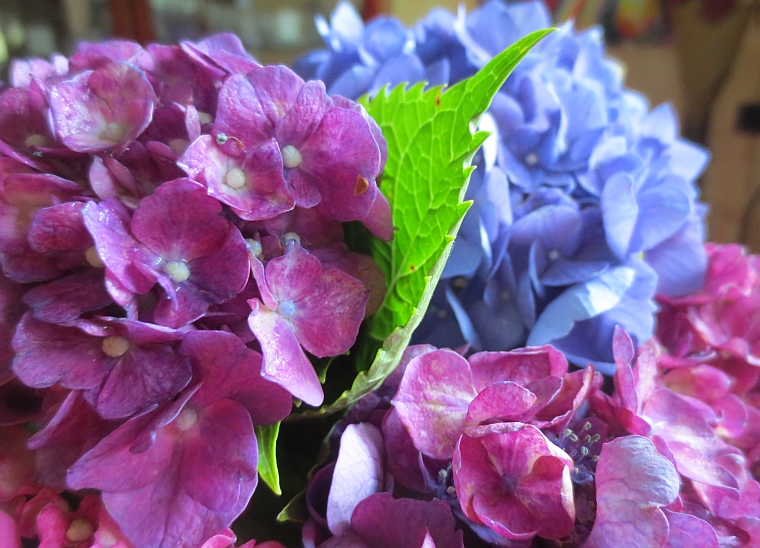
I know she loathes them, but I happen to adore hydrangeas. Unfortunately, thanks to our soil and climate, we don’t get the gang-buster colors that those grown on Cape Cod are afforded. My pal JoAnn always brings some from her Mom’s garden when she visits, so this past weekend she came up for a small gathering and brought this beautiful bouquet of flowers. They put our pale pink and light blue shades to shame. No matter how much sulphuric acid or rusty nails or coffee grounds you use up here, we can never match the gorgeousness produced on the Cape. And maybe that’s for the best. It makes these moments that much more valuable.
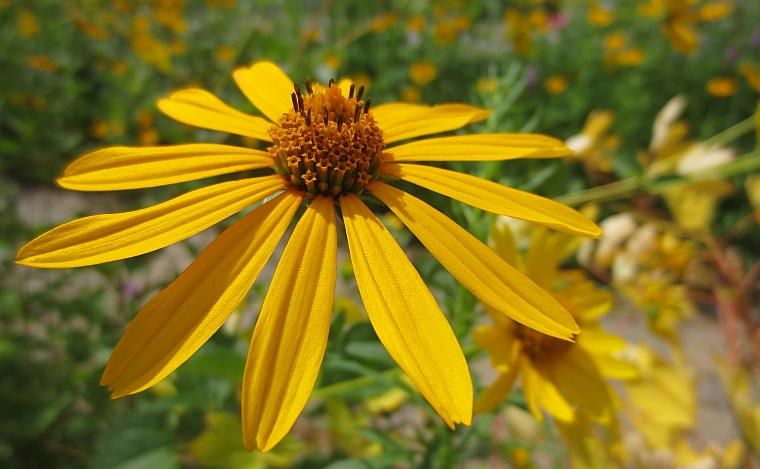
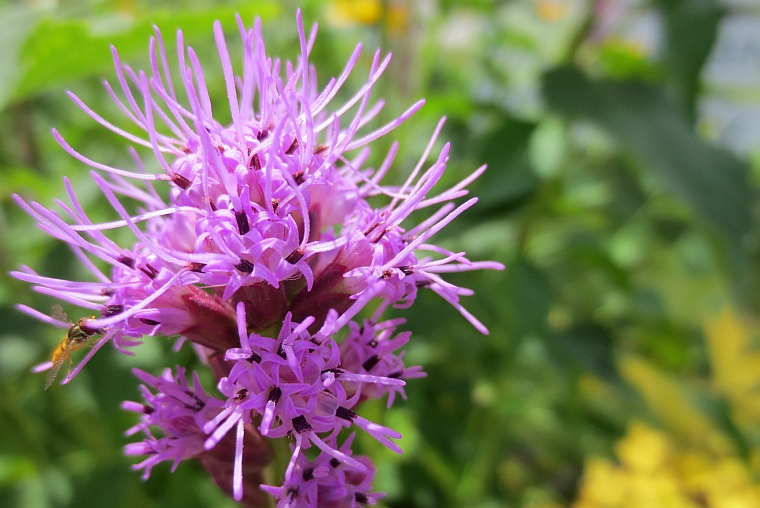
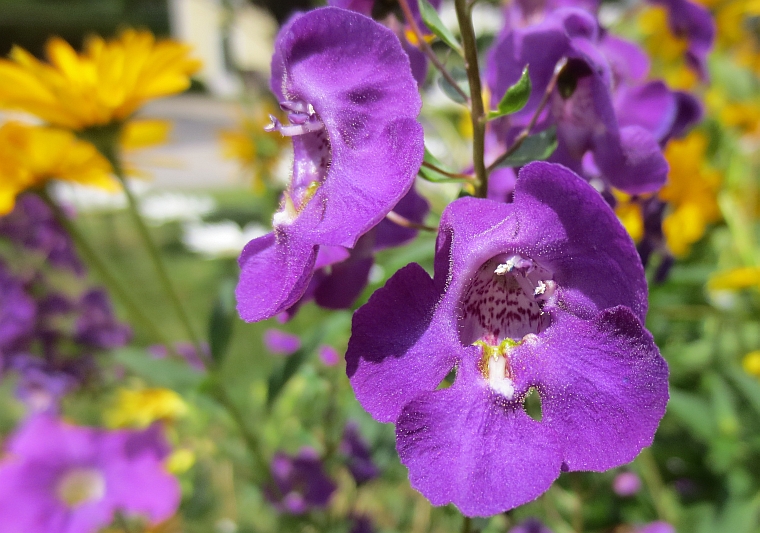
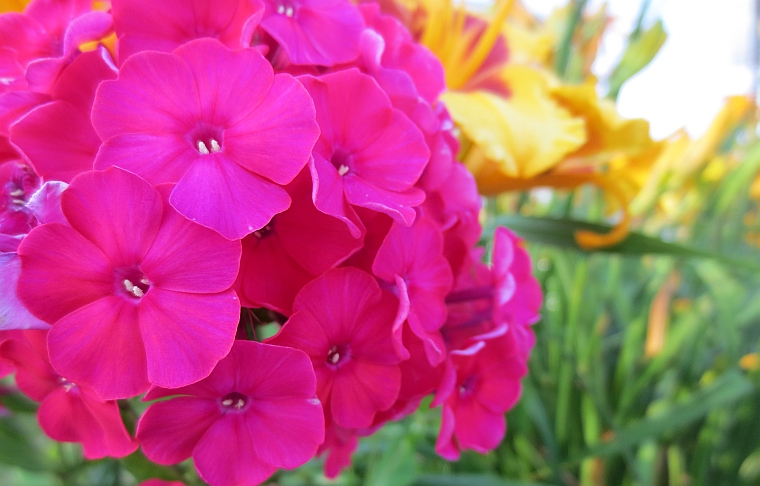
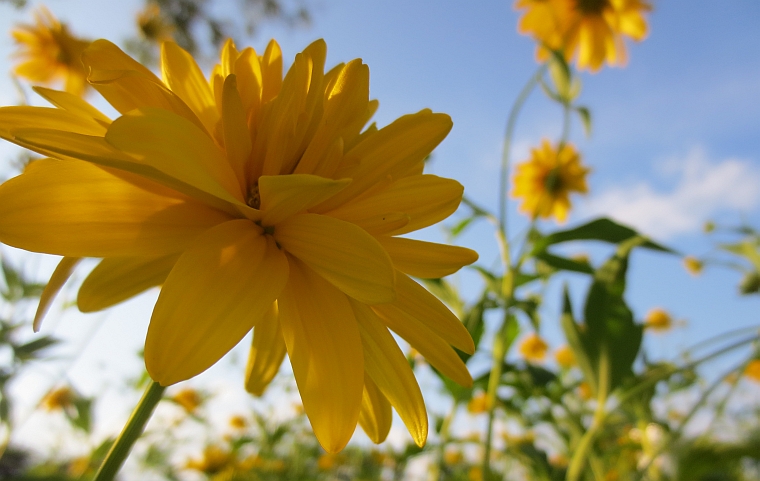
Being that we usually go to Ogunquit in May and October, we don’t get to see the flowers of high summer. On this visit, we did, and they were as lush and vibrant as expected. Our return to the Beautiful Place By the Sea was heralded by this explosion of color and form, and there’s no better way to begin the Ogunquit portion of our vacation than with a selection of those floral fireworks.

A friendship that starts on FaceBook is not usually something that goes beyond a few ‘Likes’ or ‘Comments’, but since Eric and Lonnie live near Ogunquit, we took a chance and took them up on their offer to meet up at an opening night cast party for a production at the Ogunquit Playhouse. It was an instant friendship, as Andy took to them as quickly as I did – and we hung out whenever we could in Ogunquit.
It was a joy to hear that they were getting legally married at long last (after fighting the good fight for marriage equality in Maine), and it was an honor to make it onto their coveted invite list. Their wedding was the impetus for this vacation in fact, and the reason for our journey to Portland, onto which we piggy-backed our anniversary celebration in Ogunquit.
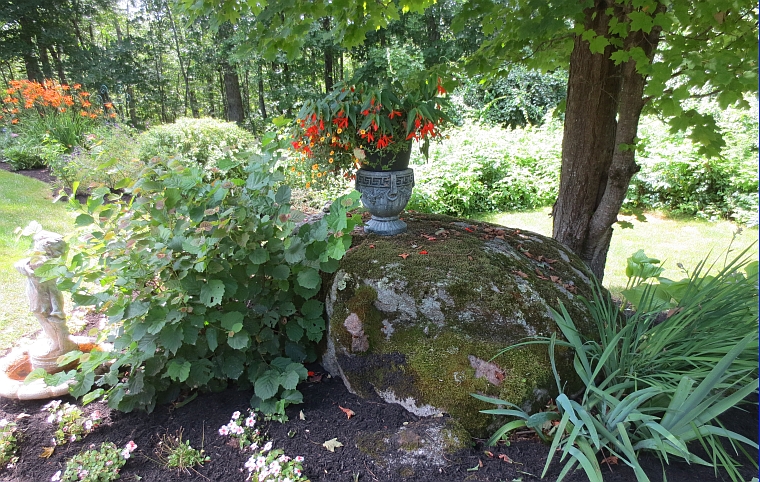
Their home is an exquisite respite in Gray, ME – a gorgeous combination of old and new, and the perfect conjoining of two complementary personalities who have served as an inspiration to any couple looking to make it last.
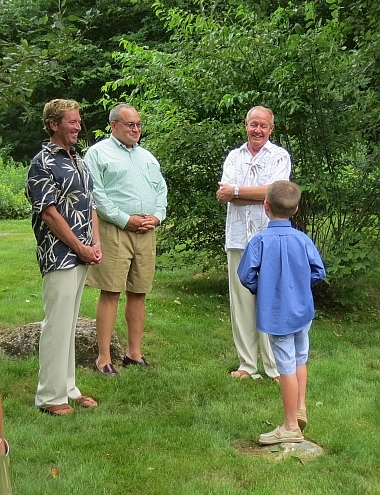
As often happens to me at weddings, I found myself incredibly moved ~ even more-so when talk turned to the trials and travails of what it took to reach such a moment in history. if you’ve never been denied the right to marry the person you love, you can’t know the joyous appreciation of when it finally happens.
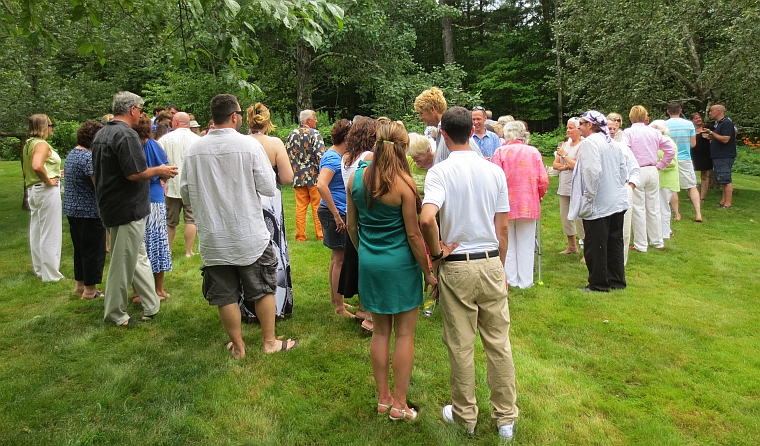
The ceremony was simple and casual, but somehow more meaningful for it. Both Eric and Lonnie spoke from the heart, in vows that brought us all to tears, and it was a brush with grace to be in the presence of such love. It’s something that emboldens all of us as human beings ~ the universal good-will felt towards two people who love one another, and who have lived a life together and made the promise to keep going. It never fails to affect me.
On the beautiful grounds of their home, the guests gathered and surrounded the happy couple. It was an idyllic moment ~ the heat-wave subsided as a cool breeze arrived, the storms stayed away, and the company of well-wishers – and the wonderfully fun friends and family of Lonnie and Eric – made for an unforgettable day.
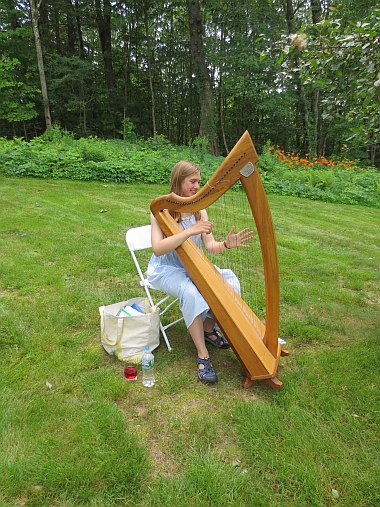
A fun side-note: I have always wanted to attend a party or event where a harpist played, and it finally happened at this wedding. I followed this charming young woman around as she plucked her strings and brought such heavenly music to the surroundings. I asked if I could take her picture, explaining how it had always been a dream of mine to have a harpist at a party. She was gracious and happily posed for my exuberant picture-taking. I think she thought I was a little touched. She was very intuitive that way.Â
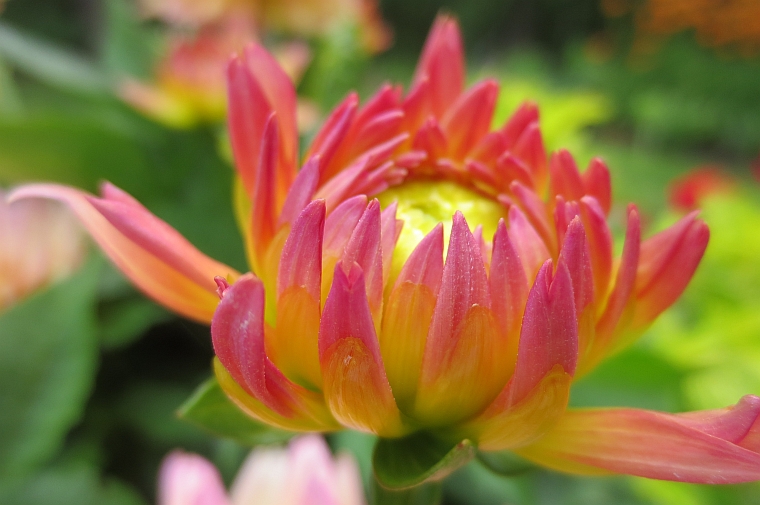
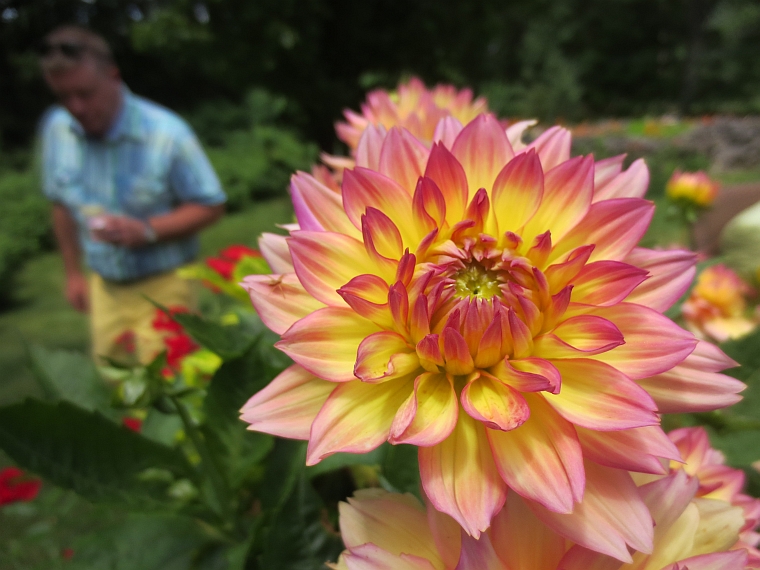
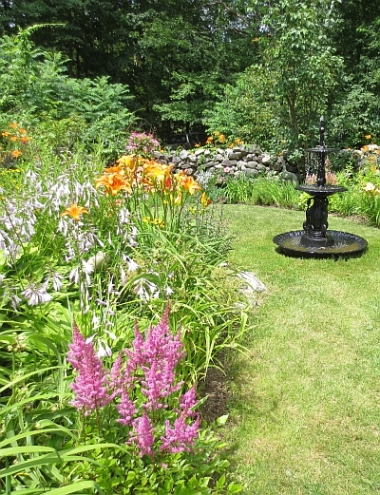
The gardens were at their bountiful peak, spilling forth dahlias and daylilies, as grand urns overflowed with colorful petunias and begonias. It was as if the entire landscape had conspired to decorate itself for the wedding.
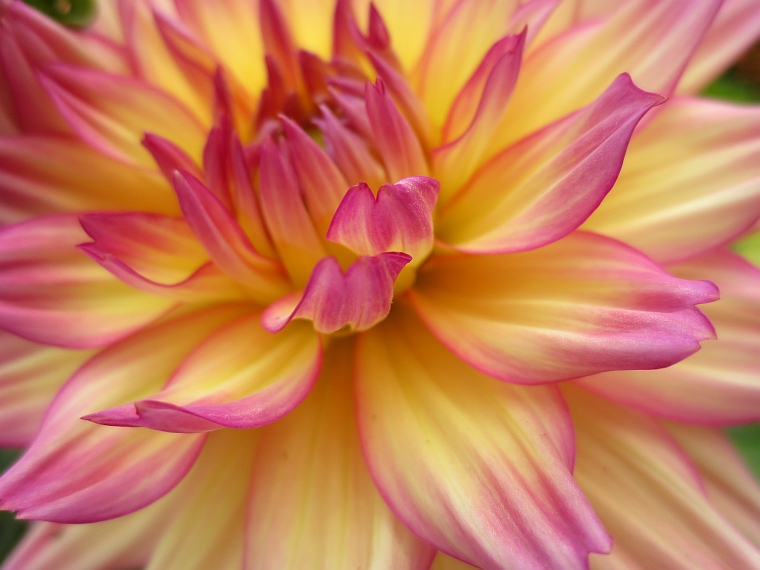
Some things are just meant to be.
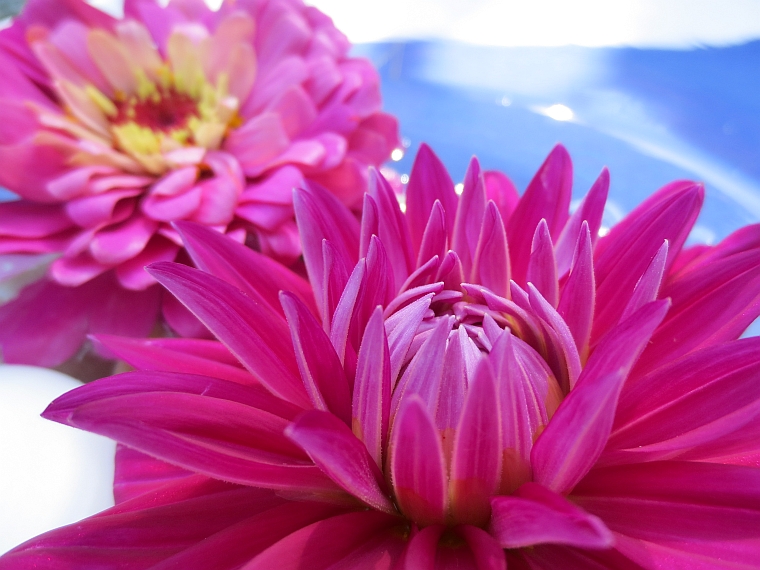
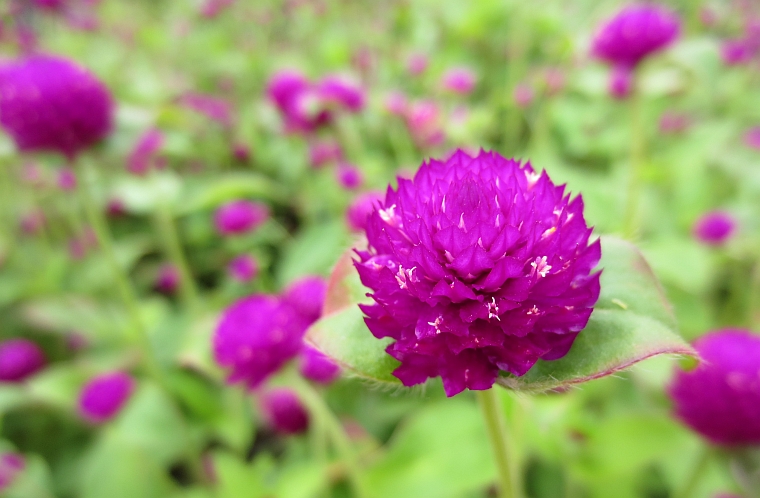
Let’s begin at the end. After a week spent in Maine, the only way to properly finish things was a stop at the Stonewall Kitchen flagship store in York. It is traditionally our last stop on any Maine visit, right before we hit the highway back to New York, and it offers one last chance at the beauty and peace that the area affords. Mostly, I go to see the gardens and pick up their amazing hand-soap. (Though last time I did indulge in their impossibly decadent lobster BLT.) This time around I stuck to viewing the flowers, including these gorgeously-hued gems.
There are certain stores that sell a way of life, certain brands that exemplify a finer way of approaching things. Stonewall Kitchen is one of these. Along the veins of Martha Stewart and the Beekman Boys, the wares at Stonewall involve the serious art of cookery, done with a rustic elegance and refined presentation. Visiting their store in York, one is transported to a simpler, more beautiful time and place, when gardens and kitchens formed the focus of most happy homes. Cooking and baking are art forms, ones which I am slowly and deliberately trying to learn – just to make a dent in the kitchen. (Andy might say I’ve made more than dents…)
The best part of visiting this store is the inspiration it provides. For a superficial, shallow person like myself, presentation is everything – and everything about the Stonewall Kitchen presents well. From the winding path lined with perfectly-pampered plants, and a wisteria-lined arbor that gently shades the walk, to the seasonally-themed entrance of flower baskets or autumn gourds, the experience of this store encompasses all of the senses. As befitting its name, the main focus is on food, and there are endless products that tease and tantalize the taste buds ~ jars of countless salsas, jams, and chutneys, baking mixes for cakes and muffins and cookies, and tons of kitchen tools, utensils, and serving objects. Taken together with the helpful and efficient staff (even when the check-out line seems long, it moves at a rapid pace), any time spent at Stonewall is a balm on the hectic pace of life. It is our favorite way to end our time in Maine, and the kick-off to this series of vacation posts.
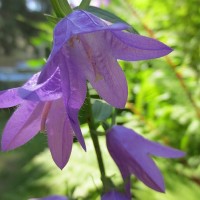
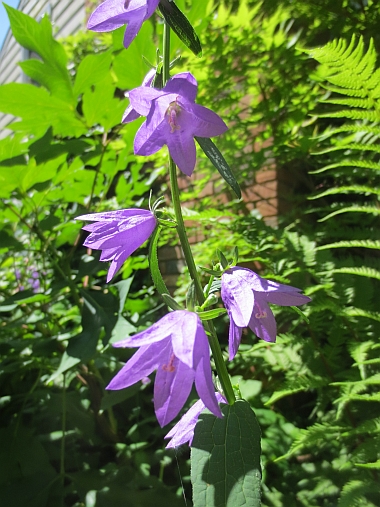
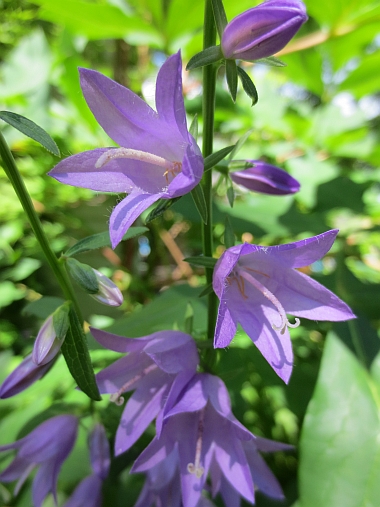
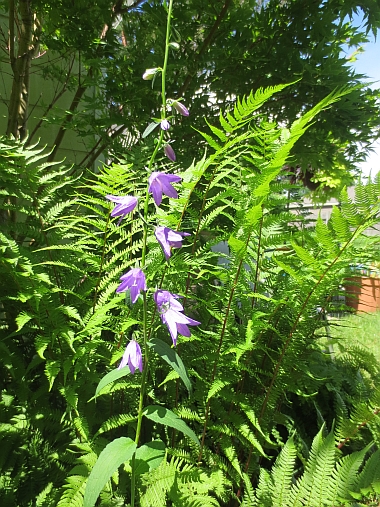
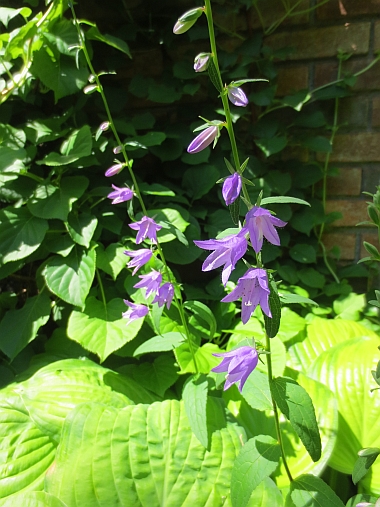
With a common-name like LadyBells one might think that I would adore this plant unconditionally. As it is, I have a few major conditions, and because of them I find it hard to love this Adenophora through and through. The flower is exquisite, with an elusive shade that almost borders on the blue. Not many flowers come that close, so those that do are highly prized. (Some contend there are no true blue flowers; I’m not that quick to be so definite, but I do know it’s a rare hue.)
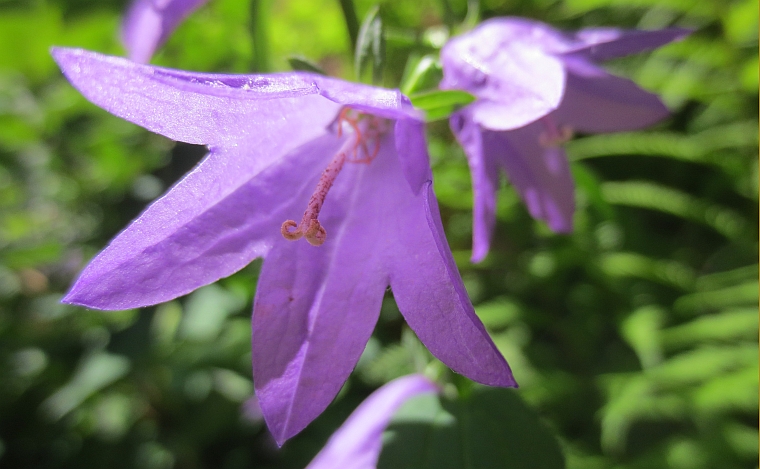
My problem, therefore, is not with the flower, but with the form of the plant. Its style is too loner-like for my taste. I like my plants in mounds or mats, with groups of stems that combine to create an overall impression. The single and solitary nature of Adenophora goes against that. From a design standpoint, I know the power and importance of vertical aspects like this – my issue is a personal preference I cannot get over. The one small patch I have going in the side garden – brought in by accident with another perennial – has actually expanded into a mat of sorts, but the results, as seen here, still bother me. Again, some people adore the effect, and I do admit that when grounded by ferns or hosta it works – I just can’t bring myself to love it. Sorry, lady.
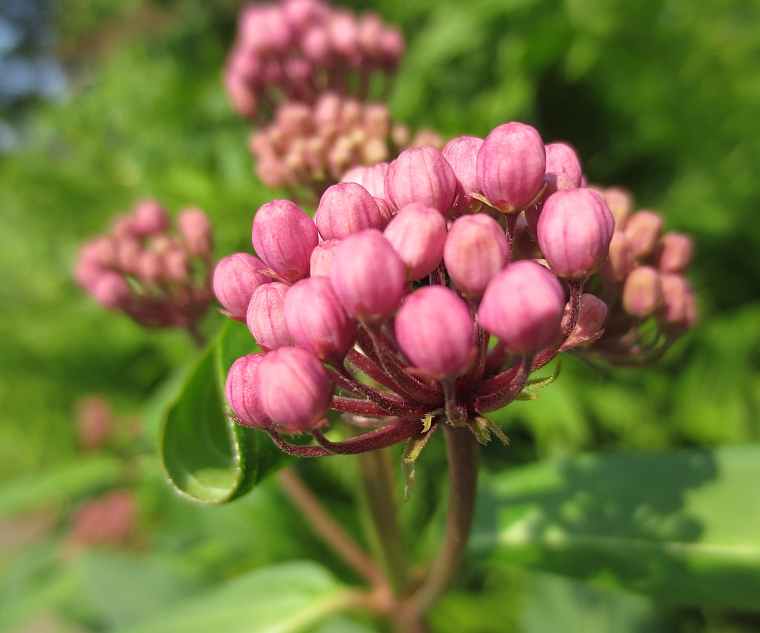
It has the somewhat unfortunate common moniker of ‘weed’ attached to it, so I prefer the scientific name of Asclepias when referencing this favored stomping ground of butterflies and bees. A relative of the milkweed, these are the more refined border versions of that prolific native plant, whose colors have been honed into bright oranges and vibrant pinks. They make an excellent addition to the sunny perennial bed, as their colors are strong, and they produce at the height of summer.
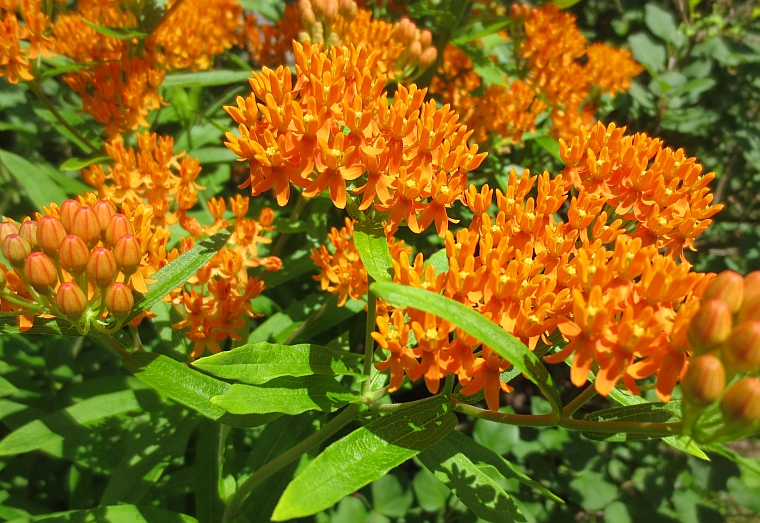
Their milkweed association becomes more apparent when the flower-heads go to seed, producing the distinctive pods that we used to open and pry apart, releasing the feathery parachutes into the wind, a seed on the end of each. Like a dandelion, they were designed to spread far and wide by the lift of the wind. As such, these tend to re-seed throughout the garden if allowed to ripen (I usually dead-head the blooms so as not to weaken the plant for the following season, but the past few years it got away from me, so there are several more of these than intended. Not a bad thing for such a great plant.)
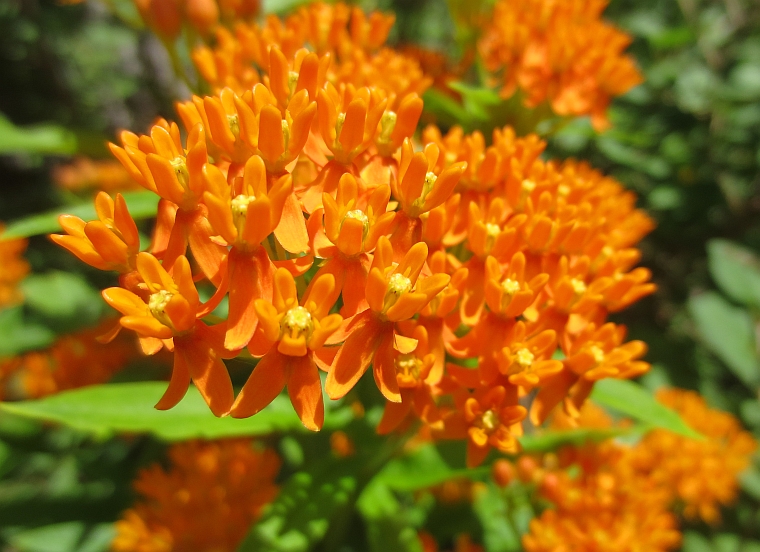
As mentioned, the butterflies love the Asclepias, and the caterpillar form especially may find its way along the stems, chewing on the developing seed pods. For the regally-striped monarchs-to-be, I allow them the snack.
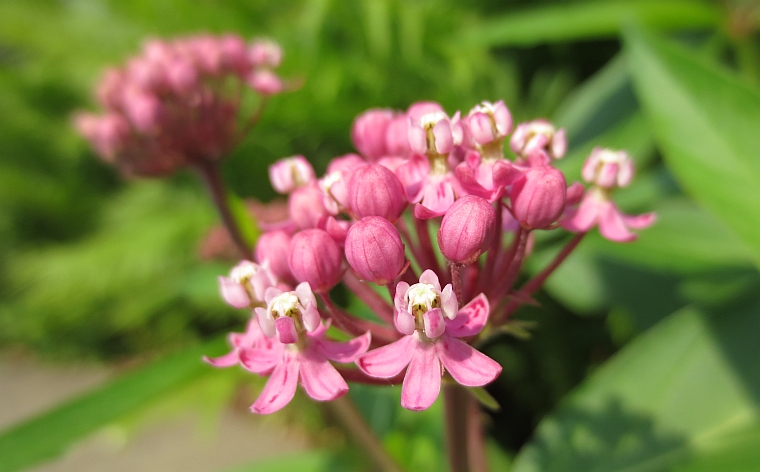
This pink version grows slightly taller than its orange counterpart, falling closer in line to its milkweed kin. Its bloom time is also slightly earlier, but a bit shorter, making it the lesser of the two in my opinion. Still, I wouldn’t throw it out of bed or border.
The title of this post takes its name from a saying that my friend Chris and I first heard from a server in San Juan. We asked her if she was into women (hey, it’s the conversation you have in Puerto Rico when you rack up a $300 bar tab between two people) and she replied very matter-of-factly that she was “strictly dickly”. Well, me too. That brief nonsensical aside over, this is the prickly pear cactus – one of the rare cacti that is hardy in the Zone 5 winters of upstate New York.
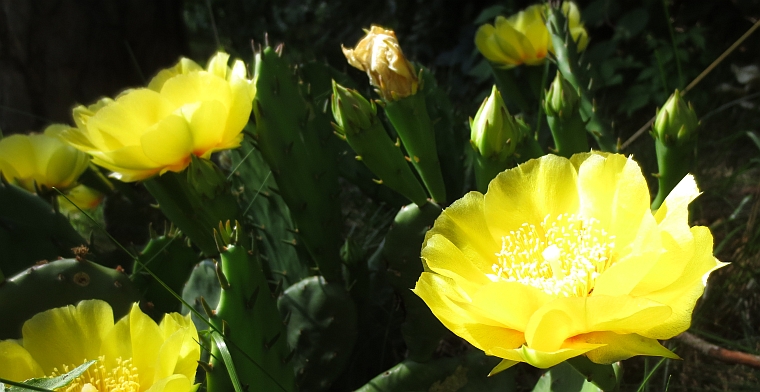
This small patch is located on a Southern-slanted hill that I rarely visit, so it’s always a surprise when I hear word from Andy that it’s in bloom. It’s largely left to fend for itself on a rather barren piece of sandy soil, its only shelter the thinning limbs of a struggling pine tree. Yet each spring it rises miraculously from a pool of withered, desiccated paddles, and each year it has steadily expanded, happy in its dry environs.
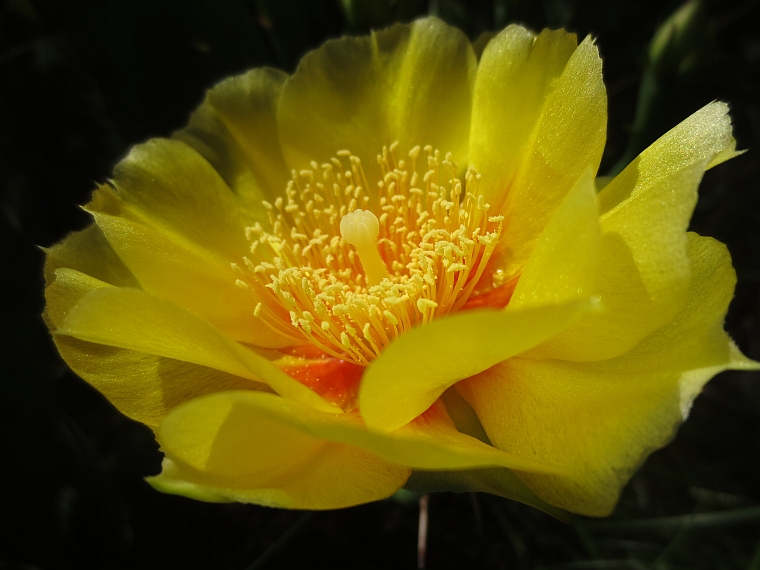
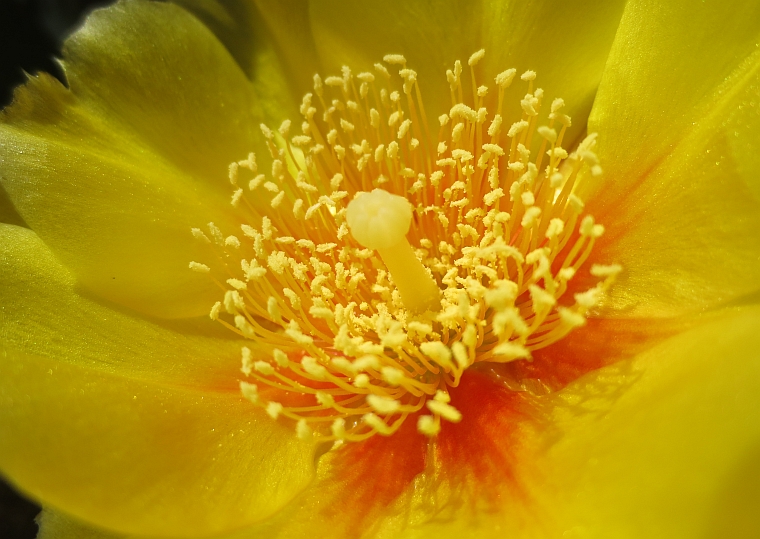
The ‘prickly’ aspect of its segmented ‘leaves’ keeps me from getting too close for weeding, but I’ll risk the proximity to capture some of the blooms, as they are exceptional. The texture of the petals is almost like velvet, and of the clearest yellow, set off by a throat of flaming orange. Like a rose, these pretty things come armed, and that’s something I can appreciate. Prickly and pretty. I can only hope to aspire.