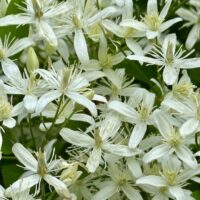
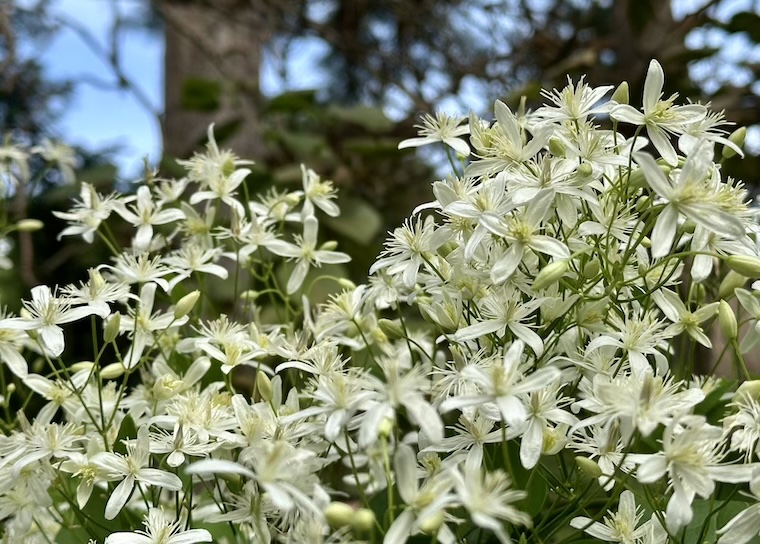
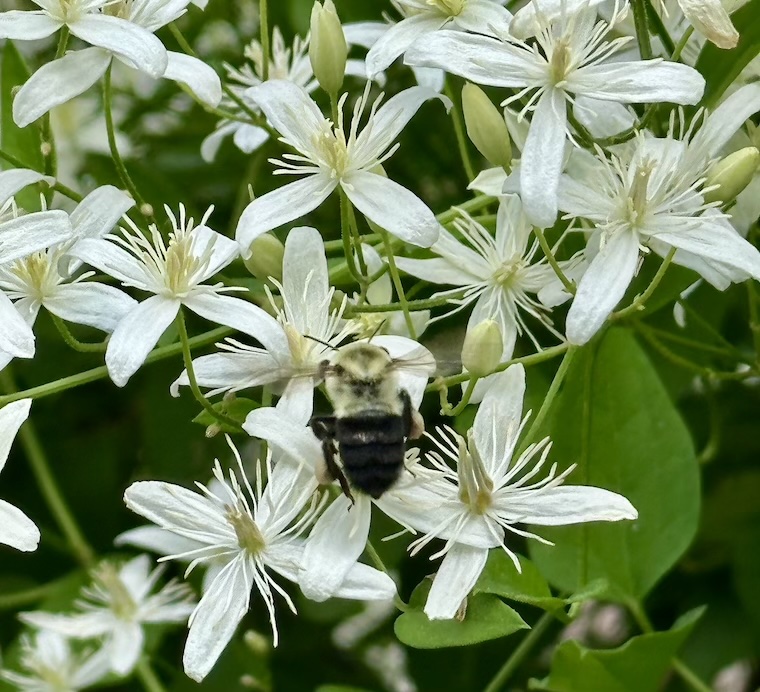
One of my favorite plants – the sweet autumn clematis – is in full bloom right now, carpeted with white blossoms and their accompanying sweet perfume, hence its common name. We used to have one at the base of an arbor, which performed reliably for about two decades before puttering out – but not before seeding itself throughout the area. One of those seeds grew into the specimen you see here – in a relatively neglected, unfertilized and under-watered section of the side yard, where it climbed up a lilac branch and spread itself out into a pine.
Next year I’ll amend its soil with some manure and give it a proper place to begin, as this show can be even more grand and magnificent. For now, it’s a lesson in resilience and power, and a testament to survival. I’m taking my inspiration here for the autumn season. Be prepared. Prettiness is not a sign of weakness.
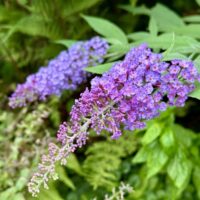
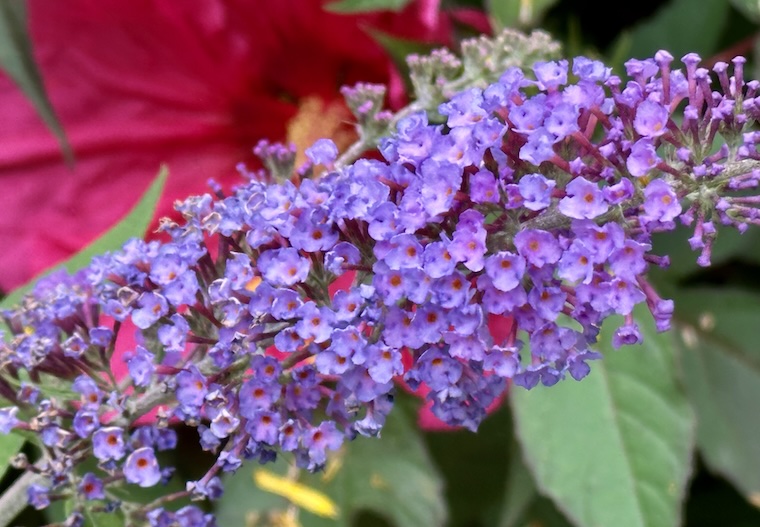
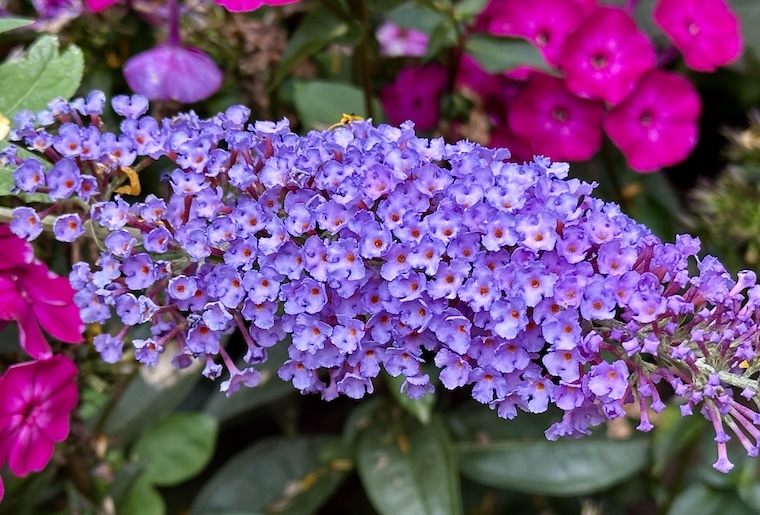
Still, the butterfly bush is in bloom should they wish to visit, and it’s a lovely thing against a brilliant hiubiscus backdrop. I especially adore their orange throats, which you can only see when viewing up close and personal, when you take the time to study and analyze instead of brushing quickly by. Another life lesson from the garden.
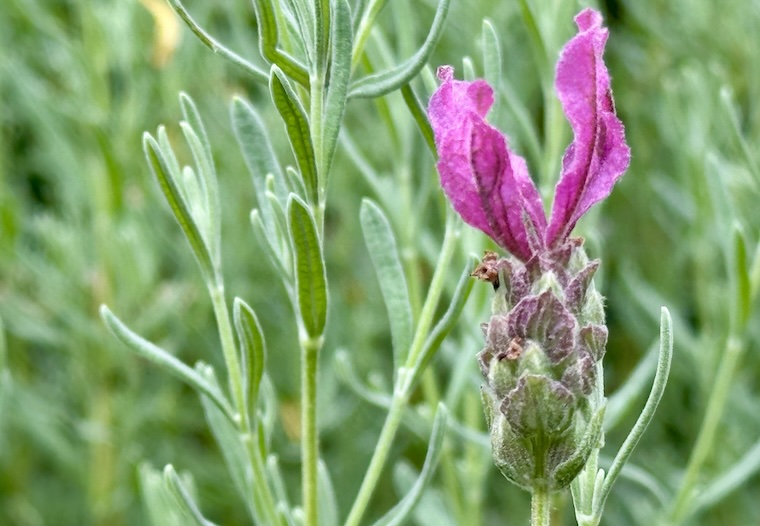
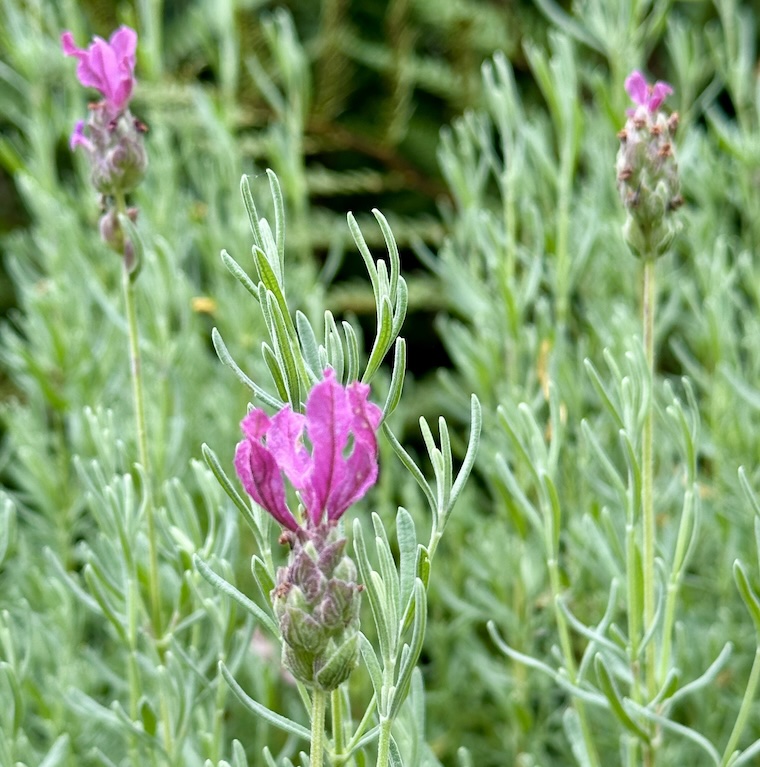
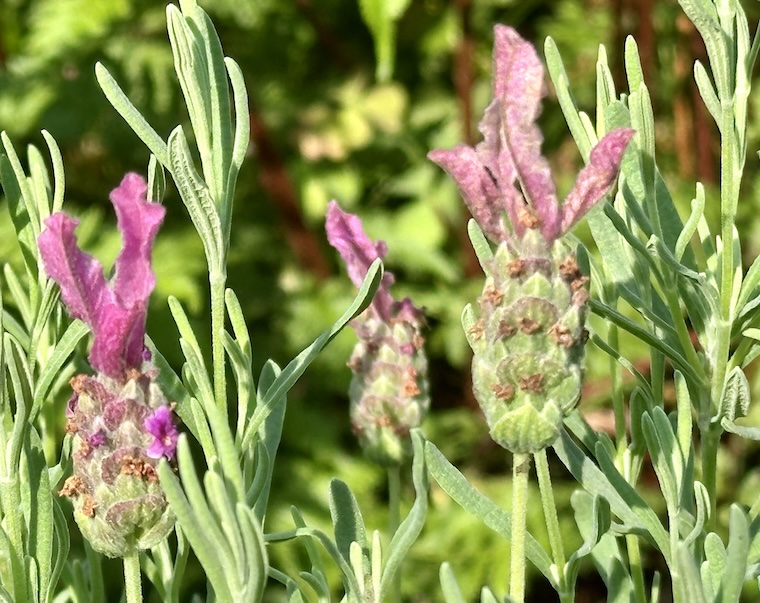
This specimen of Spanish lavender has been a bit of a surprise this year – I had no idea what variety it was as there was no label with it in the nursery – the foliage looked different to me as well, but I thought it was just a dry spring that shrunk it down a bit. Turns out it was Spanish lavender, notable for its butterfly-like flowers. To me, they’re more like bunny ears, which reside in a love/hate space of my brain – where so much of life currently resides.
I can picture the rabbit’s face here, below the purple ears, and it tickles and frightens me at the same time – a similar sort of ambivalence that exists at the end of August – somewhere between giving up, giving in, and giving everything. The end of summer is at hand – no point in pretending we’re not here. Thank God for Spanish lavender to ease this irrefutable state of affairs.
Richie and Austen are often along for the ride They don’t say a lot, but they know every inch of this drive If these trees started talking, I bet you they’d only talk shit ‘Cause we never do anything real, we just talk about it Endin’ of August, the bugs are just starting to die All the neighbors are voting for someone who wins every time And I thought getting older meant knowing it’s too late to try And I tried getting sober, I swear I did better this time
Whoa, everything you see out here will die Ooh, it’s a matter of time ‘til it’s Fields of ice and reflector lights ‘Til it’s our town And anything you need I will provide A ride home or an alibi I know the traffic light You can speed right by ‘Cause the camera’s down And I follow New York plates to the county line I ignore ‘em when they wave on 89 The minute that September hits I’m going off my medicine, oh Late August angst, and a pointless night Ooh, and the feeling of being alive For the first time, in a long time
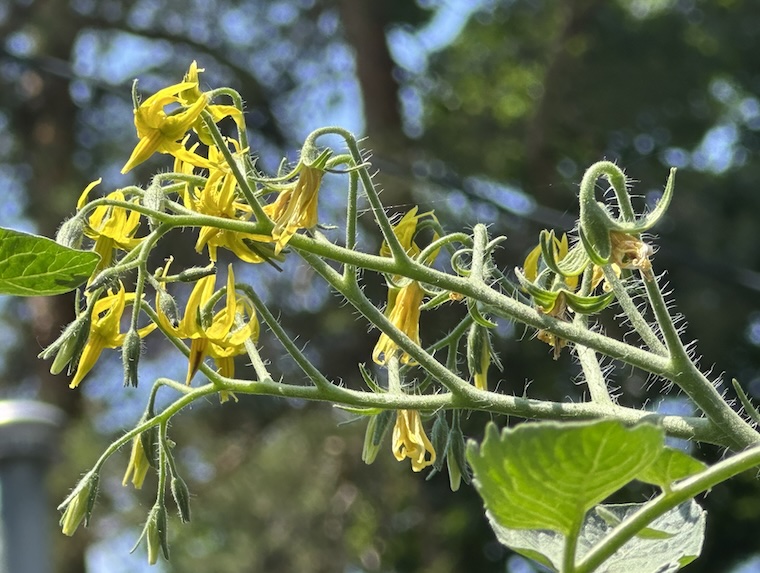
On the eve of their arrival, I step onto the back patio. It’s raining, and I don’t mind it. The tomatoes have started to split, and I hurriedly harvest a few, popping them into my mouth and savoring the summer moment. Pausing to take it all in, I listen to the rain, remembering a similar rainy day in which I sat beside a patch of trilliums earlier in the spring. That feels far away now – so much can happen in a single summer, even when nothing seems to have happened.
Oh we’re a drawing of a place We’re a photo on the fridge They mined copper for years Oh, there was nothing left to dig It’s a place where most kids Just grow up and have kids, who grow up and have kids Who build homes for the rich, oh
A pesky mosquito threatens the peaceful moment, and even that doesn’t annoy me the way it usually would. I wonder why I care so much less. I wonder why I don’t care much at all. End of summer blues, probably. They’ll be chased away once Ann and Missy arrive – friends always to the rescue.
Whoa, everything you see out here will die Ooh, it’s a matter of time til it’s Fields of ice and reflector lights ‘Til it’s our town ‘Til it’s our town ‘Til it’s our town And it’s ours now It’s ours now
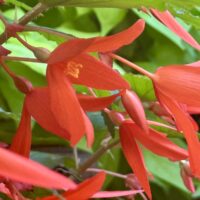
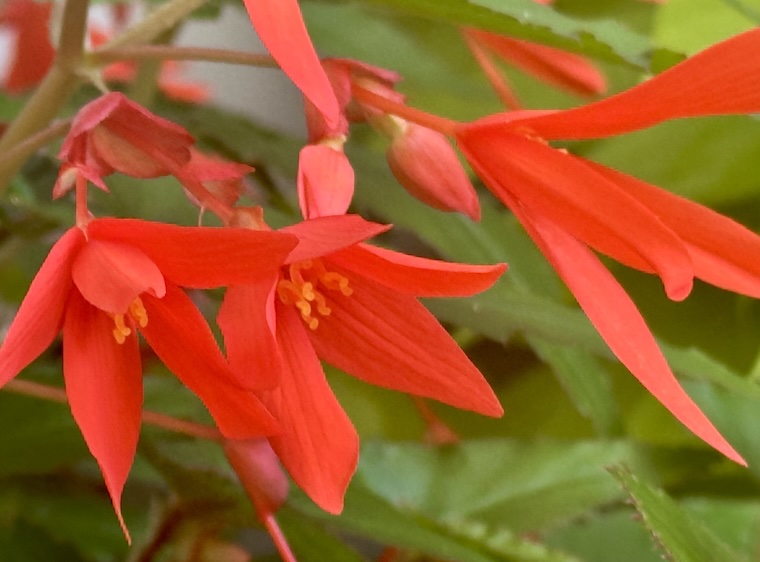
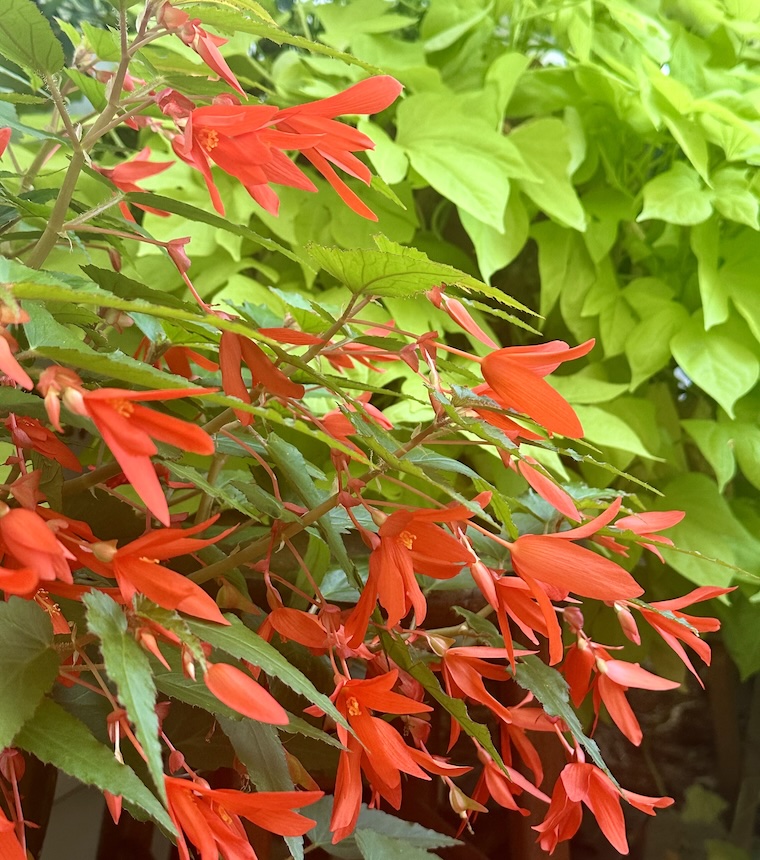
Some plants just inspire happiness – and this brilliant begonia has always been one of those plants for me – from its fiery color to its elegant cascading structure. This year I only ended up planting one of these, but it’s filled out its pot admirably, backed by a chartreuse sweet potato vine to set off its gorgeous flower hue. Some years when it gets particularly wet and cool, these have failed, rotting before they get a chance to really shine. Happily this wasn’t one of those years, and the sun and warmth have given it prime atmosphere to show off.
Our potted patio plants always come into their own right about now – reaching maximum size and floral impact – and so long as I keep up the fertilizing and watering, this incredible show should continue until the frosts begin. Let’s slow our roll in these latter days of August.
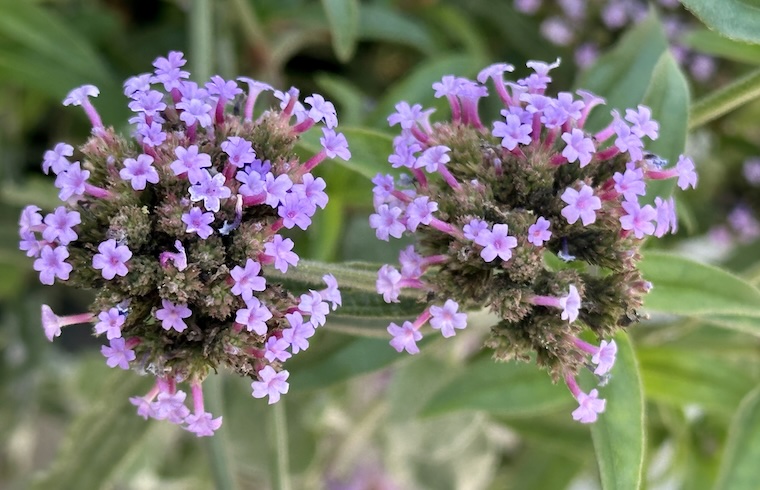
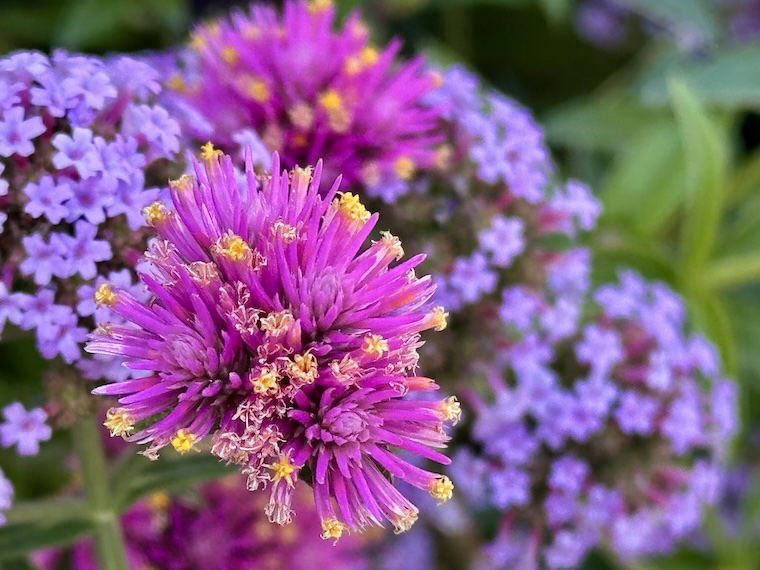
Verbena bonariensis (I love that name) holds its purple heads high above the garden for a significant swath of summer. A favorite of pollinators, it brings the bees and the butterflies to the yard, and a welcome airy and vertical element to the garden plan, forcing an informal cottage charm to the most formal of proceedings. Known commonly as the purpletop vervain (almost as nice as its scientific name) its color echoes a cross between lilac and violet in hue – remnants of a spring memory happier and more hopeful than the typical latter-half-of-summer fare on display now.
Happening upon a planter of these downtown, I’m inspired to consider a wilder and less structured garden vision for next year. Poppies and cornflowers and hollyhocks come to mind, a cottage garden of sorts being the likely setting for my winter dreams, and the color palette being what you see here – lilac and pink and all sorts of pastels to keep things cool and soft for whatever the next summer throws at us. A happy and heartbreaking couple of words: next summer.
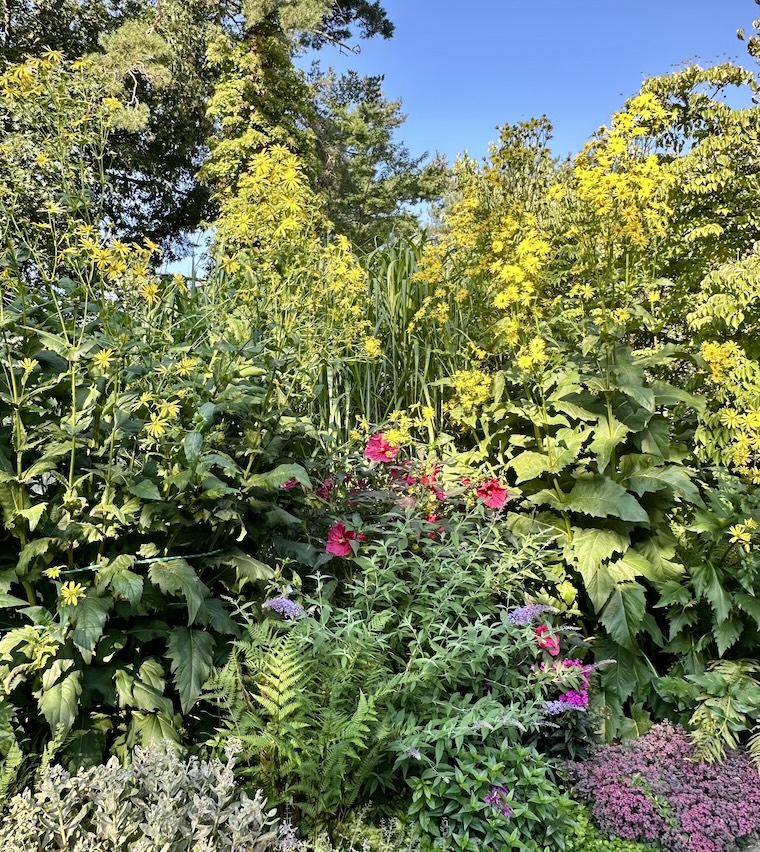
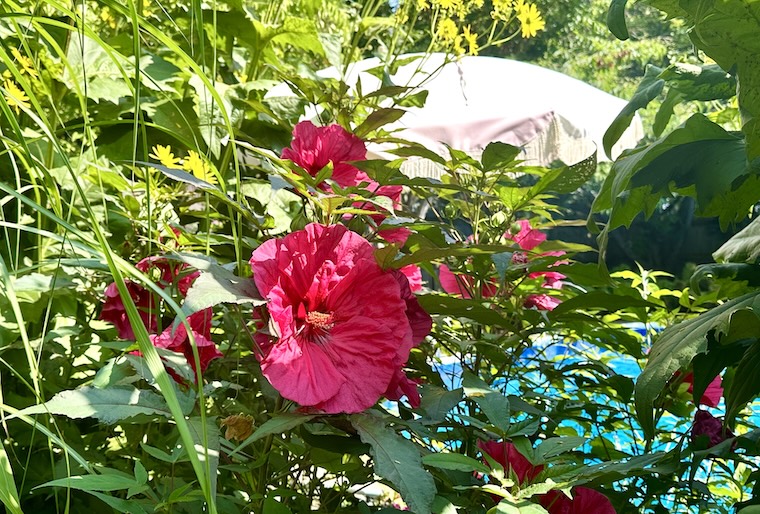
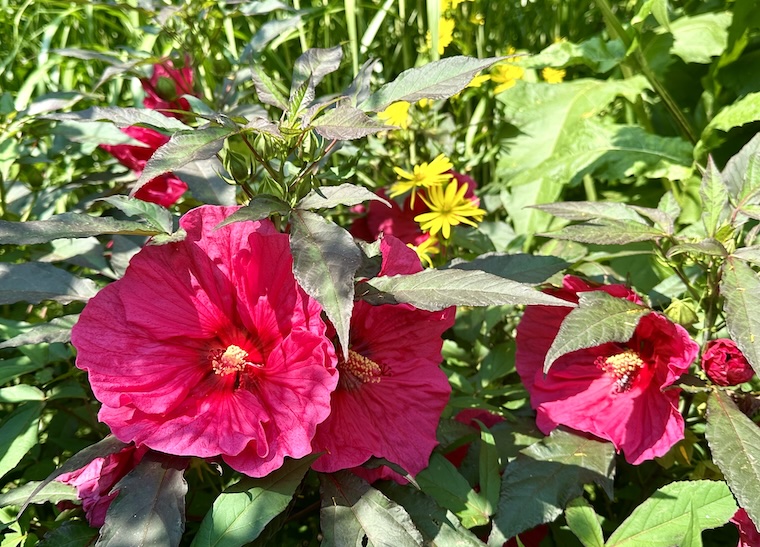
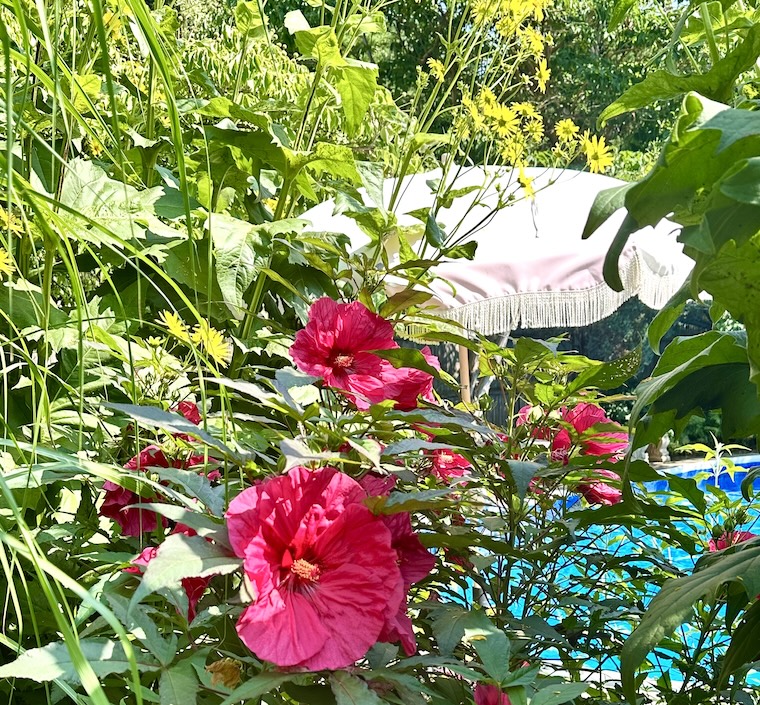
While this hibiscus plant may be dwarfed by two stands of cup plants on either side of it, the blooms are on fire, creating their own masterpiece in the garden right now. Larger than an adult hand outspread, these flowers are impressive taken on their own – when grouped they are simply stunning.
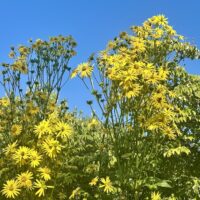
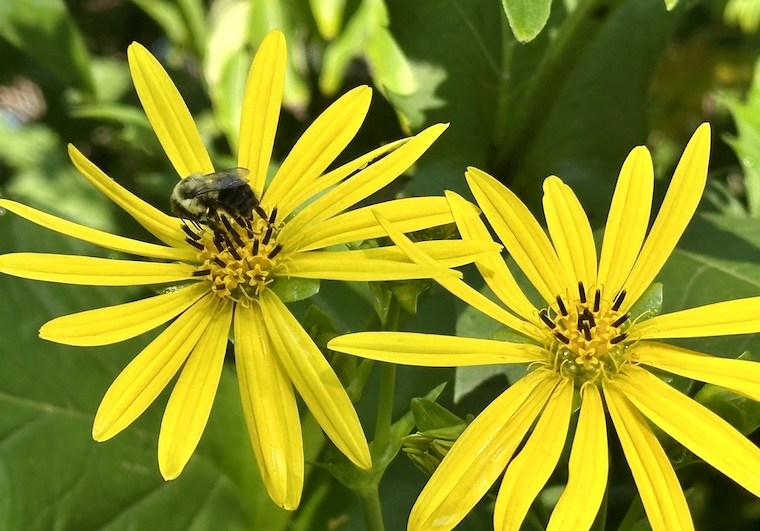
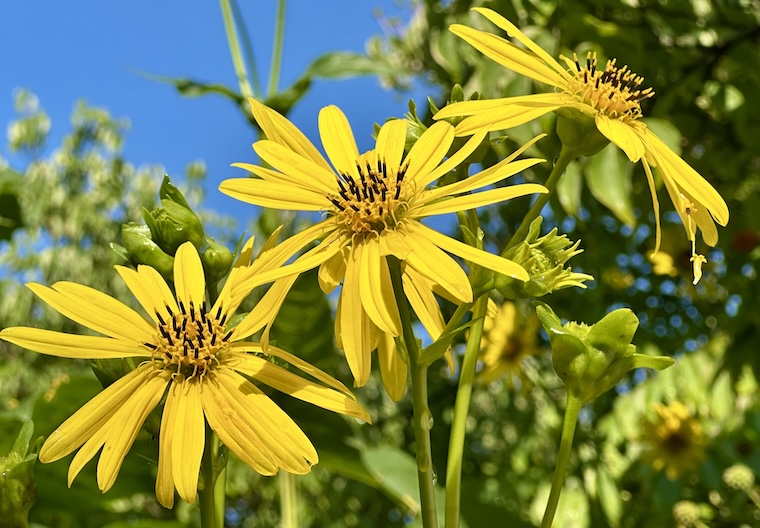
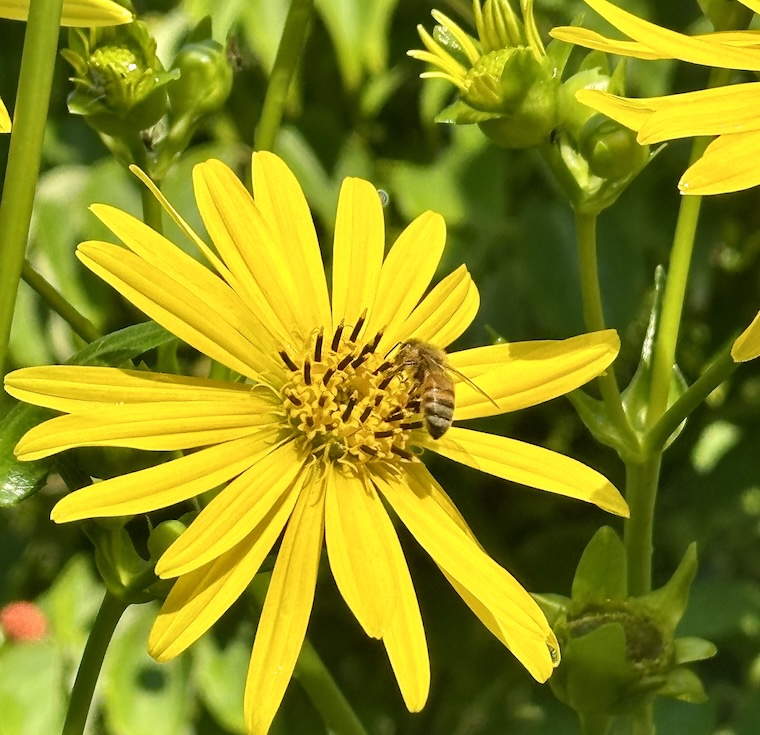
When summer bursts with cheerful color – yellow suns against a blue sky – the heart beats with palpable joy, no matter what might be going on inside. Well, that’s not always true – some summers do inherently suck, and all the beauty and color in the world can’t change that. This summer wasn’t entirely sucky, so I’m offering gratitude for the days of sun and prettiness, remembering that savoring and appreciating things is an integral part of realizing happiness. When you let the heart lean into that, it can be a reserve to help see you through winter.
Despite a horrendous attack by aphids that covered the growing stalks of the cup plant earlier in the season, these blooms still managed to appear, and at the time of this writing they sail gloriously high above the garden, lighting it up, especially when the sun hits them. The bees and hummingbirds and goldfinches have been having a proper field day with the blooms, though I sadly haven’t spied any butterflies at all this year. The world feels in danger, so I embrace the birds and the bees that remain.
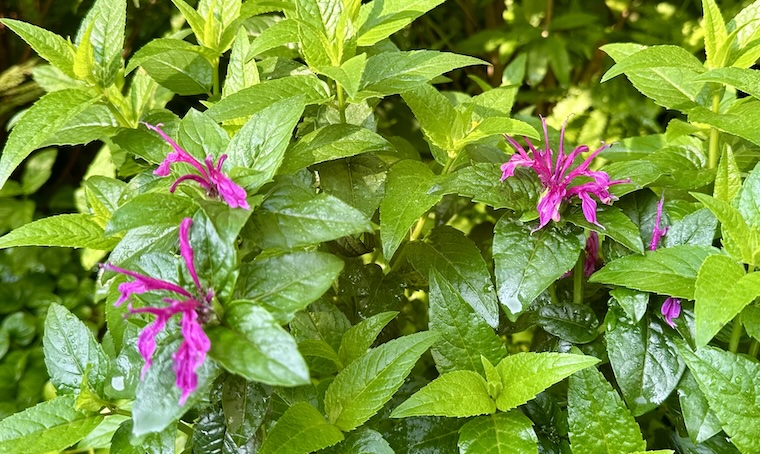
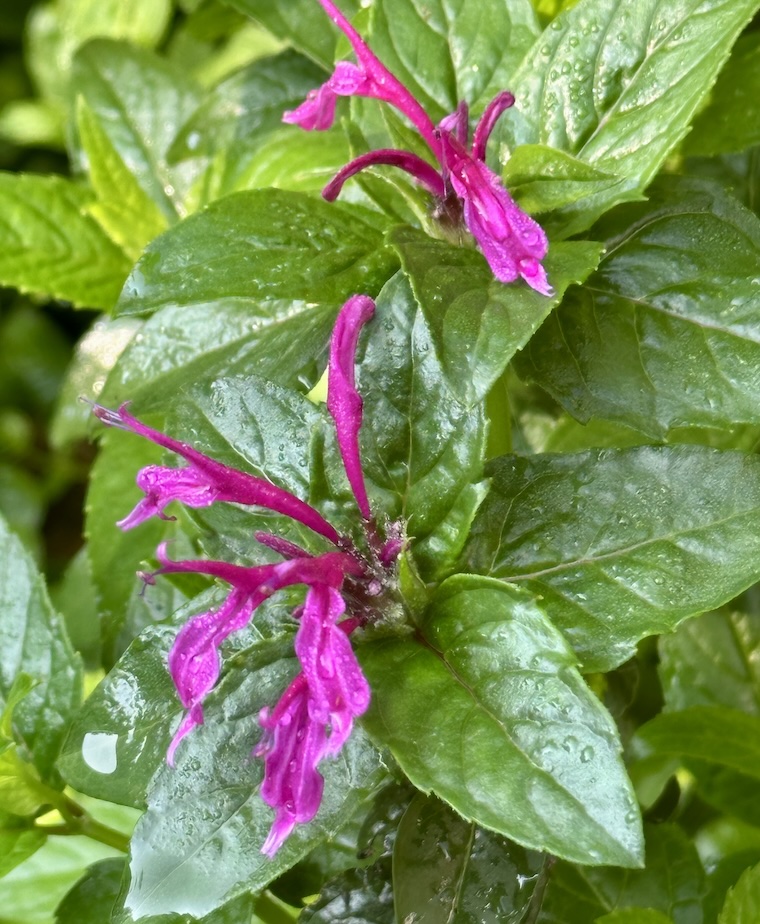
Certain perennials will sometimes offer a second showing of blooms after their first bodacious presentation. This usually happens after they’ve had some time to rest and recover, or after you’ve pruned them hard and allowed them to come back. The second show is never quite as impressive or floriferous as the first – the blooms are often smaller and more scant, more of an echo than a proper second act, but somehow more tender and precious for that.
Such is the case with these electric pink Monarda blooms. I’d sheared the plant back heavily after its first flowering spell, and it began putting out new foliage quickly thereafter, followed by the appearance of a few smaller blooms. I love these follow-up performances – they bring a freshness reminiscent of early summer back to the garden just when it’s really starting to wind down. It’s like summer insisting on staying just a bit longer, and after a few rocky weeks I’m grateful for the chance to do it again with a lighter heart.
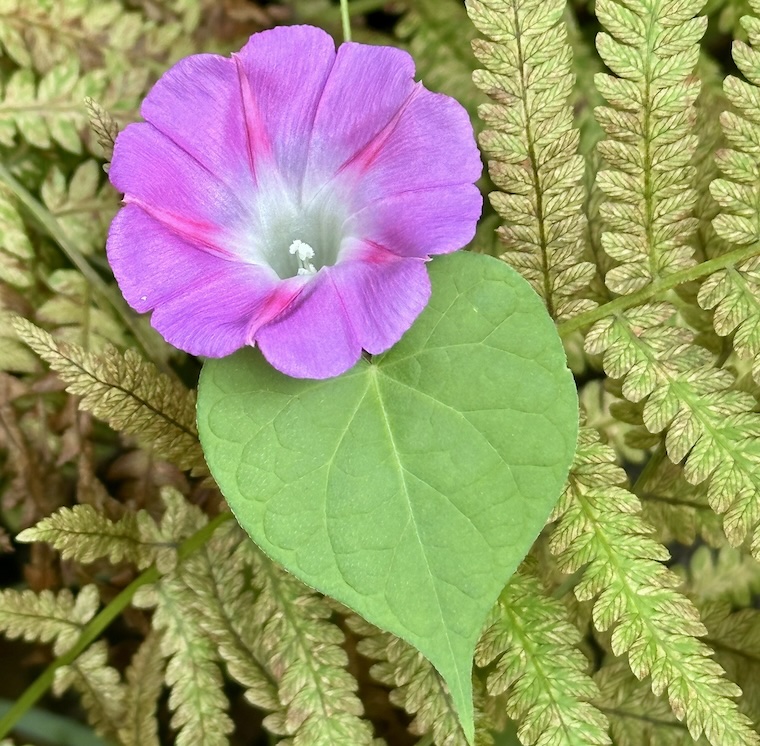
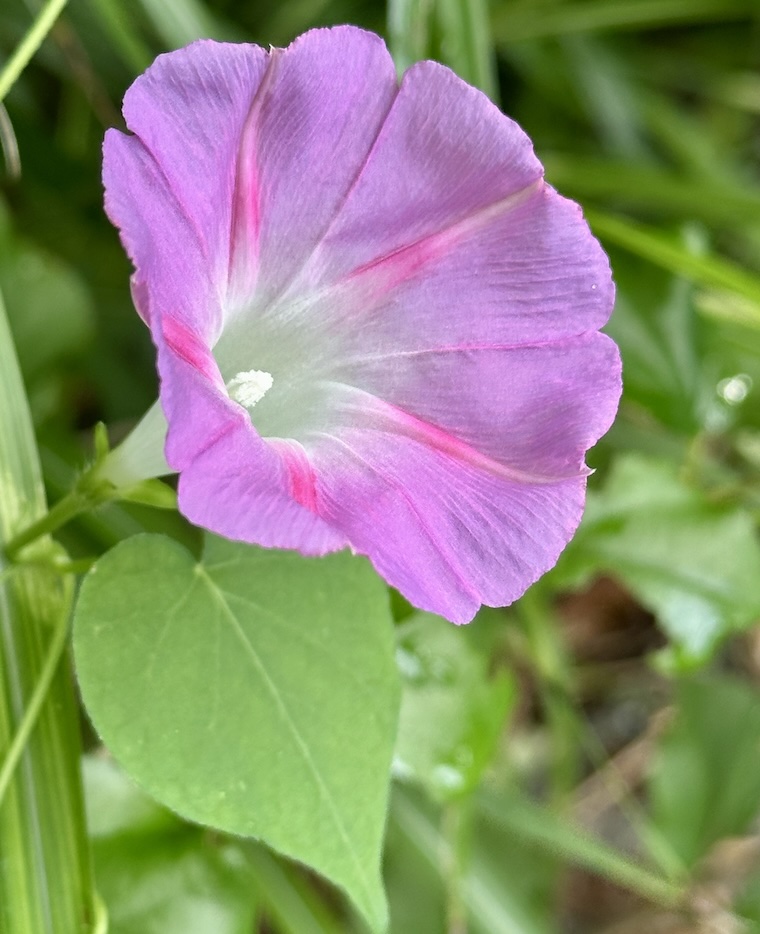
Every year around this time, the morning glories that managed to escape my early-season ruthlessness begin blooming and showing me where they are with these colorful blooms. I don’t pull them, happy for this vibrance at the time of the year when the ferns that previously hid them are starting to brown and fall apart. That’s my general feeling on the gardens right now – it’s the downhill slide, and no amount of watering or feeding will turn it around. Sometimes you have to give in to the inevitable end. You may mourn, and that helps some, but it won’t slow or stop or change anything.
There are a few more moments of fresh blooms to come – the Japanese wax bells (Kirengeshoma palmata) and the Japanese anemone (Eriocapitella x hybrida) to name a couple of favorites – and our Hibiscus just started its own show, but the overall sense is one of resignation to the coming end. That means making the most of this time, and this morning – like so many mornings that have come before – coupled with the realization that some of us have fewer mornings ahead of us than behind us.
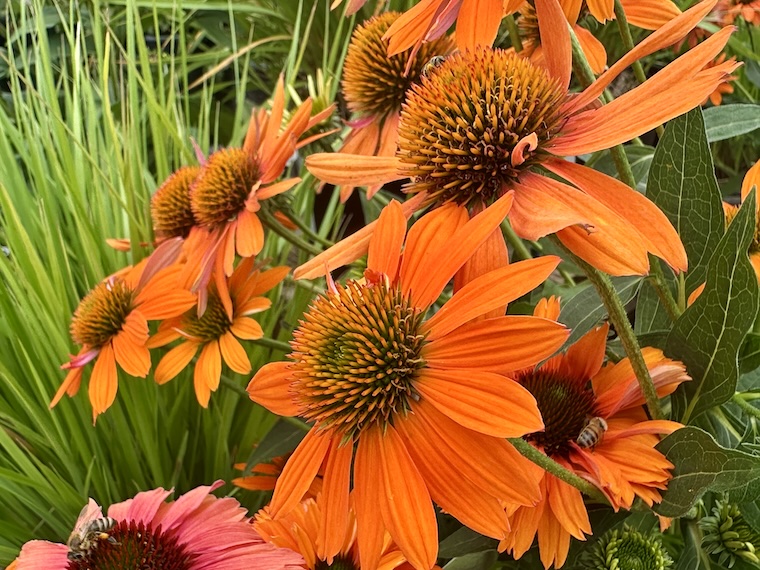
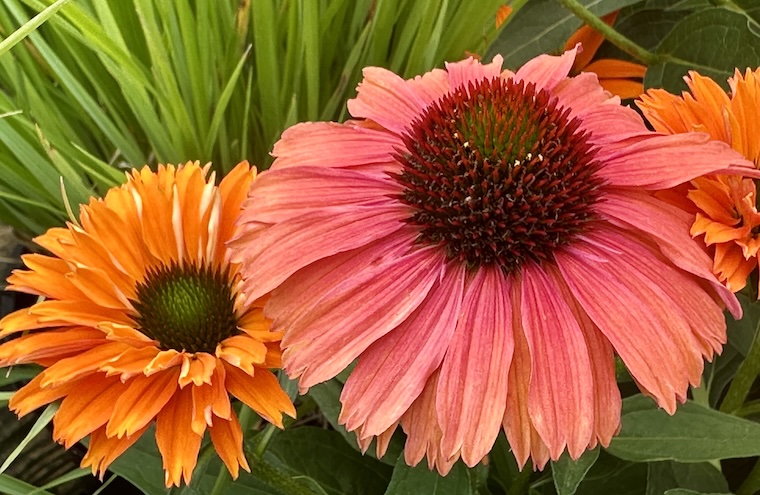
The overabundance of rain we’ve had in the past week has prolonged the freshness of the garden, which is usually dry and brown and beginning the fateful turn to fall at about this time. That has yet to happen, and so our summer elongates with blooms bright and showy, and foliage that remains green and vibrant. What a treat to be in this area at this particular time, and what a treat the garden in summer always is. Here we have some echinacea in what can only be described as the color of an August sunset.
These beauties were on display at the local nursery – I don’t have the space for any more perennials at the moment. Well, a few could be squeezed in I suppose, but I’m making room for Montauk daisies and I didn’t have Echinacea in the plans, so another year will pass before I begin entertaining that. Yes, I plan that far ahead. It’s why Virgos have their shit together.
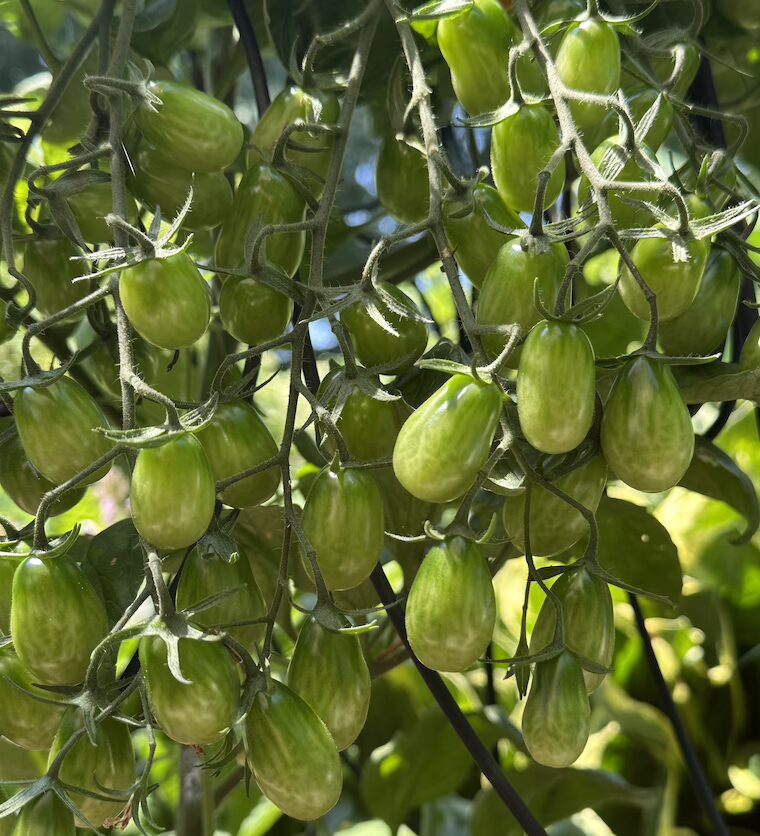
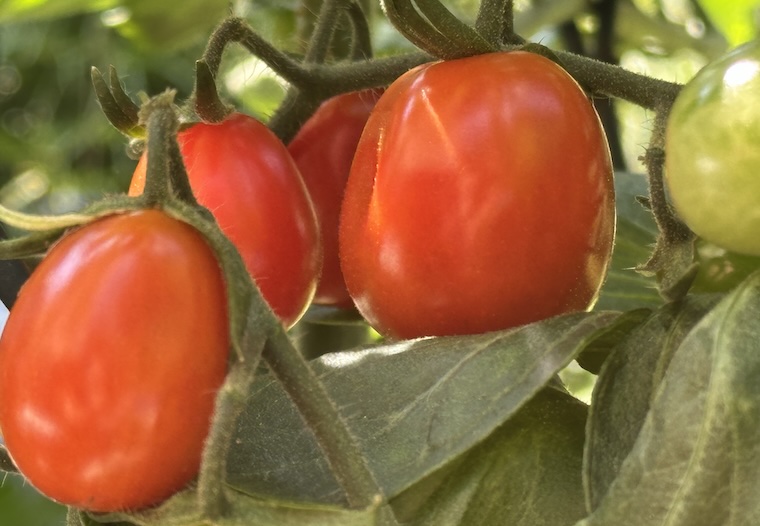
This new variety of cherry tomato (whose specific name has been lost to my insistence on throwing out the label much too early in the season) has started ripening – and it’s delicious. I always forget how good homegrown tomatoes taste compared to the flavorless supermarket objects we find in the winter here. The tomato is the culinary embodiment of summer in these parts – a giddy taste and force of nature that reminds me of how lovely the sunny season can be, especially in the mouth.
Dad taught me how to grow tomatoes, and for the past several years I’ve put them in pots on the back patio and they’ve been delivering. The cherry tomatoes are the most reliable, so that’s what I’ve focused on lately. The two pots going now are beginning to mature and ripen and the bounty is just around the corner.
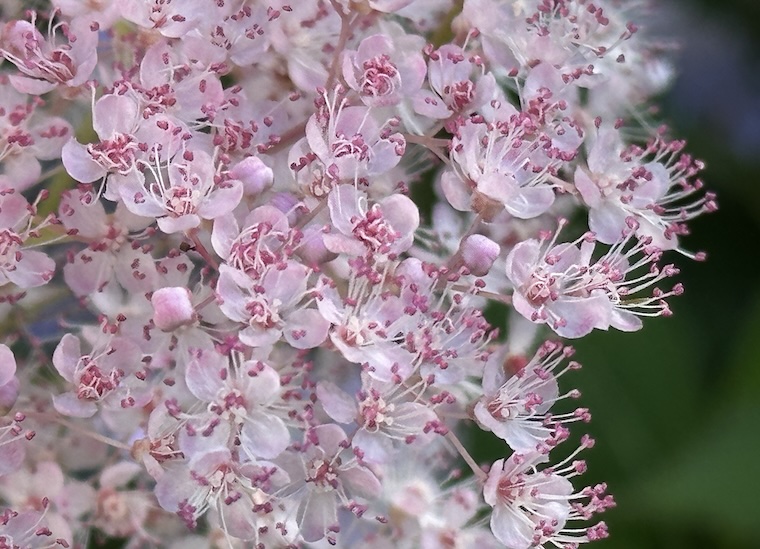
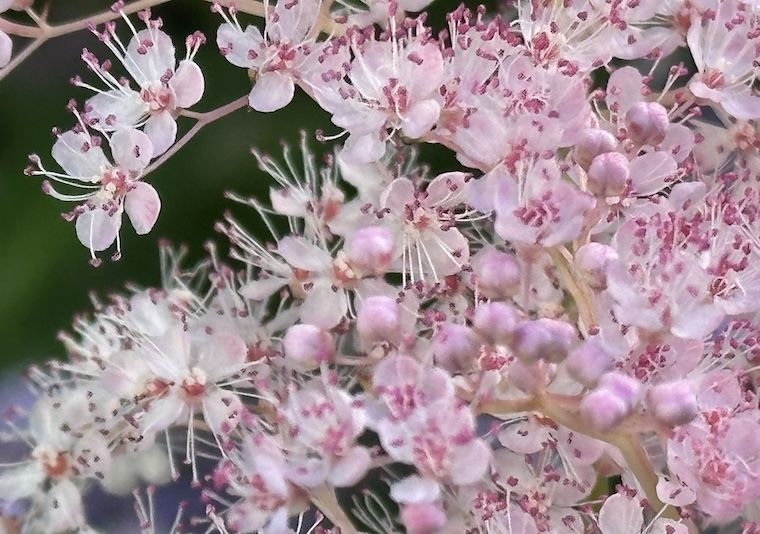
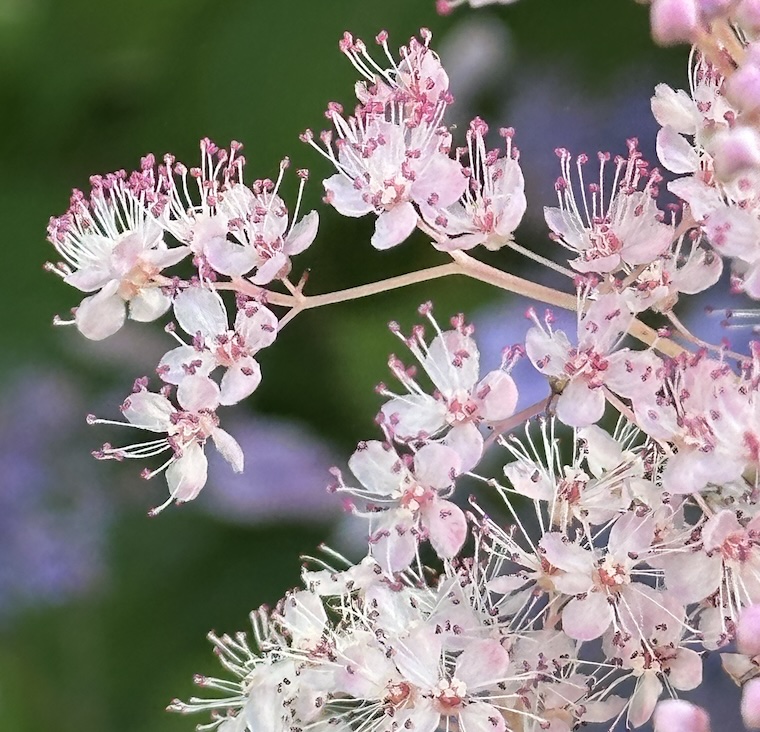
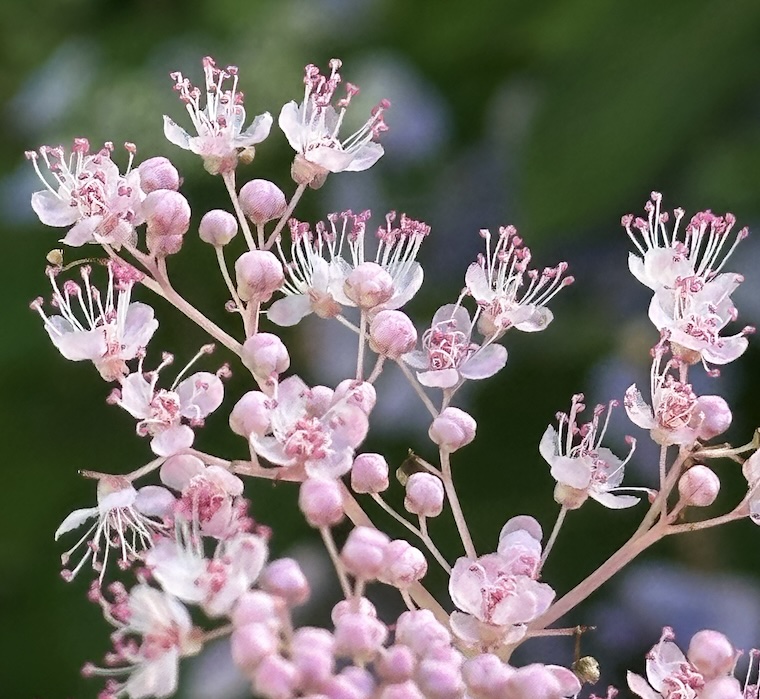
Filipendula rubra is a robust and towering plant, reaching heights up to eight feet in conditions it likes (wet feet and sun) – and is topped by fluffy plumes of pink flowers at this time of the year, earning it the nickname ‘Queen of the Prairie’. While the effect is grand from a distance, it’s even more enchanting when viewed up close, which is the main point of this post.
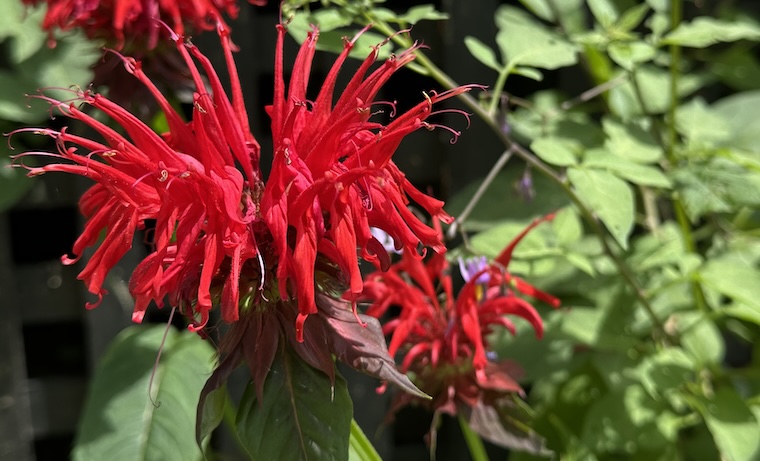
I just read a disheartening report that a disturbingly-large percentage of bees have died in the last year or so, a telltale sign of the distresses that our earth remains under. I no longer know how to process all the horrific news that is happening, other than ignoring it for my own sanity and well-being. In service to that, I will lean into scenes like this – a strikingly scarlet variety of bee balm (Monarda) thus far blessedly unaffected by mildew. We will take our small victories where we find them, grateful that there is still beauty left in the world.