“Every writer is a narcissist. This does not mean that he is vain; it only means that he is hopelessly self-absorbed.” ~ Leo Rosten
“A narcissist is someone better looking than you are.” ~ Gore Vidal
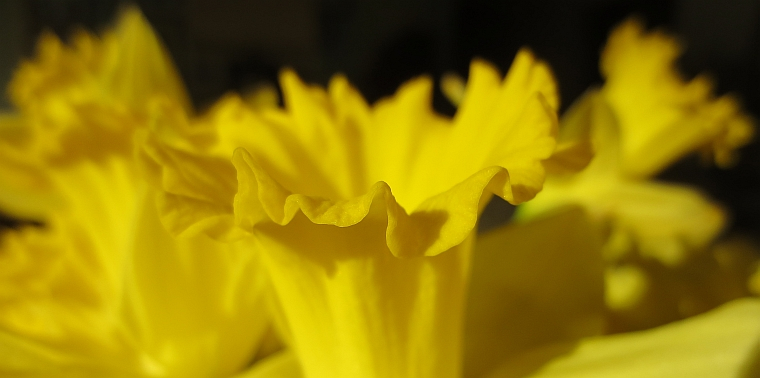

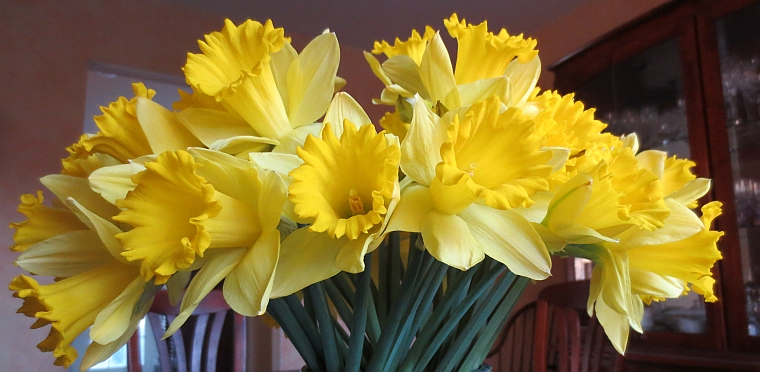
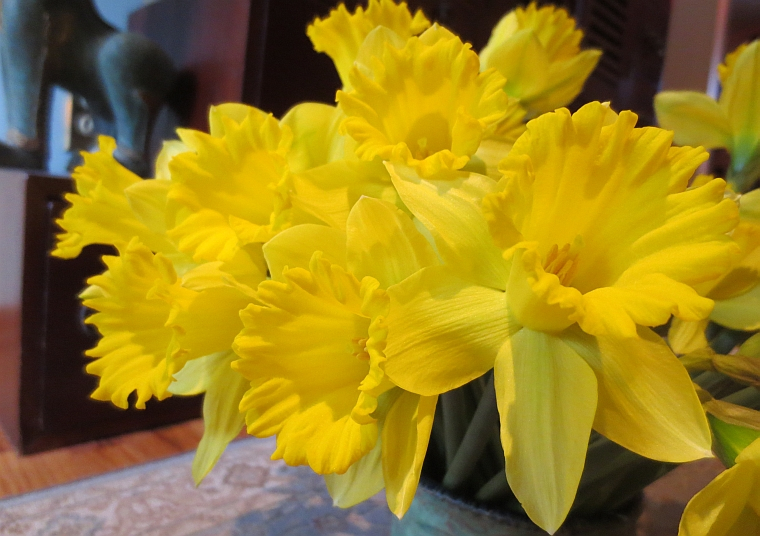
Far more than crocus or snowbells, the flower that symbolizes the arrival of Spring is the daffodil. Those pre-cursors may come first, but they also carry with them the possibility of destruction, by a late-season snow storm, or the muddy arrival of April. True, even the daffodils and tulips have been known to bloom through some late-season snow, but for the most part it’s safer to bloom as a daffodil than as a crocus.
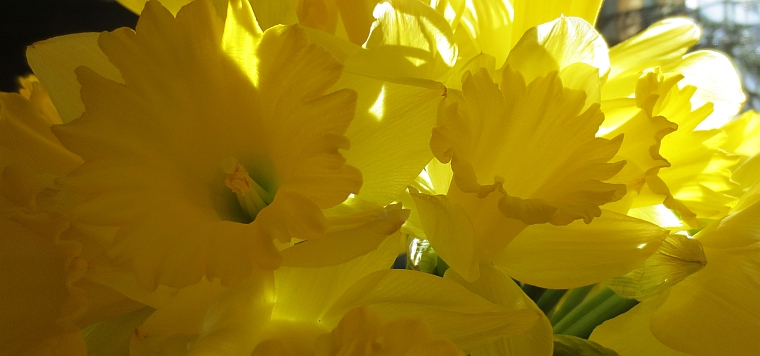
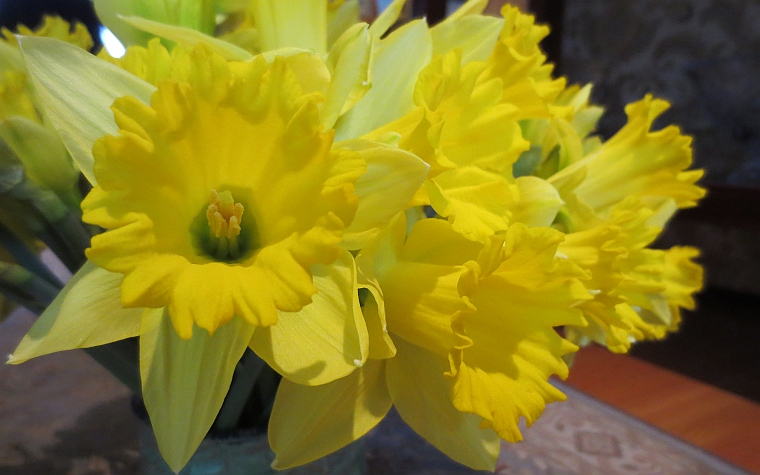
These are, obviously, procured from a market, and not the backyard, as ours is still frozen and covered with snow. But I couldn’t wait a moment longer for a peek of Spring – this Winter has gone on long enough – and when these were in such luscious bud I couldn’t resist. A big bouquet of daffodils will always boost my spirits.
For some reason, I seem to have the most elementary school memories from second grade. I remember each grade distinctly, and the main events from each year, but collectively the most numerous come culled from the second grade class at McNulty School, helmed by one of my favorite teachers, Mrs. Loomis. I remember the folders we got at the start of the year, and if we had a good week of work, she’d give us a sticker to place on the front of the folder. The students with the most stickers at the end of the year got rewarded by getting first pick at a pile of gifts she brought in. (This may have marked the start of my competitive scholastic nature.)
I remember the time we sat around drawing something on the floor, neatly staying within the lines until I messed something up, then letting out an audible “Whoopsie-daisy!” before I even knew what I was saying. For the record, not even second graders say ‘Whoopsie-daisy’ – especially not second-grade boys. But instead of being ashamed or embarrassed, I laughed along with everyone else – we were too young to know real shame, too young to have it mean more than a silly slip-up of language, too young to hate, really.
I remember the doily-festooned brown paper bags we used as Valentine’s Day card receptacles, and how thrilled I felt to watch it fill and get heavier day by day, threatening to fall from its scotch-tape-secured post at the edge of my desk. I remember trying to discern between the collective love of the class and the selective love of a few close friends, but mostly just feeling warm and happy to be part of something.
And I remember a girl named Amanda, who had long stringy hair that she often kept in two pig tails framing her face – a face that was usually stained with something at the edge of her mouth, or unnaturally pink in the cheeks, like she’d been outside on a winter day for too long. She was one of those unremarkable kids in my world – we spoke occasionally, but weren’t friends. I sat next to her at the long lunch table a few times, but she was fidgety, spinning around in her seat, or leaving the edge of her peanut butter and jelly sandwich spilling off its plastic wrap and directly onto the lunch table. (Gross.)
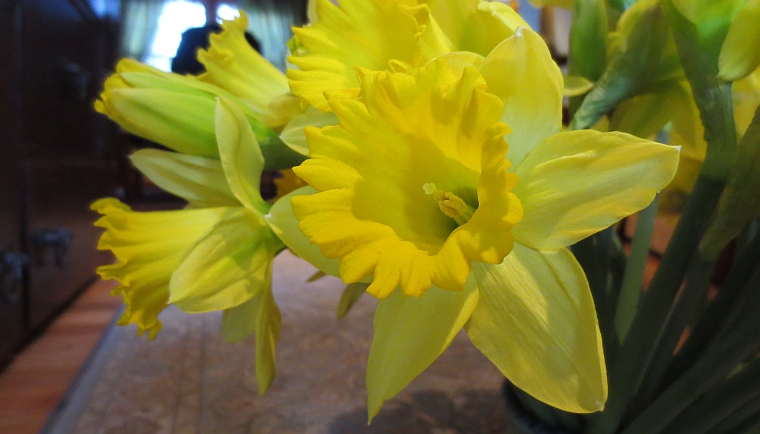
We would never be closer than that. Yet there was one thing that Amanda had that I didn’t. I remember watching her walk down the hill to school one day, so far back that she would surely be late again, and in her hand she held what looked like a few magic wands. Daffodils. It was early spring, and the day was gray and cloudy, but from this mist emerged the girl I’d never much noticed before, holding a small bouquet of flowers for Mrs. Loomis. It was a moment of beauty, and all I could do was watch. They were wrapped in damp paper towels, their green stems so fresh, tinged with the slightest tint of silver , and almost as beautiful as the colors that blossomed on their ends ~ yellow like the purest sun, cream like the thickest egg nog, and orange like the sweetest piece of citrus. Amanda sat down like she had done nothing at all, when she had really changed the world – my little world – full of judgment and criticism and class – all cut through by a simple act of generosity, of goodness, of sharing.
I watched as the daffodils bloomed for the rest of the week, studying how they opened, stealing a sniff when I thought no one was looking, and generally enjoying the preview of spring. Maybe she stole them from a neighbor’s yard, maybe her Mom sent them in, thinking her daughter needed whatever help she could get in the sticker department, or maybe she just felt like Mrs. Loomis would like a few flowers. I’ll never know, but for that one dismal morning in second grade a little girl touched a little boy with a bouquet of daffodils, and he’s never forgotten it.

When it’s only twenty degrees out, and you’re still recovering from a late night of one or three too many cocktails, you need a little brunch, and a bit of peaceful solace. The best place for the latter, and one of my only sightseeing goals for this trip, was the US Botanic Garden. Like the National Zoo, it is a stop I try to make whenever I’m lucky enough to be in town, and it provides both a respite from a cold winter day and a place of active contemplation.

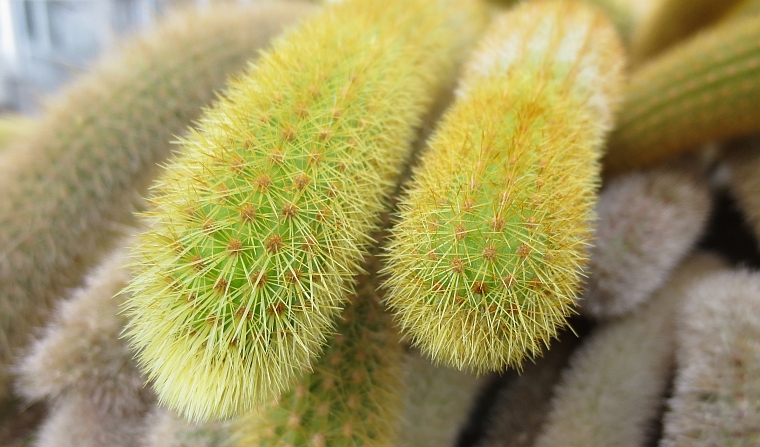
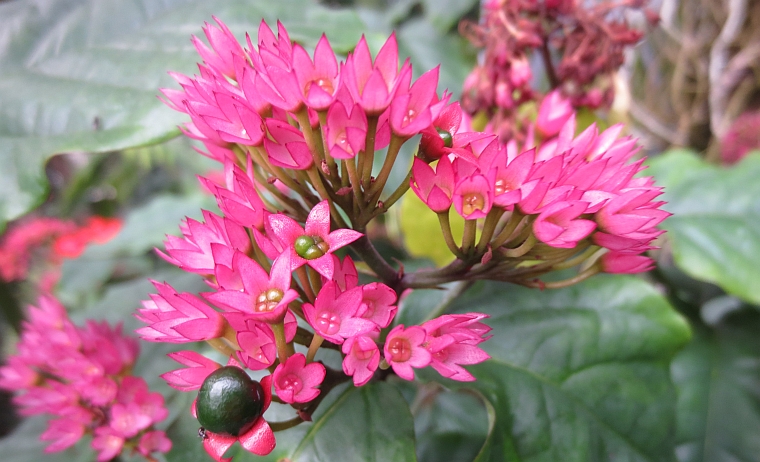
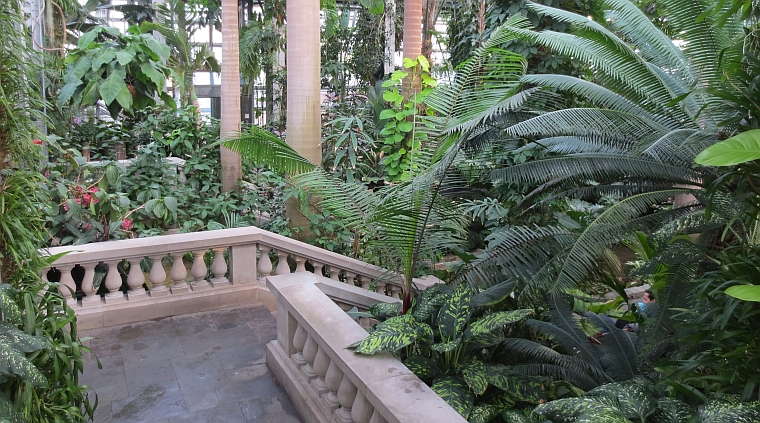
As the cruel winds blew through the locked gates of the outside gardens, we entered the Grand Foyer and were transported to a place of beauty and serenity. I have yet to find a balm that quells the restlessness and riot of winter as quickly and effectively as a greenhouse. And this was no simple greenhouse. Bamboo stretched to the sky, threatening to break through the high glass ceiling of the entryway. Trees soared upward ~ palms and umbrella plants – a trickling stream of water ran through the heart of it all ~ and a colorful carpet of mosses, creeping fig, bromeliads and orchids covered the lower story.
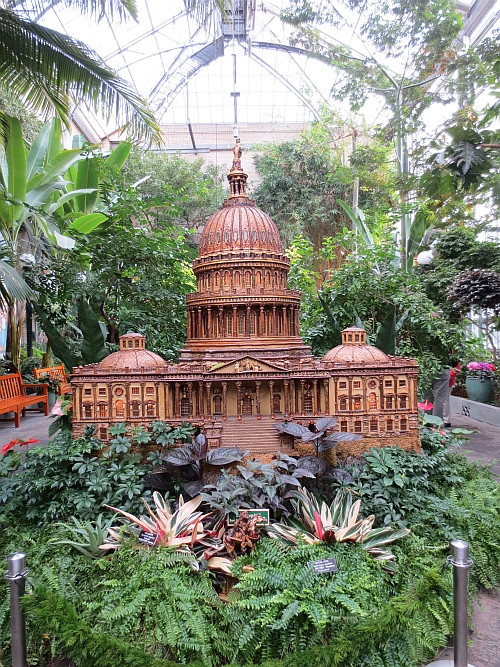
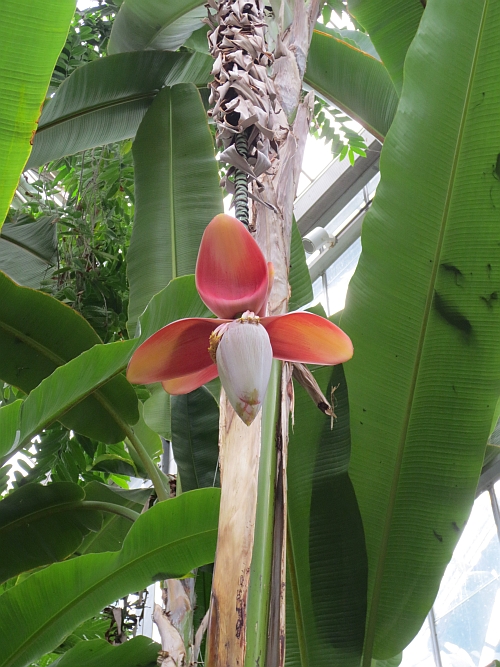
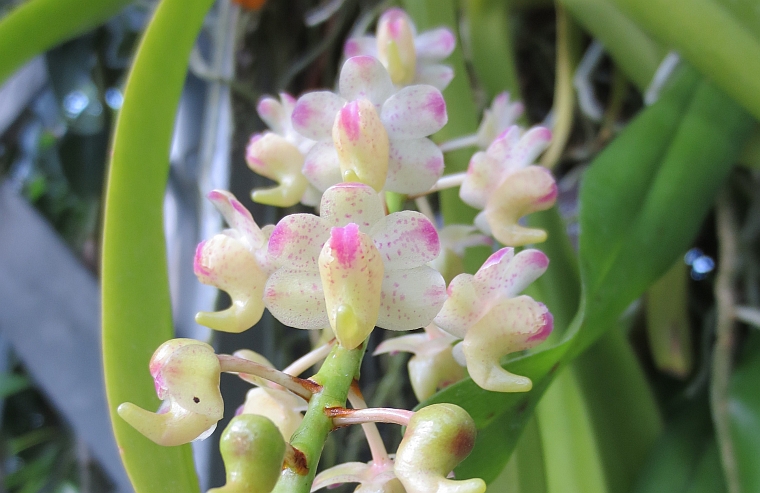
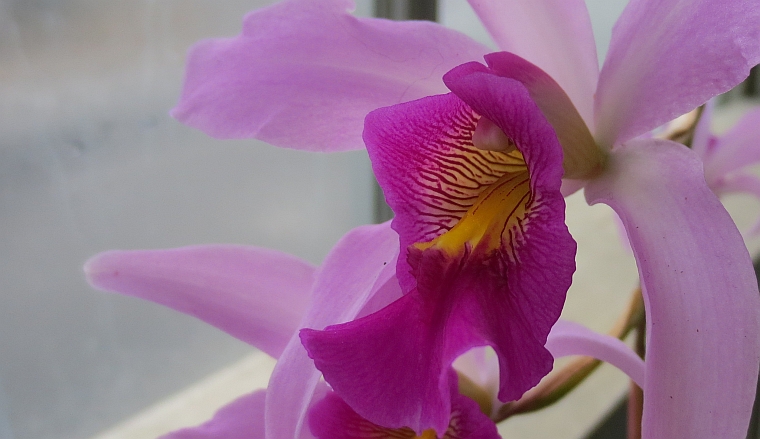
My idea of heaven is a garden like this in the middle of winter. It contains within it the hope and promise of healing, the calming salve of beauty, and the invigorating air of wonder. It is, for me, one of the only places of peace that is easily accessible, where you can find pockets of solitude in the hidden corner of some leafy canopy, shielded from watchful eyes behind sweetly-scented sprays of orchid blooms. As a fine warm mist fell from above, we breathed in the gloriously humid air, our senses already relaxing and letting go, becoming one with the environment once more.
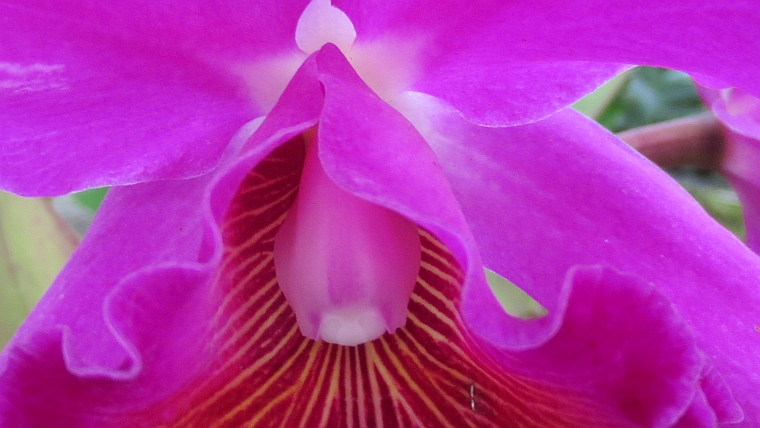
Whenever I feel the tug of Winter heavy upon my heart, and I yearn for something to free the pent-up feelings of house-bound life, I seek out a garden of some sort. This one was worth the longer trip, and it will see me through a few more weeks of snow and ice. We lingered there, taking it all in, basking in this glass-walled oasis of tropical paradise.
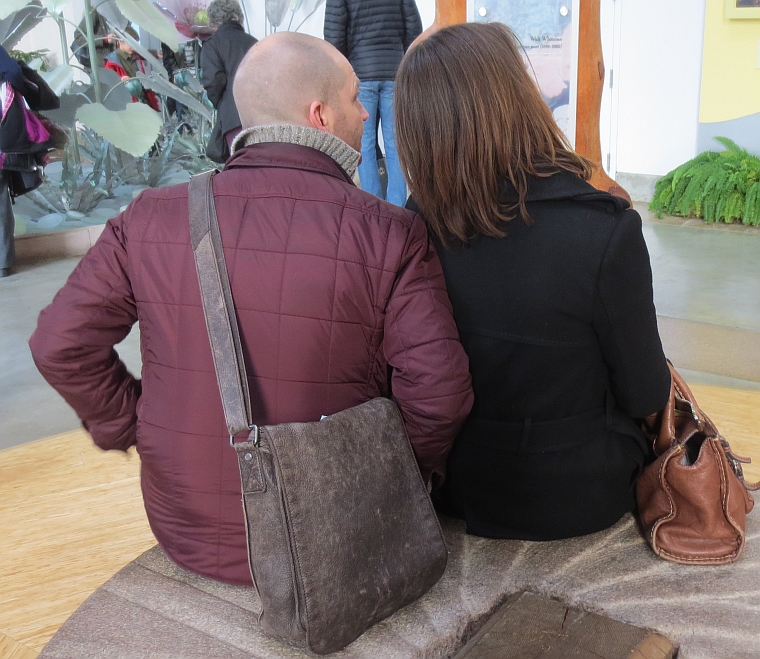
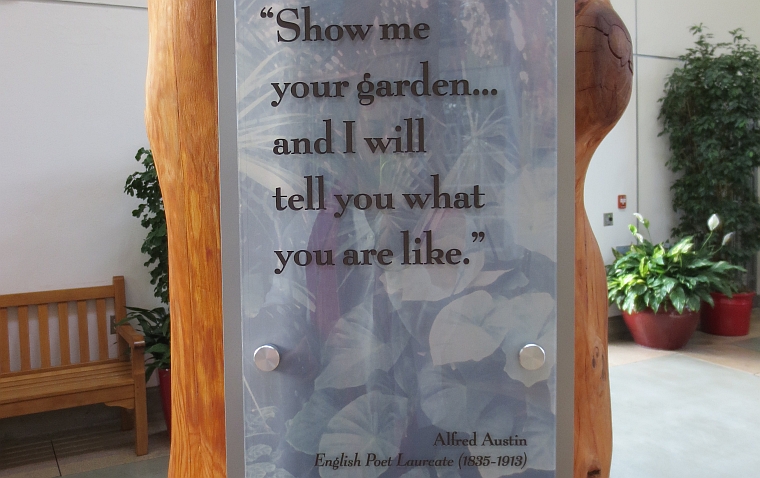
There was more goodness in store for us, as Darcey had gotten tickets to that evening’s performance of the National Symphony Orchestra at the Kennedy Center. Art and beauty have a power all their own – not unlike friendship and love – and somehow I had started to forget that. It felt like I had come to this place for some very important reasons. For now, though, it was the simple message of a garden, making itself heard even through the bleakest of Winter.
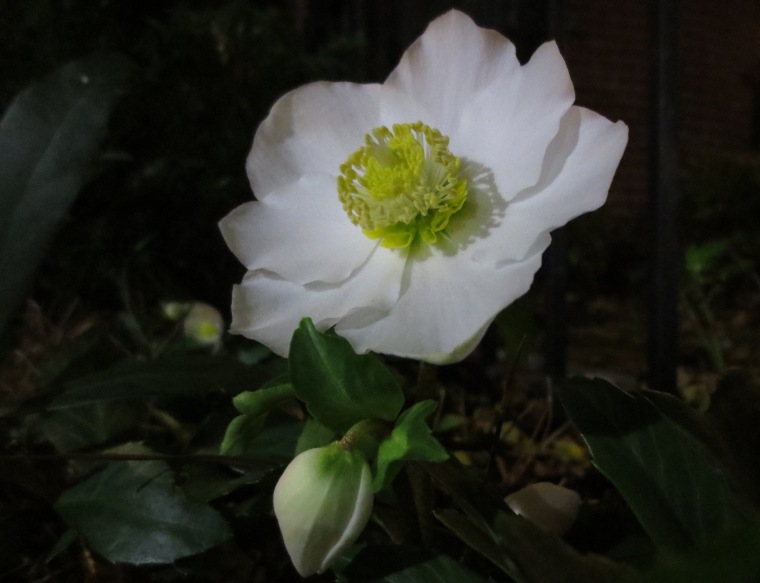
This beautiful white blossom is from the plant commonly known as the Lenten Rose – but it is also called a Christmas Rose in some parts – which for this season, and for this particular flower – is more apt. I saw this on my last trip to Boston, and swore I heard it crying out on a November night, hanging on to the last bit of warmth from the sidewalk, shrinking into its Brownstone-backed corner, and valiantly putting on its last show in the spotlight of a street lamp. I’m not sure it will still be there when I return to Boston this weekend, but I’ll keep an eye out.

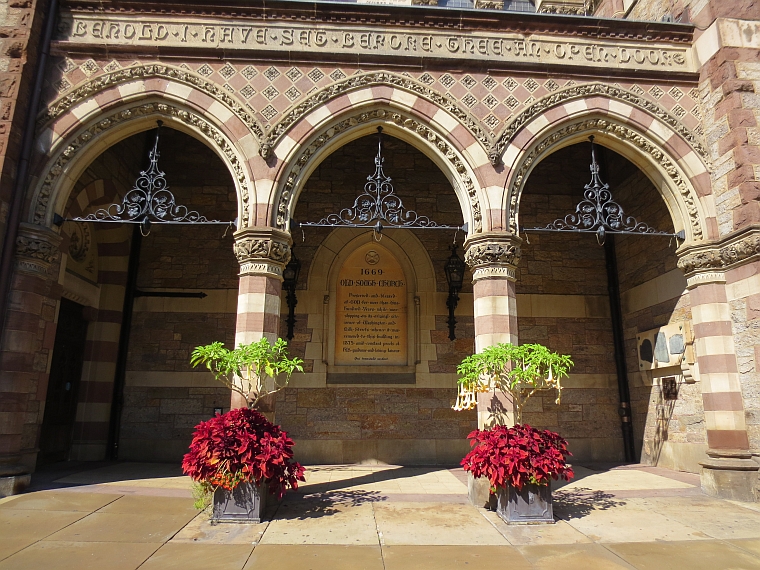
On my last trip to Boston, I passed by this church, and as pretty as it was, I was more transfixed by the two Brugmansia plants potted at its entrance. More commonly known as Angels’ trumpets, these are tropical plants that don’t survive the cold New England winters, but can be brought into a warm garage or unheated basement for the winter months, then brought back out to create the amazing show that is seen here. I once kept a couple of these, in enormous pots, that grew to be about seven feet tall. When they bloomed in summer, their fragrance filled the night – the variety I had gave off a heavy lily-like lemon scent that pervaded the entire backyard. It was especially nice for late-night swims, when the perfume seemed to cling to the water’s surface. I got lazy one year and left them outside in the winter (those pots, and the attendant tree-like trunks that they eventually develop, were not easy to move up and down stairs) so we no longer have any, but I’m tempted to try them again. It takes a year or two to develop them into the tall specimens you see in this photo, but it’s a wait that’s worth it.
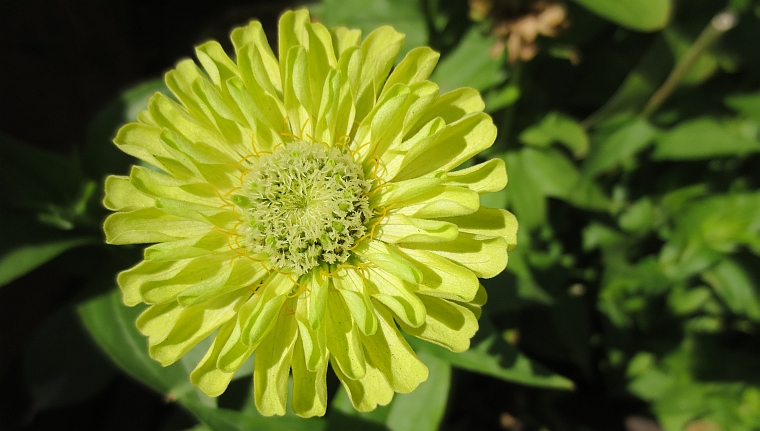
After a certain point, when the danger of frost is in the air, I give up on the blooms of the season. There’s too much trouble and heartache that comes from investing in a fresh head of hydrangeas that stubbornly refuses to hurry things up before they’re wilted by a ruthless night of freezing temperatures. That said, I also appreciate when a fine bloom has not yet gone to brown shriveled mush, as was the case with these examples in Boston. I am especially enamored of the lime green zinnia below. Zinnias hold a childhood place in my heart, but for some reason I rarely grow them. Next year I may try my hand at them once again. Next year may be an old-fashioned return to the riotous annuals of the past. Next year… is a long way away. We better just enjoy the show now at hand. When it comes to annuals, nothing is promised.
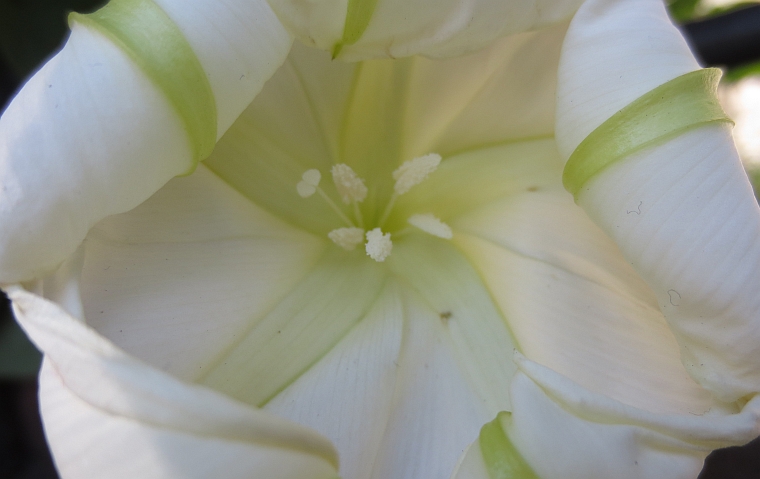
The same holds true for the fading moonflower seen below – at least I think it’s a moonflower. I passed it at the height of the day and couldn’t be sure. I like how it’s just slightly past its prime, curling in on itself and leaving the world with the barely-glimpsed artfully-recoiled curvature of petals in decline.
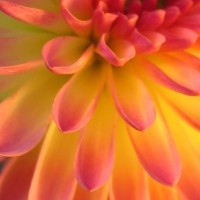
Looking as if it were lit from within, this dahlia’s coloring, and the late afternoon sunlight slanting through it on a Fall day in Ogunquit, combine to create a spellbinding effect. I grew dahlias for only one year as a child – the endless waiting for them to come into bloom was too much for my impatient heart to take, along with the fact that at the very height of their bloom the frosts came to take them out. While they have some of the most beautiful flower forms and colors, they are just too high-maintenance for me. I would never have the discipline to bring in the roots to over-winter, nor do I want to be bothered with the staking that the tallest and most striking ones require. But sometimes, at this time of the year especially, I’ll eye the neighboring yards with envy as I see the spectacular show that these plants save for the tail-end of the season.
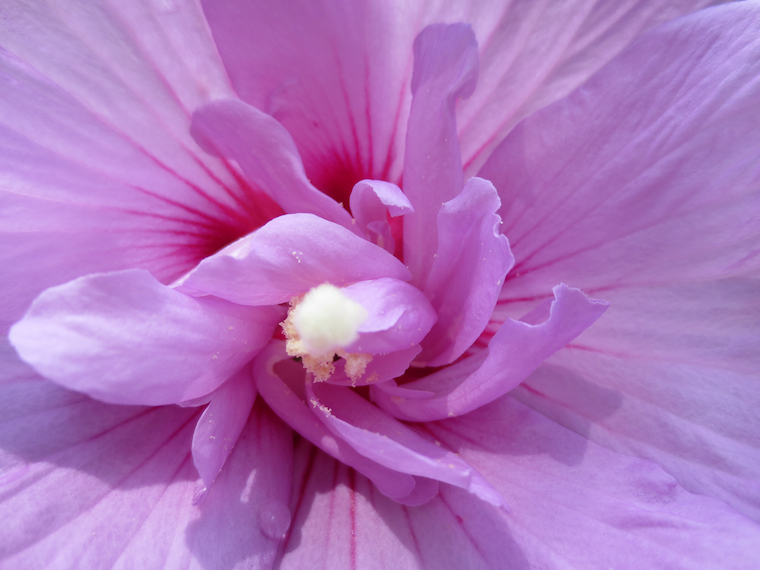
The last blooms of the season are somehow always more resonant. They may not be as flashy (though these may give argument to that) but there is something about the impending demise of the garden that gives them more import and urgency, thereby lending an impact that might otherwise be lost. At any other point in the Summer, blooms as soft as these would pale next to the hot-hued yellows and oranges that dominate the high season. They seem to have waited along with their neighbors – the Seven Sons’ flower, the Sweet Autumn Clematis, and the Bluebeard – to make their presence felt at the most precious and opportune time. I like a plant that knows the value of good timing. I like a person that knows that even better.
This is my current summer fragrance – Grand Neroli by Atelier – as seen surrounded by a few sprays of a wild sweet pea (fresh from the garden). This cologne has the distinctive orange blossom scent of Neroli, that is both light and delicate enough for summer. I debated getting Eau d’orange verte by Hermes, but held off on that due to reports on poor sillage. I may try their Eau de Pamplemousse Rose next June, but since we’re almost into July the rose cusp has long since passed. It’s better to be ahead of the curve than behind it.
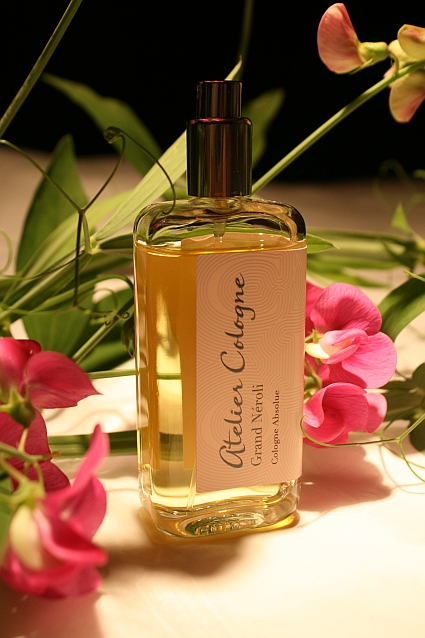
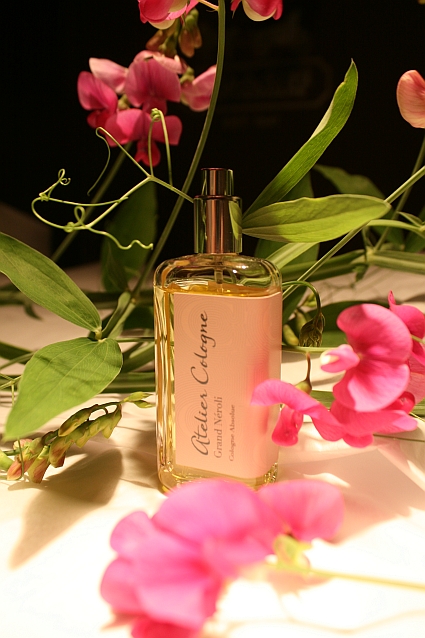
Much like Lee Bailey’s substituting Digitalis for delphiniums, this was the closest I could get to Tom Ford’s Neroli Portofino from his Private Blend series (and about one third of the cost). Mr. Ford’s version of Neroli is the only one of his Private Blend series that I would consider a good fit in the summer months – the rest of that line is too wonderfully rich and heavy, in a good way, but far more suited to Fall or Winter. In the summer I want my cologne to be light – the heat can be heavy enough. Coupled with the hefty price tag, Ford’s heavenly fragrance will have to wait.
It turns out that Atelier’s Grand Neroli is more than a fine substitute, and may actually be preferable to TF, considering its lighter touch. I don’t know why, but Neroli reminds me of various summer moments – the sound of cool, trickling water in an otherwise-silent space, the still bedroom in Boston as the sun slants across the floor, a sweetly-scented blossom floating in a snifter of water. The moments are half-remembered, half-imagined – like so much of summer seems once it’s passed. For now, it’s just begun.
Lilacs were one of my favorite flowers growing up, and remain so to this day. The aroma alone is enough to conjure memories of fresh Spring days, the promise of summer, and romantic entanglements worthy of Gatsby himself. Almost everyone has a lilac memory, a time when a row or hedge of the pastel flowers crossed our Spring paths, seducing all in their fragrant embrace. Like peonies, they are pungent and long-lived, instilling themselves in our past, emblazoning the moment with their perfume.
There is an essence both of innocence and romance in a lilac, and in their short-lived season of bloom, a wistful sense of fleeting wonder. I’ve read of new varieties that promise a decent re-bloom, but I’m partial to the old-fashioned stand-bys, where the true fragrance consistently remains. We’ve got a double version given to us by Andy’s Mom, which I’ve grown to love. The doubles also seem to hide the browning edges better than the single version. It is also powerfully fragrant, which will always be the most important part of a lilac.
I’ve also planted a couple specimens of the Korean lilac – a smaller, bushier version with a slightly later, and longer, bloom time. Though the blossoms are decidedly smaller, and erring on shades of pink rather than lavender, there are quite a few more of them, and their scent carries closer to the ground.
A hint on using lilacs as a cut flower: pick them in the middle of the night, or the very earliest of morning, then smash their stems to allow them to pull up as much water as possible. They may droop a little, but should come back if given a few hours to recover. The fragrance can fill a room with memories.
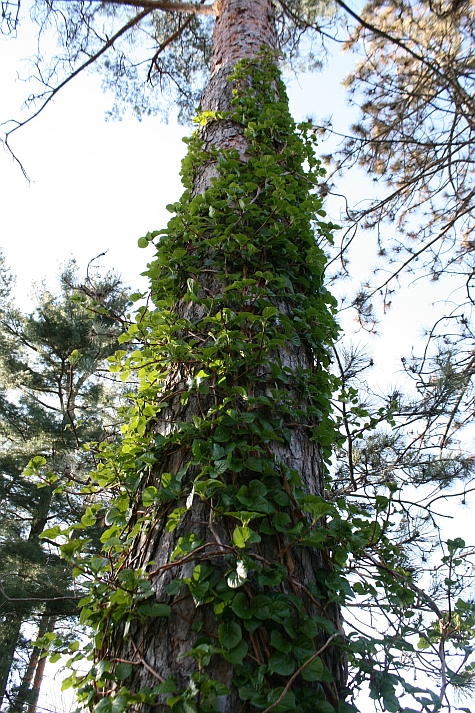
When Andy and I first bought our home eight years ago, one of the first things I planted was a climbing hydrangea. White Flower Farm once featured the vine on the back of its Spring catalog and I was completely enchanted by its form. They had it growing along an old stone wall, and showed it in full, glorious bloom. I didn’t dare attempt to plant one against my parents’ white brick house, but once I had my own backyard I nestled one in against a towering pine tree with a thick trunk. It was a tiny thing, maybe a foot tall at the most, and it looked so small against the mighty pine. Part of me thought it wouldn’t make it through one winter, but I gave it some manure and hoped for the best.
Then the wait began. Like many vines, the climbing hydrangea more or less adheres to an old vine-rhyme: The first year it sleeps, the second year it creeps, the third year it leaps. Luckily, patience is one of my virtues, and though visitors looked at me oddly when I excitedly pointed out the little creeper beside a monstrous pine, I knew one day it would reward me for waiting.
Each year I added another layer of manure and mulch to the growing mound surrounding the vine, and slowly that vine inched upward. Religiously, I watered through the dry summer spells, and gently redirected wayward shoots back against the bark of the pine. By its fifth year, it was taller than me, and had wound its way around the entire circumference of the tree.
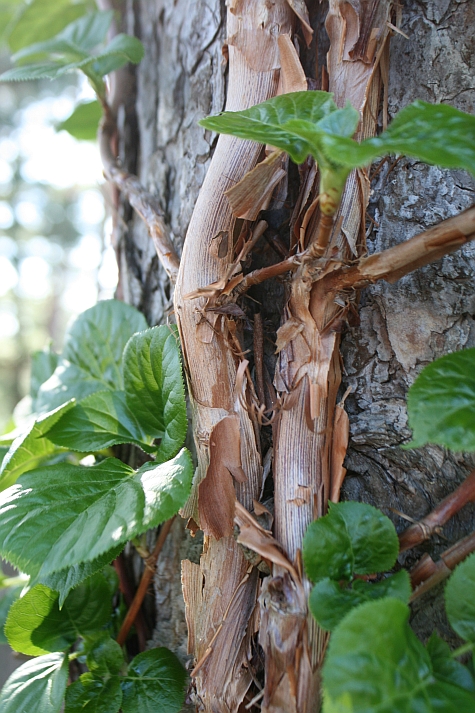
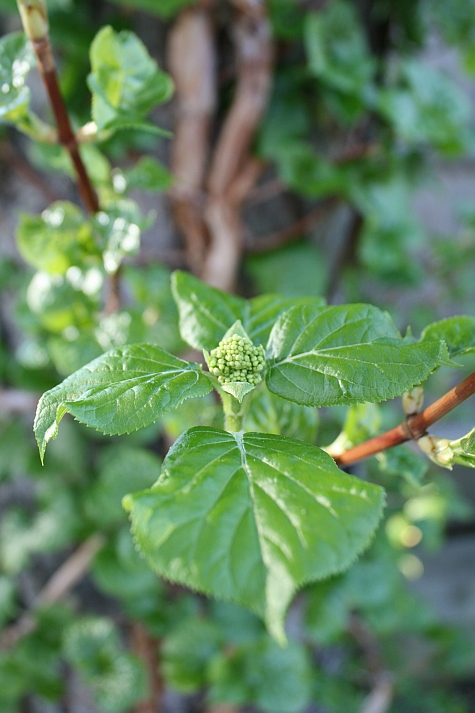
About that time it also started to flower – delicate cream-colored lace-caps that were sweetly scented with the essence of summer. The fragrance was a complete surprise. There had been nothing in the literature about it, and I assumed that, like most hydrangeas, there was no fragrance to speak of, but suddenly there it was, intoxicating the bees and everyone else who happened by.
Today, the vine towers above all, reaching upwards of thirty feet (about half-way up the sky-high pine tree that has happily provided an anchor for it all these years) and it’s still growing higher. It cloaks the ancient bark of the pine with an elegant skirt of bright green leaves that retain their luster and color throughout the season, before brightening the Fall with a final blaze of yellow. They have helped each other – the pine providing an expansive length of sturdy support and the hydrangea lending the worn, dull bark a bit of colorful glamour (and the jolt of manure-fueled nourishment that would otherwise be missing). I can’t imagine one without the other, and together they make a beautiful pair.