Category Archives: Gardening

Happy World Naked Gardening Day!

If ever a non-holiday had an awkward-sounding name, this is it! Welcome to World Naked Gardening Day. This spin-off of guerilla gardening, it was created by Mark Storey and Jacob Gabriel, who have since steppe into the shadows of promoting it, but it’s taken on a life of its own because being naked in the garden is part of our Adam and Steve DNA.

Since our gardens are a bit behind this year, and the pool is still closed, I won’t be frolicking in Adam’s original outfit in real time (I know, such a lost opportunity…) However, in keeping with the spirit of things, I dug out (get it, like with a garden spade?) some old photos of nakedness near the garden because it’s always fun to join the celebration. 


“Do you, good people, believe that Adam and Eve were created in the Garden of Eden and that they were forbidden to eat from the tree of knowledge? I do. The church has always been afraid of that tree. It still is afraid of knowledge. Some of you say religion makes people happy. So does laughing gas. So does whiskey. I believe in the brain of man.” –Clarence Darrow

{See also these posts: World Naked Gardening Day 2016, Getting Naked to Get Happy, Birthday-Suited Butt BoyNaked and Sunny Counter-Programming, Birthday Suit,  My Ass, My BallsStormy CounterprogrammingBirthday Suit Mayhem.}

Continue reading ...

When Six Is Just Right, But Feels Like Too Much

The first time I ever ordered bulk mulch delivered to our home was a number of years ago. After speaking with the person in charge of the delivery, we decided that two cubic yards would more than suffice. We don’t have a huge yard, but much of it is landscaped with gardens and various patches of shrubs and trees. That first year, when the truck arrived and dumped it in our driveway, I was happy to think of all the trips to Lowes I’d otherwise have had to make, bringing four or five bags of mulch home at a time, sometimes having to make a few trips in a single day. As glad as that made me, I was also somewhat daunted by the enormity of two cubic yards of mulch. I was also surprised by how quickly it went, and how much more I actually needed.

A number of years passed since that happened. I’ve been amending the gardens gradually since then, buying a bag or two here and there as necessary, but this year the ground was bare enough to merit another delivery. Unfortunately, the memory is fallible, especially mine of late, and the one thing that I recalled more than anything else was not the enormous amount that two cubic yards was, but rather how we didn’t have nearly enough. So I ordered six this time.

If you’ve ever ordered mulch or know how much that is, you are probably laughing at me right now. I would be too. It’s absolutely laughable, as was my horrified look as the truck dumped out an amount of mulch that would fill the entire inside of our house about three times over. Now, I rarely get overwhelmed. Even when I should be, I usually don’t feel it. But as I walked outside and was greeted with a wall of mulch that went up to my head, I felt it. Overwhelmed.

The first thing I did was to consult the weather calendar, because if it was going to rain anytime in the near future, I’d be screwed, and I needed to know if I was going to have to find some make-do tarp to cover it from water. Luckily, the skies showed clear for at least three days. I could do it in three days, I thought. Turned out I could do it in two afternoons, but I’m paying a bit of a price. 

My body is aching.

My muscles are sore.

My hands are worn.

And I haven’t felt this good in forever.

Bonus: I got it all down before the snow fell again. 

Continue reading ...

Spring Pokes Its Head Out of the Ground

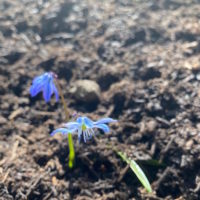
It was cooler than I realized, yet still spring arrived. The backyard was downtrodden with the weight of winter. The brown and dead leaves, matted down and trampled by wind, snow and squirrels, lay flat beneath my feet. The ground was still frozen in most parts.

Our Lenten rose, with us since the year we first moved in – 2002 – poked its mauve head out from a layer of tattered leaves, with veining the shade of rhubarb stems. The color of summer, strange and welcome at such an early date. I surveyed the area for places where a fountain bamboo might go. This is the year we go about replenishing the specimens we lost a while back in a magnificent if deadly wave of flowering.

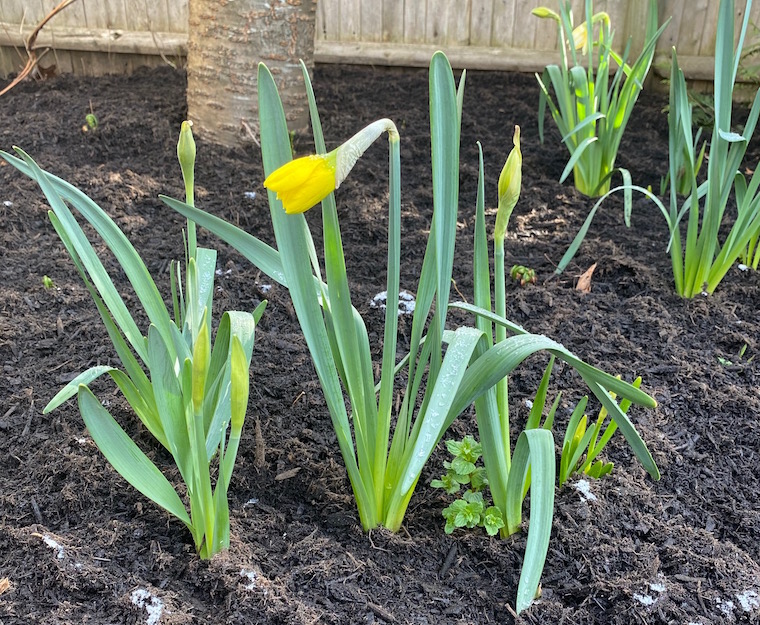
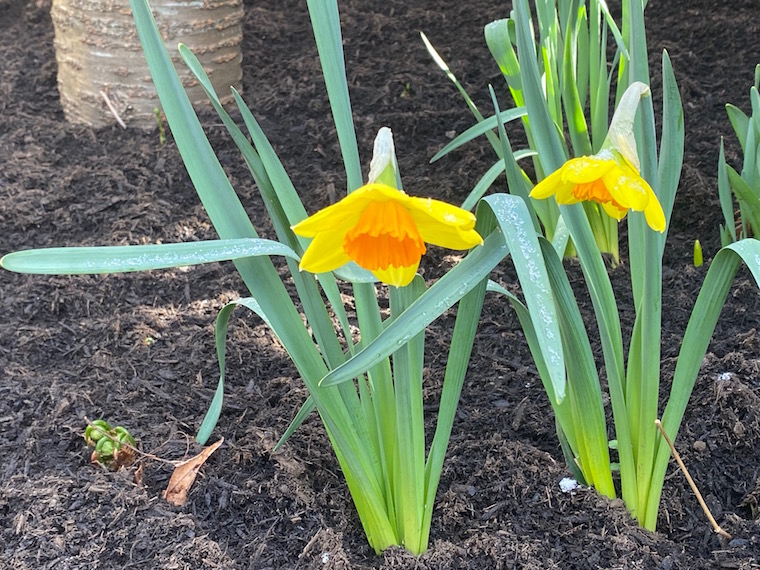
In a sheltered microclimate beside the garage, a group of narcissus was already in bud. Earlier than any other year, they were a happy sight to behold, unexpectedly pleasant, as I always forget which bulbs I planted in the fall and where. For a while, I was usually too pooped and exhausted to do any sort of fall bulb planting. By that point I was already hunkering down and putting the garden to sleep, too far ahead in my winter mindset to be bothered. The past few years, however, I’ve had a late-season second-wind, and each spring I’m glad I did. I should probably mark where they are, but there’s something more enjoyable about having it be a surprise. So few things are spoiler-free these days – we must take the joy where we can find it.

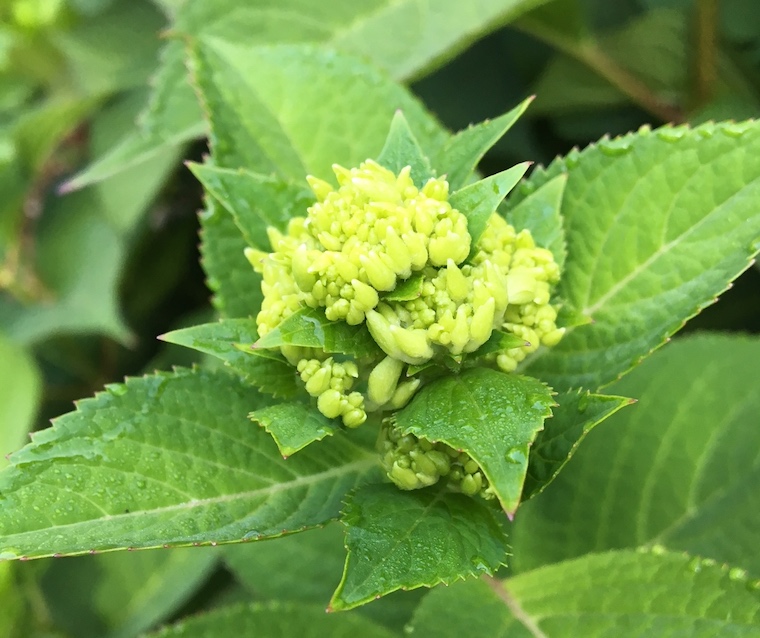
Mostly the tasks to be done in this early stage of inclement weather consist of surveying and planning. When the sun warmed things a bit I managed to prune the front yard hydrangeas, and I’ve managed to remove the old soil and dead roots from the backyard pots. Baby steps for the infancy of the season, and with snow due it’s best not to get too far into anything.

Continue reading ...

Paperwhites on Parade

They were a bunch of runts. The forgotten and discarded. I’d almost given up completely on them, not intentionally ~ neglect by omission, and is there anything worse? Even destruction in the name of anger has merited some bit of emotion. Being forgotten is a more terrible fate. It implies you never mattered in the first place.

Luckily, in this instance it wasn’t too late. They called to me in the garage, with bits of green and the smallest swords of cream emerging from the top of their papery brown bulbs. Maybe it was the emerging leaves of an early fig tree that reminded me of forgotten things. Whatever the case, I found the bag of paperwhite narcissus bulbs just in time, then planted them in some gravel, watered them well, and then they instantly grew, quicker and faster than their predecessors did back in the fall. They weren’t quite as high, but they smelled just as distinctly, their perfume a potent reminder of the past, their blooms gathered in bunches of sterling stars. It wasn’t too late after all ~ a lovely reminder for those of us lacking in patience and too ready for rash motions.

So many lessons in life come from the garden, even if the garden is a glass bowl of gravel and a forgotten bunch of papery bulbs.

Continue reading ...

Fig Life

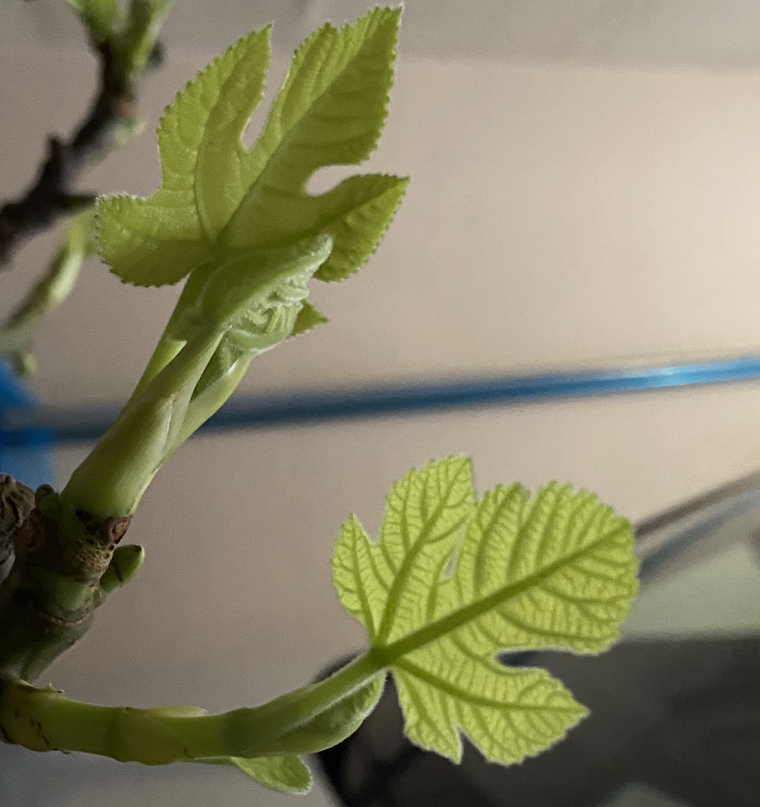
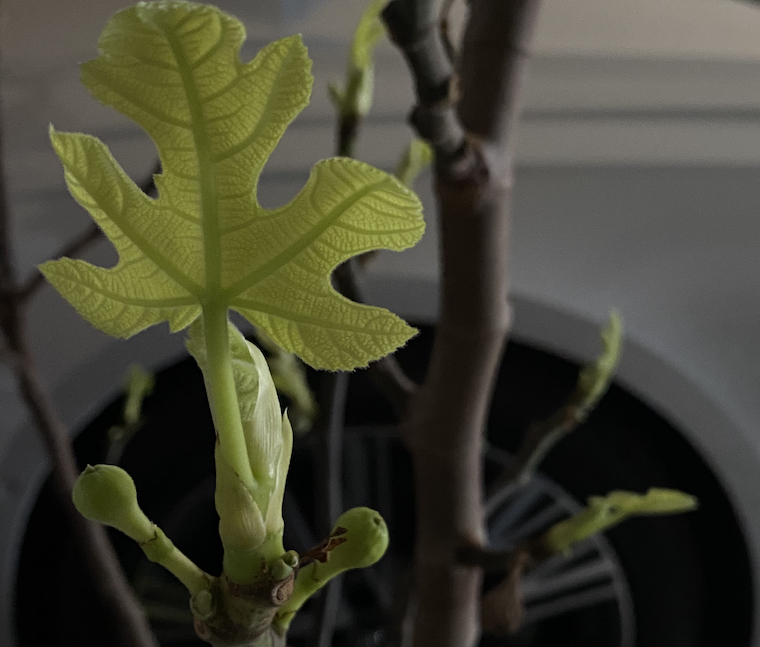
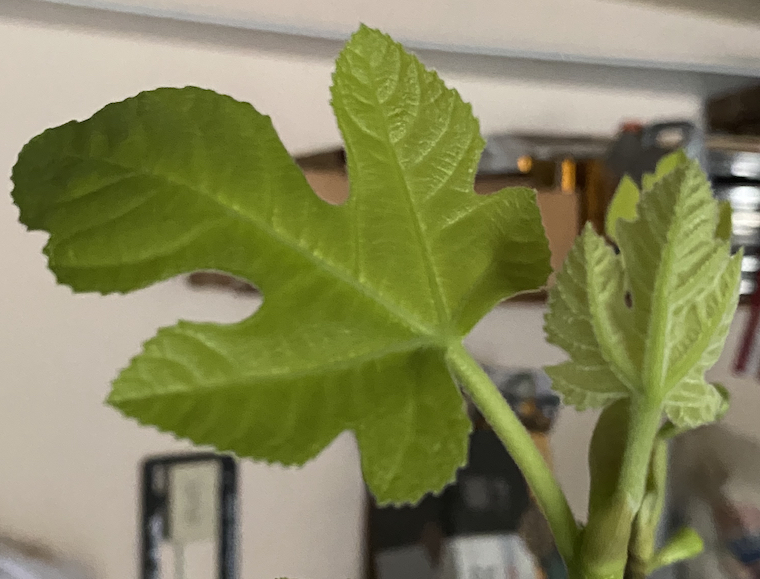
Andy pointed it out a few weeks ago – the smallest ray of hope in a dark winter – when the buds of our fig tree began swelling. On the bare branches of the dormant plant I overwintered in the garage, the first signs of life were becoming apparent. While the brown turkey fig was reportedly hardy as far north as Zone 5, our specimen had done so well last summer that I didn’t want to risk it. Some winters are more brutal than others. Without a proper snowcover, and considering the roller-coaster of temperature extremes we’ve had, it was a wise decision. Within the unheated garage, our little fig tree got its necessary period of dormancy – a rest period to recharge and rejuvenate for another season of fig-producing glory. As we neared the end of winter, it suddenly leafed out with the warm spells we’ve had of late.

That dormant period, in which a plant rests, is like a resetting of its mission. Many errors and mistakes can be forgiven with enough time and contemplation. Yes, this was an early start, maybe too early. With the celebration comes a warning – a tease filled with tension. Global warming, brutal summer, decaying winter. Still, there is no prettier shade of green than the delicate chartreuse that first greets the burgeoning light, and at a time when we are so desperate for spring, my heart jumped at the new signs of life.

If our little fig tree could survive our winter of neglect (I barely bothered to water it, afraid it might rot) then perhaps another spring might reinvigorate all sorts of malaise. I studied the beautiful tiny leaves that reached for the lone window in our garage, admiring the plant’s resilience, the way it drew upon the reserve of its roots and branches, bare though they be. There was still life here, it was only slumbering until the necessary nourishment and coddling brought it back to its former glory. Hope remained. Spring waited. Beauty rested.

Continue reading ...

The Return of Fargesia

Hints of spring, courtesy of a shadowless groundhog, put me in the mind for a look to the future. We’re coming up on breaking the hump of winter, and this is the shortest month of the year to boot. One of the most exciting prospects of a spring to come is the return of Fargesia nitida, a clump-forming bamboo that is as functional and hardy as it is elegant and beautiful. For the past couple of years, this bamboo variety was finishing up its devastating once-a-century blooming wave, which kills off the plants in a widespread massacre. Our two specimens were part of this mass flowering extinction, much to our sadness and regret, but what luck to witness the once-in-a-lifetime flowering of the fountain bamboo. Now that the event is over, it’s once again safe to plant new bamboos, as the next flowering won’t happen for another hundred years. 

It’s good to look ahead. While I’ve been trying to live more in the moment, in the winter a light ahead certainly helps, and I do better when planning and looking forward. For the gardening trajectory this year, there will be a lot of editing and paring down, a great deal of cutting back and opening spaces up. Since we’ve moved in we’ve done a lot of filling in, and the plants have taken a liking to where they are and are encroaching on living space. It’s lush and full, but I’ve come to appreciate light and air and space and expanse, something that can only be conjured through some judicious pruning and cutting back. That also means we will be making some room for a few new additions. I expect some losses due to the continuing cycle of heaving we’ve had of late – freeze and thaw, freeze and thaw – which is not good for the gardens. Fortunately, we are looking for extra room for a few Fargesia nitida bamboo plants, as well as some new roses for Andy.

The thoughts of bamboo swaying gently in a summer breeze, and leaning into the perfume of a precious rose, are enough to see us through the difficult days.


Continue reading ...

The Flames Before the Slumber

Our garden has just about gone to bed, but not before burning up the landscape in the afternoon sunlight. Here you see the once-magnificent stands of the cup plant, shriveled and dried to a dull brown. The fountain grass is still putting on its show – a show that will run throughout the rest of the winter, with feathery seedbeds that have risen ten feet in the air – texture and architecture dominating what will be the winter garden. 

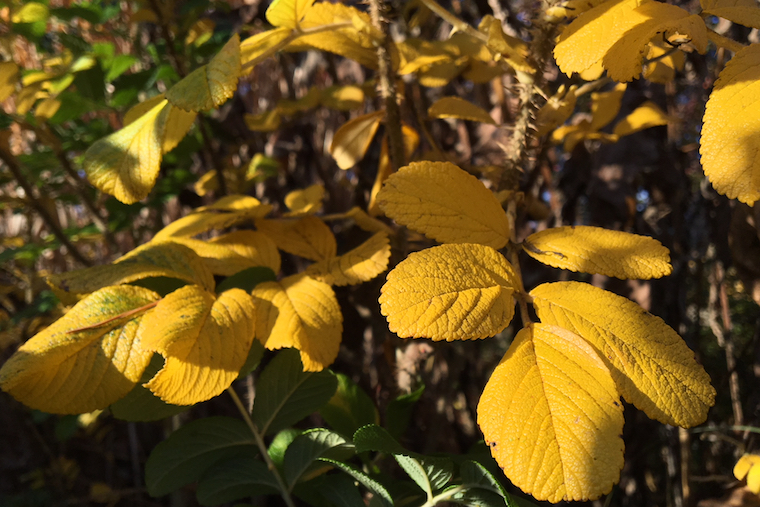
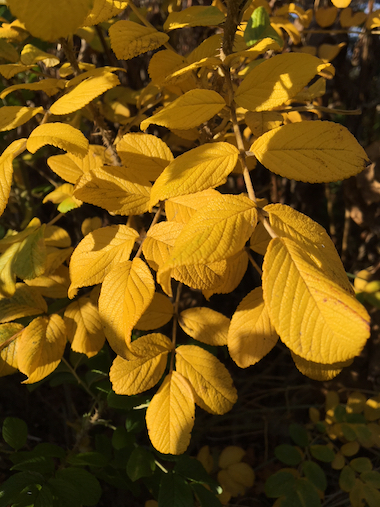
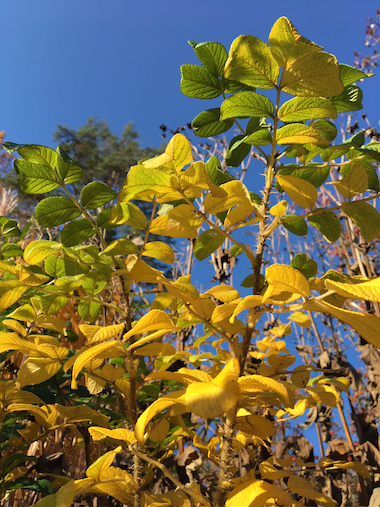
The bright yellow foliage of the Rosa rugosa continues to go strong as well, lighting up the lower tier, and there are still quite a few fruits left on the dogwood, despite the insistent and daily visitation of a relentless band of squirrels. I’m not quite ready to say goodbye, but it’s time. 

Continue reading ...

Rose & Thorn, Flower & Leaf

The rose is full of surprises. For those enamored of its beauty and scent, approach too close and be bloodied by the thorns. For those who dismiss its floral show as all it has to offer, behold the brilliance of its autumnal mantle. This is Rosa rugosa, a rugged little seaside beauty that not only offers florals and fragrance, and hips that change from green to persimmon in pretty pomegranate-like fashion, but this late-season session of fireworks erupting from its foliage. 

Unlike the fading pale prettiness of this coral bark maple, Rosa rugosa has much sturdier leaves. They can take a bit more cold, transforming into the fiery, canary feathers you see here. Catching the sunlight at this time of the year can be a tricky bit of business, but Rosa is an old-hand at doing the impossible. And a magnificent one at that. 

Continue reading ...

Catmint vs. Catnip

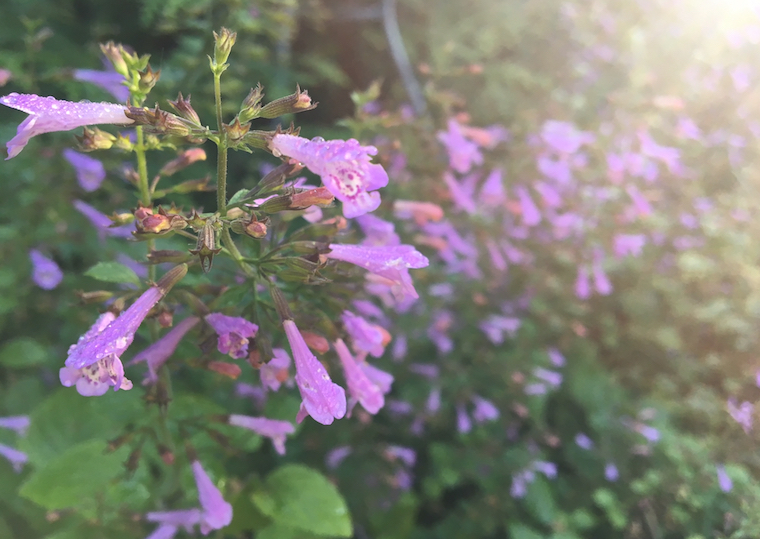
I love how our stand of catmint didn’t get the memo that summer is almost over, gracing us with this delightful late-hour show of blooms on a recent dewy morning. I’ve long since forgotten which variety of Nepeta this one is – I planted it as a whim a few years ago and it has since seeded itself everywhere. If we had a cat it would be in high heaven.

It’s a unique shade for catmint, veering more toward the reddish section of the color wheel than your typical catnip flowers. The foliage is also more green than gray. Its late, and extended, blooming season is a boon to those of us feeling seasonal fatigue. As much as I love summer, I understand that the gardens need a rest. Until such slumber, these little flowers will give us cheer. 


Continue reading ...

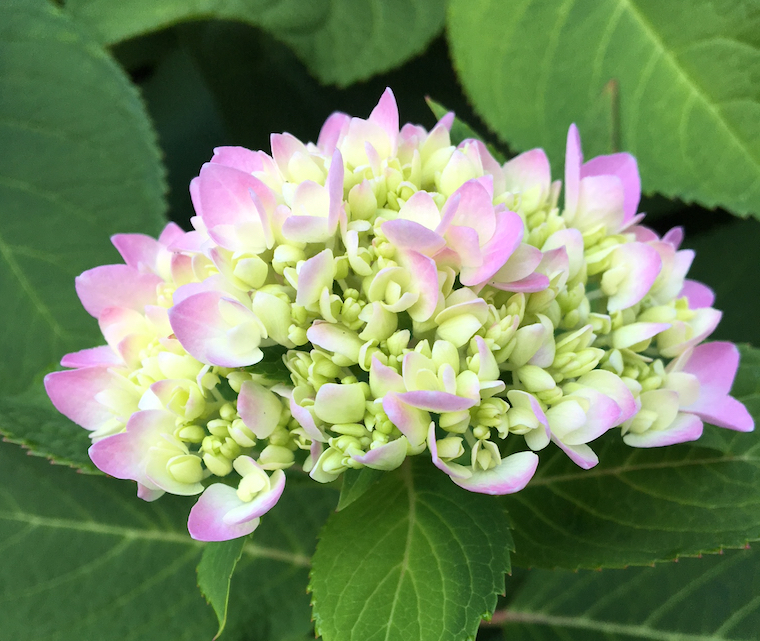
The Race to Bloom

There’s a tinge of sadness when I see the hydrangeas sending up new blooms at this time of the year. It’s a crap shoot for whether they will all make it before the first hard frost hits. Most of these should flower before we get there, but there are those that don’t. In the past I’d try to bring them inside, to save a few like we did with green tomatoes, but not anymore. There is a time and place for everything to slumber, and that cycle, forged and refined and perfected by Nature herself, will not be hijacked by my endeavors. Still, there is sadness when buds are on the brink of being felled, and I may cut them if words of a frost carry on the wings of night.

The garden often gets a little second wind at this point when summer’s heretofore relentless heat and haze gives way to a crisp, cool alacrity that seems to snap order back into the proceedings. It’s as if suddenly everything is aware that the season is coming to its close, and goes about putting on one last show. The colors are more vibrant, and though the blooms are usually smaller and secondary, they carry stronger hues and deeper shades. The lower light works in tandem to show them off at their most expressive. It’s something that can’t be produced in the high-sun days of July or early August.

That almost makes the end of summer worth it.

Almost.

Continue reading ...

Angels With Fragrant Trumpets

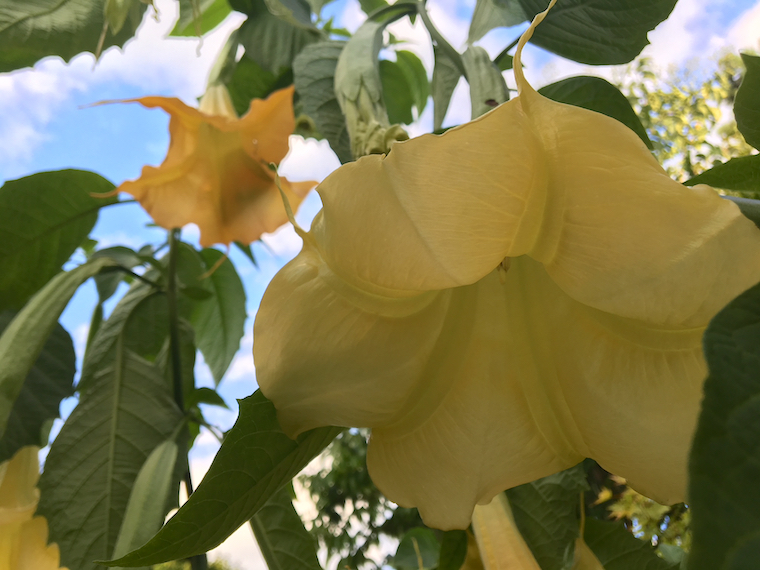
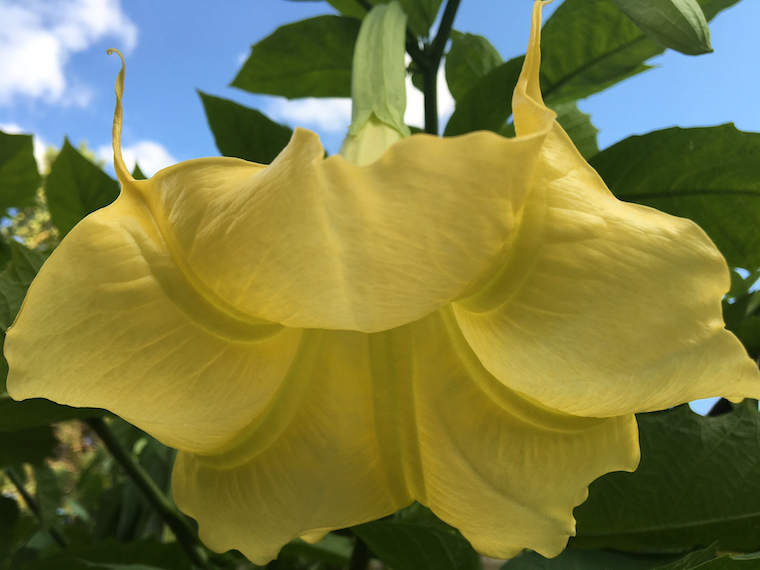
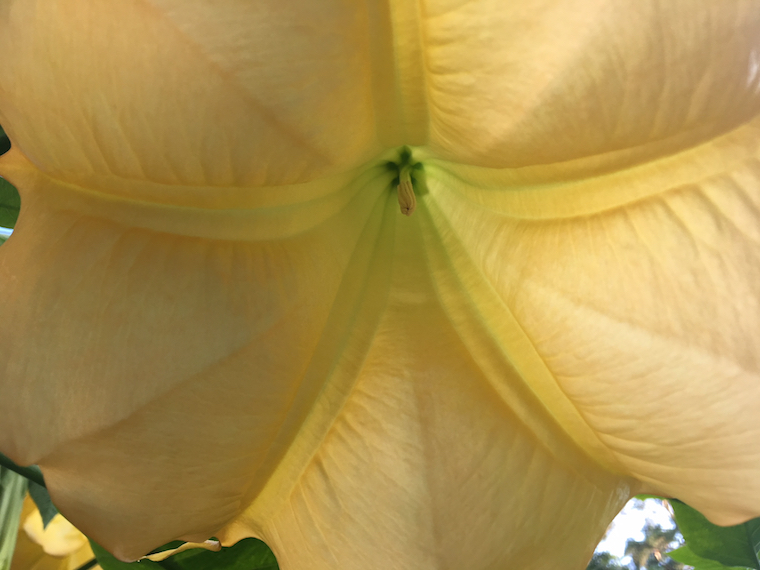
After the sluggish start to spring, I wasn’t sure if our Angel’s Trumpets would bloom while it was still nice out, but these two specimens have been putting on a glorious concert over the past few weeks, dangling their fragrant trumpets and filling the backyard with their perfume. It is the quintessential scent of summer, one that brings me all the way back to our early days together, when I started a few plants in a guestroom at Andy’s old house. They struggled inside, but once they could get out into the warmth and sun they took off and put on an astounding show.

They usually take a year or two to really get going, which makes overwintering them a necessity. I tend to pot them up every few weeks and let them go as high as they want. Our relatively short growing season will force them to top off between six and ten feet, and right before the first hard frost I’ll cut them down to three feet or so and bring them in.

While they took their time, these have gotten the tallest we’ve had, which makes them a bit top heavy and one was just felled by some of the crazy storms we’ve had of late. They are so heavy that right them is no easy feat, and I added a few large rocks to their pots in the hopes of keeping them grounded. The few branches that broke off will be put into some water to see if we can get some new ones started. Eventually they will outgrow their pot, and rather than root-prune and repot, I’ll have hopefully started a few new ones to take over the mantle of summer perfume.

Continue reading ...

The Voluptuous Fig

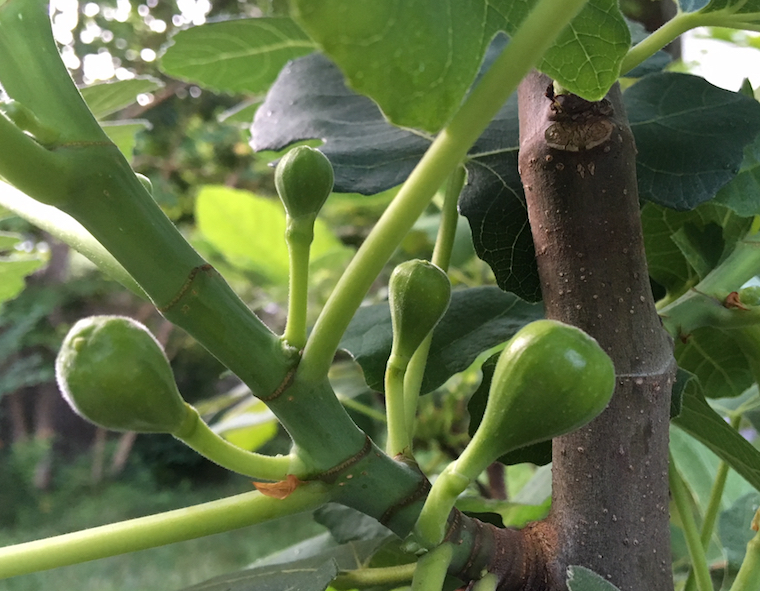
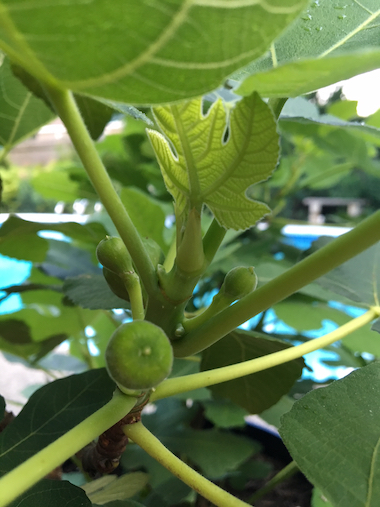
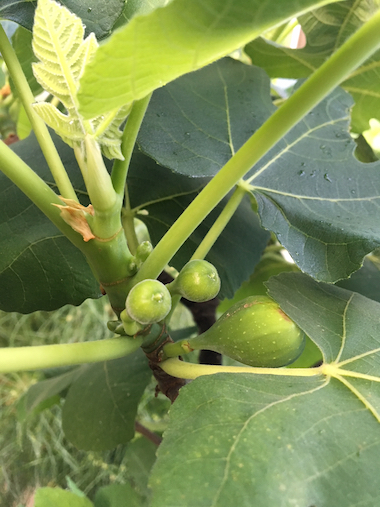
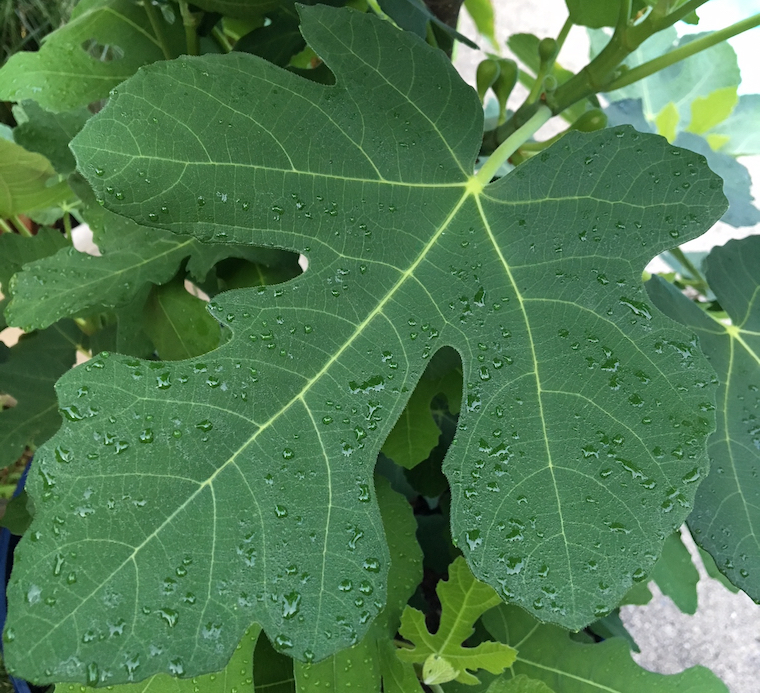
Behold, the brown turkey fig, which is reportedly hardy to parts of Zone 5. This is the first time I’m attempting to grow figs, and this particular specimen is making a grand first impression. It’s done so spectacularly this summer, I’m not going to risk losing it by pushing its survival rates in the winter of Zone 5. We’ll be making room for it in our unheated garage, where it will hopefully survive the winter there to put on an even better show next year.

This variety doesn’t need pollinators – the fruit just appears, first as a tiny little bulbous thing at the end of a short stem, after which it slowly swells into something that thus far is approaching what the ones in the store look like. The handsome foliage is enough for me – if these fruits come to, well, fruition, that’s just the cherry on the sundae. Or the fig on the frosting.

As can be seen, there are quite a few on the way. I hope they hurry up and ripen soon – a bowl of fresh figs smothered in honey and maybe some crumbled goat cheese sounds like the perfect summer snack. As pretty to see as they are sweet to eat…

Continue reading ...

Facing A Moral Dilemma, I Choose Beauty (and Evil)

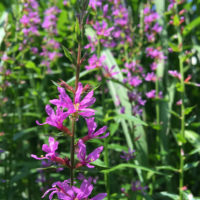
This is one of those times when I’m going to tell you to do as I say, not as I do. (Further proof that one doesn’t need children to be contradictory.) It was the summer of 1992 when I first learned about the bane that is the noxious purple loosestrife. At Brown University, my summer biology course at the Roger Williams Zoo was teaching us that most zoos were switching from simply holding animals to teaching the public about conservation and how to preserve the natural world. At the time, purple loosestrife was taking a stranglehold of the northeast, where it was choking out natives in wet wildlands. A trip along the Thruway heading south proved it – a constant flash of bright purple marked most of the roads in mid to late summer. At the zoo, it was taking hold of any place where there was moisture, and we were asked to pull it up whenever we found it. I wasn’t about to do their weeding for them, but it made an indelible mark upon my mind, and from that summer onward whenever I saw it somewhere I would shout out, to whoever was listening, there’s the dreaded purple loosestrife. (Suzie got the biggest, and probably only, kick out of it.)

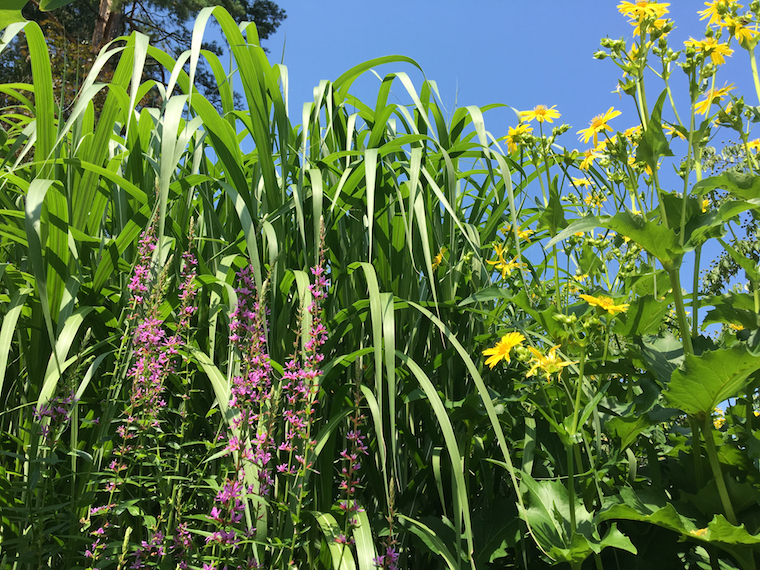
As an invasive species, purple loosestrife is a danger to our native plants and habitat. Scientifically known as Lythrum salicaria, it was, for a brief period of time, sold by nurseries because its long blooming season and striking color made for a perfect perennial. I still remember a spectacular garden border at a friend’s house – I actually went there more for the garden than the company (sorry, Eric). Next to a sky-high stand of Heliopsis was a clump of Lythrum, and together they formed a glorious backdrop for bees and butterflies to pollinate and charm. I ordered one from White Flower Farm – the variety was ‘Morden’s Pink’ and they claimed it was not as invasive as the typical form encroaching on our highways. Eventually they stopped selling it when it joined the invasive species list.

Now, this is the part where I reveal my moral failings. (One of them, anyway.) Two years ago, a little bird must have dropped a seed of loosestrife in our garden. Whether it came out of its mouth or ass, I couldn’t tell you, but soon a little loosestrife plant was growing. I wasn’t sure what it was at first – the foliage of a young plant is rather handsome, and the stems were fleshier and more substantial than most of the weeds I knew. It looked somewhat refined, so I let it go. As it matured, I thought it looked like a lythrum, so I kept a careful watch on it as WE ARE NOT SUPPOSED TO GROW THEM HERE.

As summer progressed, it grew tall and high, and sent up those gloriously-hued flower spikes. I had a beautiful but dangerous specimen of purple loosestrife in my garden. But it was so pretty, and worked so well beside the cup plant and in front of the fountain grass that, to my continuing shame, I kept it. I even pampered it, sprinkling liberally with water whenever things got too dry. It just works too well to pull it out – providing the perfect spot of color at a time when most things are pooping out. I will also dead-head it and make sure no seeds form to prevent its spread, I promise, and the moment it moves just one inch beyond its allotted space, I will tear it down. For now, I’m enjoying its beauty and coming clean for my conscience.

I repeat, DO NOT GROW THE PURPLE LOOSESTRIFE.

Do as I say, not as I do.
Continue reading ...
Happy Cup

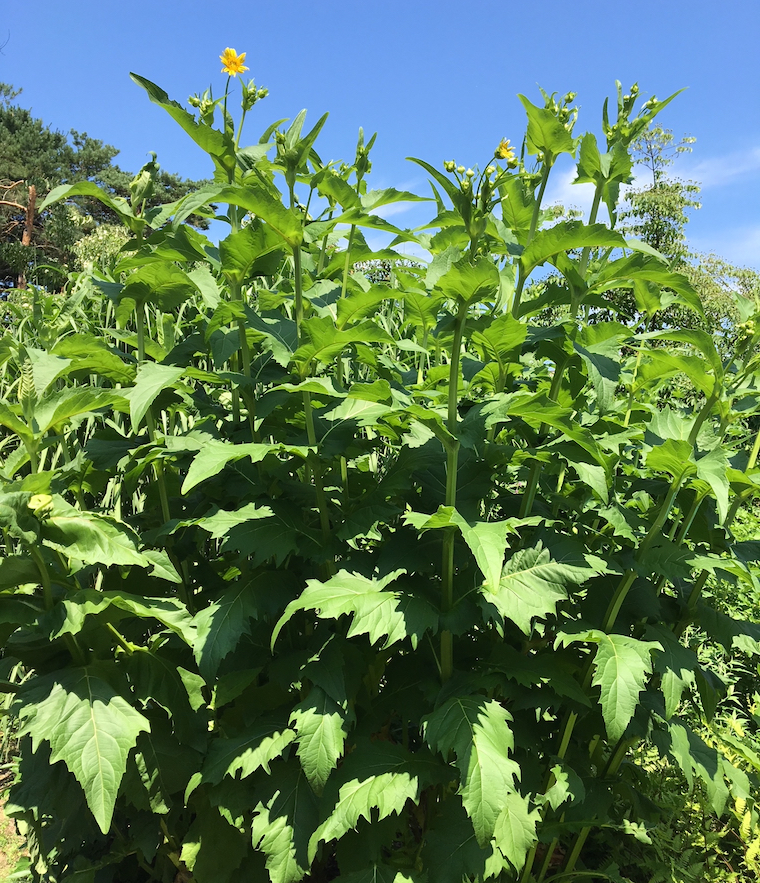
One of my favorite plants came into bloom last week: the cup plant. This year it’s making a grand show, thanks in part to last year’s preparation (lots of manure and water) and this year’s wet spring. I’ve also given them lots to drink as the air has gotten hotter and more dry, so they are rewarding us with enormous stalks (these rise to eight or nine feet, towering above my most strenuous reach) and a liberal sprinkling of flowers.

These are one of the happiest garden features we have, not only for the sunny disposition of their bright and cheery daisy flowers in pure yellow, but also for the neat cups their leaf axils form to collect water, allowing birds and butterflies to drink while visiting the flowers. The set-up is especially attractive to a regular crew of yellow finches, whose color mirrors that of the flower petals, eventually lending the impression that some of the blossoms themselves are detaching and taking flight. It’s a magical effect. The birds are especially fond of the seed-heads once they begin to ripen, often not waiting until they are fully formed before trying to pull them off.

I’m happy to have them take their fill ~ the minor drawback to the plant is that in location and conditions it likes, it will reseed and soon set up plants where you may not want them, so the early editing of the finches is a welcome bit of help. Based on the cup plant’s eventual immense size, it is not fit for most front-of-the-border positions, which is usually right where the seeds end up. Those are easily dispatched if caught early in their growth cycle, so it’s not very onerous ~ just requires an observant eye and some persistence. On good days I exhibit both.

Continue reading ...

Before the Ostriches Burn

Though the Ostrich fern is one of the hardier (some might say invasive) varieties of fern, belying their elegant and delicate appearance, they still have points of vulnerability. This is especially true if you are bending their preferred environment. Most ferns appreciate some shade, and more than a little moisture, but the Ostrich fern will put up with a fair share of sun and heat, provided you keep its soil on the wet side.

We have a large stand of them that gets most of the morning and midday sun, and after amending the soil with a healthy layer of manure in the very early spring (before the fiddleheads appear, ideally) the best way for them to prosper and put on a show is to keep them very well-watered. This is more of a preventative action than corrective. Even in the best circumstances, these ferns tend to naturally die back in late summer. They will, however, succumb much earlier if conditions are hot and dry, and once they start down that path it’s impossible to change course. What works better is preventing it from starting for as long as possible, which means regular and heavy watering during those hot and windy days. Since we have them in a pretty prominent location, I’ve been doing my best to keep them watered and happy so they remain pretty as long as possible. Yet another instance where prevention is the best possible cure. You just have to start early and trust.

Continue reading ...