Category Archives: Mindfulness

Awakening to Awareness ~ Part Two

“We see people and things not as they are, but as we are. That is why when two people look at something or someone, you get two different reactions. We see things and people not as they are, but as we are.” ~ Anthony de Mello

 One of the first courses I took at Brandeis University was for a science requirement. Back then I thought my path to a career was via science, particularly something in the realm of biology. Upon promptly failing the first (of only four) exams, I soon realized science was not going to be my calling. Fortunately, when handing out that first exam the professor explained that those of us who did not do as well as we would have liked [sheepishly raised hand before realizing it wasn’t a question] still had a chance to do well in the course, as the final grade was also based heavily on improvement.

The class was titled ‘The Brain: From Molecules to Perception’ and went from the molecular level of brain functions to how we actually perceived all these messages we were getting. After my initial freak-out at the first failure, I refocused and stayed for extra help in the next few weeks, raising my next effort to a ‘B+’. By the last two exams, I was getting perfect scores, and my final grade ended up being a solid ‘A’ thanks to the trajectory of improvement. (There was really nowhere else to go.)

The point of that trip down memory lane was that perception of most messages may begin on a molecular level, but somewhere along the way it gets muddled by myriad influences – experience and history and assumptions – and the end result is not a literal, factual interpretation of things as they are, but as how things seem to be. And it’s different- often wildly different – from person to person.

So much of what we perceive of the world is filtered through our own prisms, and though we may transform them into pretty rainbows or shattered dreams, they are only our perceptions – and in most cases they are misperceptions. It’s hard to think about such an idea, because it means rethinking about almost everything. It’s worth the effort though, because once you begin to do that, all future perceptions become easier to process -and what seems difficult and painful isn’t as bad as you think. Again, this takes a major shift in how to deal with everything that comes at us, but if someone as stubborn and self-righteous as me can make the attempt, then anybody can. And it’s already making my life easier, and much more enjoyable.

“Happiness is our natural state, Happiness is the natural state of little children, to whom the kingdom belongs until they have been polluted and contaminated by the stupidity of society and culture. To acquire happiness you don’t have to do anything, because happiness cannot be acquired. Does anybody know why? Because we have it already. How can you acquire what you already have? Then why don’t you experience it? Because you’ve got to drop something. You’ve got to drop illusions. You don’t have to add anything in order to be happy; you’ve got to drop something. Life is easy, life is delightful. It’s only hard on your illusions, your ambitions, your greed, your cravings. Do you know where these things come from? From having identified with all kinds of labels!” ~ Anthony de Mello

{See also Awakening to Awareness: Part One.}
Continue reading ...

Awakening to Awareness ~ Part One

“We don’t want to look, because if we do, we may change. We don’t want to look. If you look, you lose control of the life that you are so precariously holding together. And so in order to wake up, the one thing you need the most is not energy, or strength, or youthfulness, or even great intelligence. The one thing you need most of all is the readiness to learn something new. The chances that you will wake up are in direct proportion to the amount of truth you can take without running away. How much are you ready to take? How much of everything you’ve held dear are you ready to have shattered, without running away? How ready are you to think of something unfamiliar?” ~ Anthony de Mello

Book recommendations from friends I admire are some of the greatest gifts this world affords. For the most part they work out beautifully, because my friends have great taste (with the possible exception of the occasional item of clothing or a perm here and there). Word-wise, my friends can usually tell what sort of story I’ll enjoy. Such was the happy circumstance when Mary pointed me in the direction of Anthony de Mello and his book ‘Awareness’ which is really a written form of the lectures he gave over the years. Its message dovetails perfectly with all that’s been going on in my little life, as well as how my life fits into the larger world at work.

A significant melding of Christianity, Buddhism and Hinduism, ‘Awareness’ takes the most primal and basic tenets of all religions and excises the problematic notions of separation and literal readings, as well as the coded and human-warped ways of worship, returning to the essence and core of what love is and who God might be. More specifically, it offers a way to freedom from the binds of illusion and labels and our own unhappiness.

The tools on offer here are simple enough, but figuring out how to use them, and to implement that use in our lives, is the difficult part. Not all of us are looking to change. We hold onto illusions because they’re pretty and comfortable and ingrained into our beings from the moment we can begin to mentally formulate the world around us. Such things are woven into our make-up, and that’s not easy to change. But there are ways to do so, and it begins with being aware – truly aware – and taking stock of ourselves in as honest and blunt a way as possible. If you’re not ready to truly examine your life and all your own failings, then you may not get very far, but the knowledge and instructions are there if and when you’re ready. I’m doing my best to continue on this journey, and it’s definitely improved my life.

There is so much good stuff in the book that I’ll excerpt a few passages at a time and turn this into a mini-series. We’ve got the time, I’ve got the notion, and there’s no need for any further commotion.

“When your illusions drop, you’re in touch with reality at last, and believe me, you will never again be lonely, never again. Loneliness is not cured by human company. Loneliness is cured by contact with reality. Oh, I have so much to say about that. Contact with reality, dropping one’s illusions, making contact with the real. Whatever it is, it has no name. We can only know it by dropping what is unreal. You can only know what aloneness is when you drop your clinging, when you drop your dependency. But the first step toward that is that you see it as desirable. If you don’t see it as desirable, how will you get anywhere near it?

Think of the loneliness that is yours. Would human company ever take it away? It will only serve as a distraction. There’s an emptiness inside, isn’t there? And when the emptiness surfaces, what do you do? You run away, turn on the television, turn on the radio, read a book, search for human company, seek entertainment, seek distraction. Everybody does that. It’s big business nowadays, an organized industry to distract us and entertain us.” ~ Anthony de Mello

Continue reading ...

Moving My Meditation

My meditation journey began in winter, just in the nick of time. It has prepared me for the nightmare in which we all find ourselves, or at least given me a place of grounding when the world is falling apart outside our home. The first few weeks, in small sessions of just a few minutes at a time, I saved it for the end of the evening, usually after my shower and before I went to bed. It was an ideal way of preparing for slumber: setting the scene for stilling the frantic pace of a day

I grew into the habit, elongating the meditation into fifteen minutes – still a small window compared to, say, a freaking monk – but more than enough to lend a new calm to my routine. (My plan is to slowly expand to half an hour by the time summer ends and I need an extra dose of calm.)

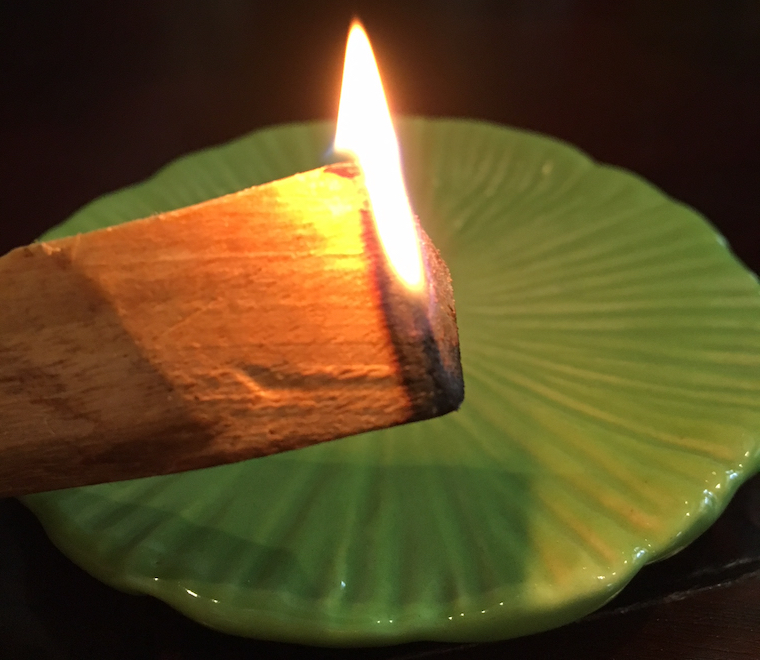
Coming after dusk descended, the darkness was softened by candlelight and the glowing embers of a stick of mystical Palo Santo wood. I enjoyed these sessions in the dark, hidden away from the world cloaked in the night, swaddled by the warmth of rose quartz in my palm. I also recognized that my enjoyment was partly because it was becoming a ritual, and as a Virgo, I like ritual. Part of my journey of late, however, has been in allowing change to happen without freaking out or fighting against it. Such as in learning to work from home with the current state of the world. As much as I know it’s the best and safest thing to do, and I’m completely in support of it, I would much rather work in the office. It has taken some adjustment. That’s where moving my meditation came into play. After logging in and working a full day on my computer (which is literally burning up these days in another bout of perfect timing), I found myself feeling more stressed and nerved up than had I actually been in the office. It was an untenable but necessary circumstance, so on the second day of the new work-at-home schedule, I moved my daily meditation to right after the work day ended. 

There was still light in the sky – lots of it – and the living room was bright and welcoming. I’d forgotten that while darkness could be soothing, light could be uplifting in a different and sometimes grander way. I close my eyes when breathing deeply and going through my meditation, so light or dark made no big difference. What was new was the line of demarcation between work and home life, even as they melded into their shared location. It was a distinctive period of decompression that brought me back to the peaceful atmosphere our home usually provides. 

The magic of meditation – it’s a real thing. And a good thing. 

Continue reading ...

The Unmindful Shower

Far from the serenity of mindful meditation, a recent shower reminded me that not every moment can be mindful and not every morning allows for meditative moments. It was an average weekday, and I had to get into work a little early, so I basically bounded out of bed and into the shower. Any notion of a mindful shower, had it even crossed my mind, would have proved an impossibility. As it was, I didn’t have much time for anything besides wetting my hair and dampening down the bed-head. Some mornings are like that, and you realize almost too late that you missed an opportunity for beauty and appreciation and simple gratitude for existence.

I’ve been more guilty than most of missing the grandiosity of the smallest, most mundane efforts of an average day. I don’t chronicle the ride to work, or the fleeting lunch break, or even the triumphant scheduling of a dinner out. I miss the inherent beauty of the simple tasks of a person’s life. Lately, I’ve been opening my eyes to the beauty of these things, mostly because I feel the fleetingness of time, its incessant ticking, its ongoing tocking. Someone told me recently that many men go through a freak-out between 57 and 60 years old. I’m not quite there yet, and quite frankly I was hoping to have averted another mid-life crisis, but it seems I have yet another thing to which I can look forward and dread.

As I turned the shower off, it dawned on me that I hadn’t been mindful. I hadn’t appreciated or honored the moment, mostly because it was impossible. Well, not impossible, just not practical, and it would have disrupted the schedule of the day. Some disruptions are unavoidable, some aren’t. I promised to do better the next time, which would simply involve getting up a few minutes earlier to allow for a mindful start to the day. That makes a difference.

It takes time to make habits like mindfulness part of one’s daily existence. I’m still learning. Still working on it. Still trying. And tomorrow I’ll do better.

Continue reading ...

Losing Myself in Meditation

As a novice to the whole meditation scene, I’ve begun slowly and in small, short, and easily-accomplished sessions, starting out with a few minutes of deep breathing and gradually increasing the time I sit in silence. I’ve been setting the timer phone feature for 13 minutes, as that’s a good number for me – long enough to reach a genuine state of calm within the limited parameters of a busy day, but not long enough to cause discomfort. Sitting in the lotus position for an extended period takes some acclimatization.

The hybrid practice I’ve adopted is to turn off all the music and noise, lower the lights, light a candle and some Palo Santo incense, then hold a smooth piece of rose quartz in my hands as I gently allow my gaze to ease and focus on the intake and exhalation of breath. In the beginning I simply count – one breath slowly in, one breath slowly out – and repeat the process until any shallow breathing has deepened and slowed.

Then, with each breath going in, I’ll focus on whatever feeling or emotion or thought comes up, and let it pass by as I breath out. It works best when these things are acknowledged and recognized, honored and respected no matter what form they take. That means things like sadness and sorrow and loss and envy and anger and impatience all get a breath in and out. Each has its moment of recognition. By this point, the length of a breath is of decent duration, and every pleasant and unpleasant visage that rises receives its due. Then it floats away. As I’m told is the trick with ghosts, simple but genuine acknowledgement is enough to allow even the most uncomfortable thoughts to pass. The goal here isn’t to solve any problems, only to recognize their presence, spiritually nod to them, and let them continue on their way. It’s ok if they come back – sadness and sorrow visited me more than once in recent days, and I had to sit with them a little longer.

I will go through the events of the day, allowing the emotions that surfaced their time in the light of awareness, and it’s amazing the power such light carries. It doesn’t change or alter what it touches, but it somehow works to ease the mind of the burden of keeping them all in darkness, shadow and silence. In that respect, it’s part mysticism and magic, and the only thing I know is that at the end of a meditation period I feel calmer and more relaxed. Part of it is due to the physical act of focusing on deep breathing, part of it is the clarity and cleansing of thoughts, and part of it is something I can’t quite explain just yet. I just know it works.

As I mentioned, this is only the start of my meditation journey. I don’t know how long it will last or how far I will go, but I’m hopeful, and it’s already helped. The last time I meditated, I started the stopwatch and went into my method. Midway through, I felt the discomfort of sitting, but worked by breathing through it and letting the thoughts of pain rise and fall. Eventually the breathing won out and the discomfort passed. I could feel myself moving deeper into a meditative state, and I kept up honoring whatever feelings or thoughts of images came up, until time and clock and time again came up in my mind, at which point I snuck a look at the phone and saw that I had pressed stopwatch instead of timer, and I had clocked in at 17 minutes. It wasn’t very long at all, but it was longer than 13, and felt like the natural time my body and mind needed. Maybe this is how a greater sense of peace begins. I’m going to need it when the earth shifts into Mercury in retrograde on the 17th. We’re all going to need it.

Continue reading ...

Words Are Useless, Especially Sentences

One of my favorite classes at Brandeis was a spring semester course on Buddhist Art. In truth, I had no business taking this course,  it had nothing to do with my English degree, and wasn’t even of particular interest to me. Despite this, the description made it sound like a peaceful and almost spiritual experience, and that called to me more than anything else. It was also a time in my life when I was seeking calm. Still entwined in a romantic relationship with a woman, and just starting to question and make sense of my sexuality, it was a tumultuous time for the heart and the head. I was desperately seeking serenity.

A spring semester takes place largely in the winter. At least, that’s where it begins, and the beginning – in those first weeks of snowstorms and weather battles – is what remains most salient. Much of this course involved looking at slides in a darkened amphitheater and listening to our instructor explain the various meanings of the motifs in what we were seeing. One assignment involved going to the Museum of Fine Arts and perusing their collection of Buddhist art, which was not an arduous assignment in the least. I soon learned that connecting the historical aspects of a work of art, and bringing my own personal take to what the scene was conveying, earned me the best grades. Such flowery prose was well within my wheelhouse, and turning art into words was a challenge I embraced. That makes this post somewhat problematic, as it’s a testament to a world beyond words.

As someone who has loved and lived for reading and writing since I was a little boy, it pains me a bit to write this post. I used to think that all things could be solved or least understood when put into words, when analyzed and reconstructed through language and communication. That’s not always the case. Sometimes you simply have to feel.

As human constructs, words and language were always going to be limited in the end. There would always come a point when they didn’t matter. The hard underlying truth could only be fathomed through our five senses, and sometimes it could only be felt on an emotional level that was somewhat spiritual, somewhat emotional, and somewhat mystical. There is room for magic in this world, and magic cannot be contained by words. Neither can enlightenment or meditation.

I’m slowly learning that the best and most effective forms of meditation are not accomplished with a background of Tibetan flute music or the ringing of a prayer bell or even the intoned om of a chant – they are done in complete silence, when the only thing heard is the breath. That is in stark contrast to the bombardment of sounds and sights in our current world. For as long as I can remember I’ve tried to distill that chaotic bombardment into words to make it palatable and easier to digest and understand. I’ve tried to take the confusion of my own mind and flesh it out here and there – online or on paper – to make some sort of sense out of things, to write it down as a form of therapeutic exercise, and it has indeed helped. It simply isn’t everything, and that’s why I’m learning to turn to silence to find a greater peace, and a better understanding.

That said, and that written, I still believe that when used properly and genuinely, a few well-chosen words can change the world. We just need a little something extra to change our hearts.

Continue reading ...

Essence of Palo Santo

Scent and smoke are ways of connecting the spirit to the body, and the body to the atmosphere. From smudging a home to spritzing on some Tom Ford Private Blends, we have continually used fragrance to enhance our surroundings, and sometimes it becomes something deeper. This is Palo Santo (Bursera Graveolens) – a South American tree that translates as ‘Holy Wood’ and has been used as spiritual incense for healing all sorts of ailments. 

I tried it for the first time a few days ago, and to be completely honest it wasn’t an instant favorite. It wasn’t entirely off-putting, it just had a thread of something I didn’t immediately love, an element of the faintly medicinal, not unlike the first time I smelled the creosote bush after a rainfall in the desert (which I eventually came to love). I switched back to my favored Tibetan cedar wood incense sticks for a week of mindful moments, wherein I worked on mindfulness and meditation. Maybe that changed something in me, because when I returned to try the Palo Santo again, I found its fragrance pleasant and calming. Its purported benefits are certainly worth a second sniff, so I’m glad I didn’t give up on it. Some things deserve a second chance. 

Continue reading ...

The Mindful Shower

These have been a challenging few months for me, and I’m doing my best to work through things that stretch back decades. Throughout this journey, however, I’ve attempted to take things one little step at a time. Focusing on the end result or the larger picture had previously been my modus operandi, but lately that has failed me. And really, that’s no way to go through life. You end up missing out on the present moment, all the little day-to-day, minute-to-minute joys that you could, and perhaps should, be savoring. I don’t want to rush through it all just to die at the end wondering what the hell happened. In an effort to be more present, I’ve been looking into mindfulness and meditation as a way to calm the rush of our daily life. That begins with learning to appreciate the beauty and the gratitude in the mundane. My introduction to that philosophy is just taking place, as I’ve started reading ‘The Miracle of Mindfulness’ by Thich Nhat Hanh. One has to begin somewhere…

In the first chapter, the author goes into the idea of ‘washing dishes to wash the dishes’. The act was the goal, and the focus should be solely and completely on the act itself – not the idea of getting to sit down and rest afterward, not on the image of a completed pile of dishes done and dried and put away. It should be a simple act of being wholly present and inhabiting the moment. Unsure if I could find such peace in dishes, I put a different spin on it and tried to make a mindful shower.

It was after a restless night of troubled sleep. Awakened by an ice storm, and the tiny pings and ticking of ice against the windows and roof, I thought of being more mindful and putting the troublesome burdens that weighed upon my mind into the background. With the electricity going on and off a few times, and the repeated hammering of ice on the windows, it felt like our home was under attack from outside forces. I’ve always been sensitive to such attacks, and they’ve filled me with unease. I decided to try some mindfulness to get out of that muck.

For the next few minutes, I would focus only on the shower, wishing mindfulness for myself, as well as all others, sending out a wish into the universe that everyone taking a shower feels the same connection to the moment. I wasn’t sure I could be that empathetic, or if it would feel as false and hokey as I thought it might, but as I stepped into the warm stream of water, I did my best to wish wellness to everyone else. A hot shower is a luxury I’ve never taken for granted.

I rolled the soap in my hands, paying attention to the resulting foam, the way it started awkwardly then turned smooth and easy. For the first time, I stood there and actually felt the warmth of where the water was hitting me. I connected to it, and a few worries were displaced by the feeling. Tilting my head back, I felt the warmth roll over my face and neck. Wetting my hair, the water immersed me completely in its heat. It traveled down my shoulders and back, rounding my elbows and running down my arms. I turned and felt it travel over my lower back and butt, racing down my legs and splashing about my feet.

The conditioner in my hair smelled of green tea and cucumber. It was a pleasant scent, one on which I never really focused much. It had only ever been a way of making my hair easier to comb. On this morning, I made note of its texture, the way it smoothed out every strand of hair, and how sweetly it smelled. I felt its silkiness as I massaged it out with streams of warm water. What indulgence exists in such heat and sensual pleasures. This wasn’t some obscenely expensive bottle of Tom Ford, this wasn’t some decadent spa in a five-star hotel. This was the mundane ritual of a morning shower, suddenly imbued with significance and meaning and joy. Another troubled thought flew fleetingly across my mind, but I did my best to return to the task and moment at hand.

A bar of unscented goat milk soap swirled in my hands. I cupped the foam over my body, feeling the skin running smoothly against more skin, aided by the bubbles, loosening the remnants of the night. I bring it to my nose to smell the scent of clean – there’s no other way to describe it – and I become conscious of my efforts to make a mental note of things. I don’t yet know if that’s bad or good, so I let it be, and go back to focusing on the act of the shower. Washing my face, I relax into the feeling of fingers on my cheeks and forehead, then arch my head back and simply allow the warmth of the water to flow over my eyes and nose and lips and chin.

After switching the water off, the fluffiness of a simple white towel engulfs me. I try to make note of every fiber soaking up moisture, the way my skin dries, still warm from the shower. There is a feeling of peace. It goes away shortly after I rush back into the morning routine, and worries and concerns of the day and previous night return, but the experiment had been a success. It was possible to be mindful. It was possible to bring deliberate purpose and pause to something as mundane as taking a shower. I understood it was only a beginning, and just a glimpse of the realm of what might be, and that was enough. 

Continue reading ...