Me: Why do barber shops use that spinning red and blue sign?
Andy: I think that originated before people could read.
Me: [Convulsive laughter]
Andy: I meant immigrants who couldn’t read.
Me: [More convulsive laughter]

Me: Why do barber shops use that spinning red and blue sign?
Andy: I think that originated before people could read.
Me: [Convulsive laughter]
Andy: I meant immigrants who couldn’t read.
Me: [More convulsive laughter]
I am writing this a few minutes after returning to Albany. It is 9:44 AM and Kiera and I just did Boston Pride yesterday, so the thought of another Pride Parade and Festival, for Albany no less, is not quite as thrilling as it once was. However, I know once it begins and I start seeing those smiling faces, all doubts and dreariness will be a thing of the past.
That’s sort of how my ambivalent relationship with Gay Pride works. The bitchy side of me believes (and not wholly unrightly) that Pride is something I have every day. Living openly as a gay man in upstate New York is its own statement – one that, fortunately, means less and less as more and more people accept equality. Being that I surround myself with friends and family who don’t see me as just a gay man, I tend to forget how important these days are for those who are just coming out, and for those who don’t have acceptance in their lives. It always strikes me when I’m standing there watching the beginning of the Boston Pride Parade.
This weekend, in what may be a completely foolish move, I’ve committed to attending both the Boston Pride Parade (Saturday) and the Albany Pride Parade (Sunday). Last year I only made it to Boston, and recuperated on Sunday (not really necessary, but a nice buffer). This year I’ve agreed to judge the Albany Pride Parade floats (I assume) so I have to be there. No guarantee on my status or outfit (I haven’t had time to do up two pride costumes, so the Albany one is decidedly simpler. In fact, it’s probably the simplest thing I’ve ever worn in public – and those are usually the ones that make the biggest splash – think Madonna at Cannes circa 1991.)
The parade always reminds me of a story I’ve told here before. While working at the Rotterdam Structure over summer break, I encountered a co-worker who had only met one other gay person in all his life. He was well-built, wore tight t-shirts and gold chains, and had the Italian guido look down pat (and I mean that in the best possible way.) On our first shift together we were folding shirts when he asked me if I liked parades. It was out of the blue, not related to anything else going on, and I wasn’t sure I heard him correctly.
“Umm, not particularly,” I answered. “Why did you ask me that?”
He proceeded to explain that his Uncle, who was gay, always liked parades, and he wondered if all gay guys did. His genuine and earnest, if slightly stereotypical, question touched me. He was not saying it any derogatory or mean way, he was genuinely curious and wanted to expand his understanding. I will never ridicule anyone for inquisitiveness.
I do still have a chuckle at the whole exchange, but that’s the sort of thing that brings people together, bridging our differences and forming a bond beneath the common joy of laughter. In the same way that I lumped him into what I viewed as a classic Italian Stallion stereotype and had to reconsider my views when he turned into a sensitive person, so too did he manage to reconfigure his take based on his limited experience with gay people.
This is one of the very first songs I danced to at a gay club in Boston. It was at Chaps, which was still on Huntington, right across from the Copley Marriott. A few retail co-workers (shout-out to the Fanueil Hall Structure crew) were going, and having recently turned 21 I decided to join them. (Aside from a one-time-only chalked-license night at the Branch one previous summer, I was never one for under-age drinking.) Once I turned legal, I didn’t go crazy, so I had been of age for a couple of months before really utilizing it.
My poison then was the White Russian. Yeah, I was once that kid, but at least it was better than the amaretto sours I started on. (We won’t mention Boones here.) After my third, I was relaxed enough to join my friends on the dance-floor. I had been to one or two gay dance clubs before, but had watched the dancing from a distance.
Thanks to countless choreographed danced numbers practiced in the carpeted world of my childhood bedroom, I could cut a rug as well as the next gay guy, so the dancing never intimidated me. And even the tiers of men watching from the elevated section above didn’t phase me. There was a certain freedom from worry in a gay club that straight people will never understand. Even if they spend a few nights in a gay bar, they can never know what it’s like to have spent a lifetime in a straight world, only to have that oppressive tension (even if nothing ever happened) lifted. Maybe that’s why gay clubs are so much more exciting than straight ones – everyone is just relieved and happy to be there, and we’re going to have the time of our lives no matter what.
I don’t remember all the songs we danced to – just this one – as this was the climax of the night, the song playing when everyone was collectively moving en masse, when for a few brief moments the whole becomes greater than the sum of its parts. It’s the time when even the shy guys will take their shirts off and swing them in the air with gleeful abandon (most, not me). As we moved in unison, dancing and jumping and clapping to the music, I thought surely there was salvation here, surely this was heaven, surely this was the closest I’d come to a religious experience.
I remember that night to this day, so important was it to my initiation into the gay world. While I would never be a regular club kid, I would always enjoy the occasional night out, and when Chaps moved over to the theatre district, it was never quite the same (nor was it as easy a drunken walk home). That moment, and its place in my life, had passed. But we had that time together – all the men and women in that darkened room, with a throbbing strobe light, the pounding beats, and that feeling of shared elation.

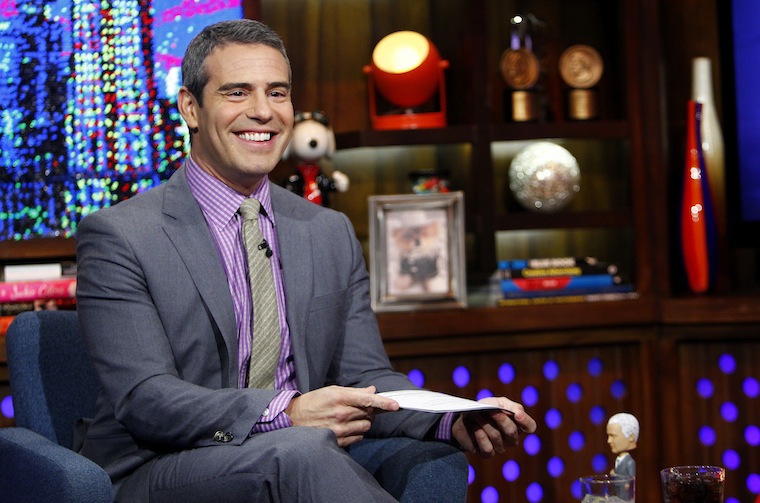
A number of years ago, when Bravo was first making its mark in the pop culture world, and I was sending out promotional missives to any and all interested (and mostly uninterested) parties inviting them to check out this website, I sent one to an executive profiled in Out or The Advocate (that was the way I networked) and Mr. Andy Cohen was kind enough to write back.
It wasn’t a lengthy diatribe, but it was enough encouragement from a man whom I would come to admire and respect, and whose conversational genius was about to explode on ‘Watch What Happens Live’. For me, it was a simple nod of acknowledgement, something that has often been missing from my insular world.
Since that time I’ve loosely followed Mr. Cohen’s upward trajectory as he landed fun gigs (Hello Miss America) and his reality shows stampeded onto the pop culture landscape. He even got me hooked (to my eternal guilty-pleasure shame) on a few of those Real Housewives (NY, NJ, & Beverly Hills only, thank you). What made him even more remarkable was the fact that he did all of this as an open, if unassuming, gay man. When he announced he was writing a memoir part of me jumped for joy, and part of me cringed.
We all knew he could talk, but too many good talkers mistake themselves for good writers. Luckily, Cohen’s voice translates well to the printed word, and his conversational strengths result in a breezy tome. In fact, Most Talkative may be the perfect summer book for anyone looking for an effervescent, easy-going romp. That’s not to say it doesn’t have depth.
Cohen has always been a rather under-the-radar gay person, not loudly proclaiming it, but proudly owning it. It’s the way of the new gay – aware, self-confident, and matter-of-fact about the non-issue of sexuality today. Reading about the ways he came to this self-realized evolution is the most powerful aspect of his book, even as his humor and self-deprecation sprinkle the proceedings with laugh-out-loud hilarity. (The camp letters to and from his mother are insanely hysterical.)
He doesn’t dwell on his more-or-less happy childhood (admitting that it is the part he likes least about most memoirs), and it is a refreshing attribute that the book does not get bogged down in a pathos-filled past. While his struggles over coming to terms with his sexuality and the coming out process lend en unexpectedly emotional depth to the early proceedings, they are balanced with Cohen’s self-deprecating wit and willingness to make himself the butt of most of the jokes.
A must-read for any gay boy (and said boy’s parents), it is often hilarious, occasionally poignant, and wittily cutting, mostly at the expense of the ‘Jewfroed’ author.
It’s also a good book for anyone just starting out on their career – especially for those doubting their passions and wondering if they’re on the right path – not by giving the blueprint to the way of success, but rather by inspiring anyone to do what they really love doing, and to do it well.
{Note: The Madonna Timeline is an ongoing feature, where I put the iPod on shuffle, and write a little anecdote on whatever was going on in my life when that Madonna song was released and/or came to prominence in my mind.}
Driving, pedal to the metal, through the cruel winter of upstate New York. I’m upset at something or someone, and it’s a righteous resentment, a wrathful anger. I’m mad at the world, my rage will not be contained, and the only way out is through this song. It is not the first time a Madonna song proves a savior and a means of survival, and it likely won’t be the last.
By the time this song was released, I’d already been with Andy for about five years, so it had been a while since a man had done me wrong, but not long enough to have me forget. Some kinds of pain cannot be forgotten. Most of us have been there at some point or another, whether we like to admit it or not. The more calm people may have a better way of dealing with it ~ weeping quietly to themselves or categorically eradicating that person from their lives ~ while others may thrash and crash and burn everything around them. I’m somewhere in the middle, having done a little of all of the above. Usually though, I’ll put my anger into a thinly-veiled post, or take a ride and play something like ‘Sorry’ at ear-throttling volume, singing (well, screaming) along with the words, until the anger exits my system, or at least dissipates a bit before returning home.
While the song is clearly aimed at a lover-done-her-wrong (at that point in her life it would likely have been Guy Ritchie), I don’t always use it as the soundtrack for any grumpiness on Andy’s part. More often it’s for anger directed at wrong-doings by the world, or work or something equivocally unimportant. That’s why a relatively-silly song like this works. I save my serious anger and disappointment for the ballads.
This is one of my favorite Madonna songs – maybe not Top Ten, but possibly Top Twenty (the only thing missing may be a sung-through bridge) – and at the time it came out (2005/2006) it was her best since ‘Music’. Nobody throws a dance-floor tantrum better than Madonna, as exemplified by the roller-skating video follow-up to ‘Hung Up’. It prompted a slight resurgence in corsets, and even a bump in Farrah Fawcett feathers. It’s also fun as hell, cheeky as ever, and a reminder of what Madonna does best.
My latest adventures in babysitting resulted in the first time I gave my nephew Noah a brief time-out. Now, I really don’t know how to do a time-out. I’ve heard the term thrown around and never paid it much mind. I figured it was this magical zone that only adults who didn’t have a firm hand resorted to when things got a little rough. I should have paid more attention.
Let me go back to how it came about. I can take a lot from my niece and nephew, and I’m not any sort of disciplinarian. I’m their fun ‘Unca Al’, who lets them horse around and scream and dance and do all the things that kids want to do. But there are limits, and one of them is when Noah starts throwing things. I can take a ball or two, or a plush backpack, maybe even a small plastic animal, but when a big-ass heavy toy truck gets thrown at me, that’s the limit. And even then, I let it slide twice, but on the third go, it was time for the time-out.
I looked toward the corner where I thought my Mom said they went for this scenario. ‘Shouldn’t there be some sort of holding pen, or box, or padded cell?’ I wondered. I saw nothing. What was going to contain him? Maybe this was a new sort of open-air time-out for a two-year-old, maybe they had graduated to a corner of the couch. It was the only area I could see. I picked him up and placed him on the couch telling him he had a time-out and had to sit there.
The waterworks started immediately. I thought this time-out thing was supposed to stop the crying? What was I doing wrong? I picked up his sister and we walked to the other end of the room. Noah got up and followed us, crying at the top of his lungs. I put Emi down and brought Noah back to the couch, saying he had one minute left in his time-out. He stayed put for a second or two (literally) and popped right back up, still crying. This was not going well. The time-out was a bust. I tried one last time, putting him back on the couch telling him he had to stop crying if he wanted to end the time-out, all the while wondering how many words he actually understood. “If you don’t stop crying, you can’t finish your time out,” I pleaded, and the weakness in my voice was almost laughable. I was sure Emi was smirking the whole time. Finally, Noah walked up to me and I couldn’t do it any more. I picked him up, held him close and told him it was all right. We sat down on the couch and I rubbed his back until his tears stopped.
“Are you going to say you’re sorry?” I asked quietly.
His eyes looked down, and the faintest little ‘Sorry’ escaped his lips. I hugged him closer, rubbing his back, and told him it was okay.
He said it better than I ever could.
A minute later he was rolling on the floor, laughing as I tickled him and his sister. Maybe the time out worked in some small way after all. I wonder if it would work on Andy?
Peking Duck, to be precise. Well, any duck will do, but in this instance I had the aforementioned Chinese preparation of the waterfowl on a recent dinner in Chinatown. Kira and I had just seen a show, and rather than puzzle out which restaurant would serve us at such a late hour, we walked to Chinatown, which, I’m told, is generally open deep into the after-hours for night-crawlers like ourselves.
It’s been years since I had Peking Duck, but after the giddiness of the show, and a few giddy cocktails, I had to share it with Kira and remember the night. I still recall the other two times I tried the dish – the first was at my cousin Lee Marie’s wedding rehearsal dinner. I must have only been about ten years old. My Aunt ordered for the table, and when it came around someone showed my brother and me how to properly assemble it. Part soft taco and part burrito by way of China, it was both fun for a kid, and insanely tasty for an adult. I fell in love instantly, but the extravagant price and preparation time put it far from my mind.
It wasn’t until a few years later that I had it again – this time in Washington, DC, with my Uncle Roberto. I was treating him to dinner at one of his favorite Chinese restaurants, and, perhaps because I was doing the treating (or, more accurately, my parents’ credit card was doing the treating) he went for the Peking Duck. It was the first time I’d thought about the dish since that wedding, and in one fell swoop he brought back one happy family memory, while making a new one. We sat at the table leisurely awaiting its preparation. Far from being annoyed or antsy about the prep time, I relished the moments alone with my Uncle. The restaurant was cool and slightly sterile, but a welcome relief from the heat of high noon. Is there anywhere hotter than Washington, DC on a summer afternoon?
When the dish arrived it took up half the table, which was suddenly and extravagantly laid out with all the culinary accoutrements, including that criminally delicious hoisin sauce. Taking our time and savoring the meal – it was as much a treat for me as it was for my Uncle – we gorged ourselves on duck and tea, the two of us finishing almost all of it, in addition to a few other side dishes. I don’t remember what, if anything, we talked about. It was one of those memories that exists in emotional and sensory recollection only – not for the topics or discussion at hand, and if my Uncle were still alive he would likely not remember it. But for me – and for the kid I once was – it was one of the best lunches I ever had.
On this particular evening, almost ten years after my Uncle has passed, I take my friend Kira to a restaurant in Chinatown and order the Peking duck for her – for us – and I share the memories I have of the dish.
The Super Moon rose a few Saturdays ago – on our anniversary weekend no less, when we were ensconced in Boston and enjoying a dinner at Clio – and wreaked havoc with our evening in the form of a big fight. Exerting its pull and its crazy power to upend things, the moon worked to wreck a very fine dinner as Andy and I fell prey to its advances and went into warrior mode.
We’re not one of those couples who yells or screams all the time – that’s not the way we operate. Our style – the one that works (or doesn’t always work) for us is smooth sailing for a long time, then a big huge fight that brings up everything that’s bothered us over the previous few months, then a few days when it all dies down and goes back to normal.
I’m not saying this is the best way to deal with things – most of my perfectly-married friends say we need to work on communication – but I was not raised that way, and every time I did communicate, well, it ended in a fight anyway so why even bother?
Personally, I’d rather have one or two days every few months where things are brought up and discussed (or yelled about) and enjoy the majority of peaceful time in-between, rather than deal with every single squabble that comes up and potentially ruining every other hour.
{Note: The Madonna Timeline is an ongoing feature, where I put the iPod on shuffle, and write a little anecdote on whatever was going on in my life when that Madonna song was released and/or came to prominence in my mind.}
Whoo-hoo! Our very first selection from Madonna’s latest, ‘MDNA’, has made it onto the timeline. While ‘Some Girls’ may not be the best song on the album, the record is so strong that even its weak offerings are substantial. This song illuminates what I’ve always felt was Madonna’s slightly ambivalent relationship with women – both in their role as friends and confidantes, but also as people to be watched with a wary eye.
In one of the many biographies written about her, it was reported that Madonna didn’t liked to be in company of beautiful women, that she felt threatened by them and insisted she be the star attraction in any given room. Taking that with a grain of celebrity-biography salt, I do wonder if there are bits of truth to it. She is notorious for making herself the sole blonde in all of her stage shows (back-up singers and dancers who are any shade brighter than brunette need not apply), and the women who feature alongside her in videos are well-relegated to background status.
Yet one of her main messages through the years has been the original rallying cry of Girl Power. The tongue-in-cheek aspects of’Material Girl’ and her Boy-Toy belt-buckle phase, the stripper-in-command power of ‘Open Your Heart’, the seductive crotch-grabbing power-suit of ‘Express Yourself’, the sexual libertine of ‘Erotica’, and the take-no-prisoners rebel of ‘American Life’ have each posited questions of female domination in a world largely run by men, and the question has mostly been answered by Madonna ending up on top (of fame, fortune, influence, and power).
‘Some Girls’™ is a contradictory collective of praise and criticism of other ladies. This is much more pointed and jaded, highlighting the notion of competition. At this point (30 years from her first single ‘Everybody’), she has left virtually all wanna-bes in the dust at one point or another, and it looks unlikely that anyone will take her mantle as best selling female artist of all-time, yet she still seems to feel their heat. Maybe it’s more personal – prior to marrying Guy Ritchie she had seen a number of former romances find long-term love and children shortly after moving on to other women (Sean Penn, Warren Beatty). It seems to have happened again with Mr. Ritchie, who recently had another baby of his own with another woman.
Maybe Some Girls aren’t career competition, maybe Some Girls are a little bit more, and maybe Madonna is still a little scared of Some Girls.
Given that at this moment I’m watching a total of two TV shows (two more than usual, and they are, quite psychotically, Mad Men and the Real Housewives of New Jersey), a play about the invention of television would seem to be the last thing to captivate me. Yet that is exactly what the current production of ‘The Farnsworth Invention’ manages to do at the Albany Civic Theater.
Masterfully directed by Aaron Holbritter and written with the deft, quick-worded brilliance of The Social Network’s Aaron Sorkin, it ostensibly sets out to document the creation of television, but manages to display layers of human drive, greed, hope, and innocence along the way. This is a mannered, thoughtfully-paced, and intricately-nuanced production, but its complexities play out in charmingly entertaining fashion, as much a testament to the talents of the director as to the strength of the cast.
At its center is the fictional interaction between media mogul David Sarnoff (Isaac Newberry) and Philo Farnsworth (Tom Templeton) as they compete to be the first to bring television to the world. Their relationship propels the show forward, and Newberry and Templeton ground the evening with an ever-evolving emotional arc between two very different men who came from similarly-barren pasts. As moving as they are, it is the ensemble as a whole that works together to flesh out the unexpectedly gripping drama as it unfolds. The supporting cast works wonders, creating around 60 characters between them, and somehow making every one distinct. Stand-outs include Ken Goldfarb and Joey Hunziker, who each get a few luminescent moments to shine.
There are a number of passages that soar, such as the exuberant explosion of the cast’s joy upon seeing the first glimpse of a moving picture on the small screen, or the comical juxtaposition of both witness teams in the lawsuit, and all of it serves to underscore the riveting dynamics between Newberry and Templeton.
In the hands of a less-skilled director or a less-restrained cast, the Farnsworth familial portion of the play might have verged on cloying – here, under the guidance of Holbritter, and the desperate yet contained grief conveyed by Templeton and Kyrie Ellison, it is an effective moment that sets up the final act. (One of the only minor complaints that can be made is the fault of Sorkin, who has yet to prove he can write a compelling, three-dimensional woman – whether that’s really his own flaw, or a product of the time period in which this subject took place is a debate that can rage elsewhere). That said, this production is one of the most subtle yet powerful stagings I’ve had the privilege of seeing in quite some time, and credit goes mainly to the cast and the director.
Ironically, or intentionally tellingly, what they manage to do – and what can only be done in live theater – is something that you can’t capture on television – that moment between actor and audience, when you inhabit the exact same time and space, breathe the same air, live in the same world – and feel as if you are actually there, sharing their heartbreak and happiness, striving and yearning along with them, aching in their grief.
It’s easy to root for the good guys, to be given a clear sense of who’s right and wrong and follow that simple path – but so much more rewarding and challenging, so deliciously tense, to be presented with complicated, fully-human characters complete with flaws, ambitions, hopes, and failings. We are given such a glorious dilemma here, and Newberry, as the first and final narrator, exemplifies this gorgeous ambivalence, shining light upon this human connection that brings us all together – not unlike television once did.
There is not a ‘first-thing-in-the-morning’ post today as I’d like you to read last night’s post (scroll down) and really think about it. This is the first time a sitting President has come out in support of gay marriage. Ever. That is historical, in a way that most of us don’t register anymore. Barack Obama is the first President in history to do this. No really, stop… please.
Think about it.
There is something incredibly affirming and powerful about hearing your President speak directly in support of you as a full-fledged citizen for the first time. It’s something straight people have had always, and that they have sometimes taken for granted, but when you’ve never had a President in office say that – on your behalf – it means more than I thought it would.
In the wake of the news in North Carolina, to hear our President proclaim unequivocally – at last, and once and for all – that he supports gay marriage, is a galvanizing and monumental moment. It is an act of forward-thinking progress, political courage, and history-making fortitude.
It may be damaging politically, and it may tilt a tight election the wrong way, but it was the right thing to do, and as such President Obama will rightfully, and proudly, be written into the history books, whether the prejudiced people like it or not, as a champion of all citizens, regardless of race, religion, natural origin, gender, or sexual orientation.
This is history. This is real. This is now. And this is major.
Pay attention – because what just happened in North Carolina will be seen as an act as backwards as sending Rosa Parks to the back of the bus, as mindless as denying women the right to vote, and as shameful as beating Matthew Shepard to death. To argue with this is to argue against love, and I defy anyone to take such a stance and stand behind it with any semblance of reason.
It’s time to pay this President the same respect that you would pay any President in office. There is no excuse for ever having done otherwise. President Obama, I stand behind you, and I thank you for representing the finest values of freedom for which this country has always stood.
On the same night that North Carolina voted to write hatred and discrimination into their state constitution by banning gay marriage (a constitutional move that was last done in the 1800’s by a vote that banned interracial marriage – a ban that was only lifted as recently as 1971), I finally found the fortitude to watch the video above. I’m asking you to do the same – and then to ask anyone you know who is against gay marriage why they would be against love.
That’s all it is. That’s all we ever wanted.
How could anyone be so against love?
I do not understand that.
I hope I never will.


