Category Archives: Theater

You Can’t Do This On Television

Given that at this moment I’m watching a total of two TV shows (two more than usual, and they are, quite psychotically, Mad Men and the Real Housewives of New Jersey), a play about the invention of television would seem to be the last thing to captivate me. Yet that is exactly what the current production of ‘The Farnsworth Invention’ manages to do at the Albany Civic Theater.

Masterfully directed by Aaron Holbritter and written with the deft, quick-worded brilliance of The Social Network’s Aaron Sorkin, it ostensibly sets out to document the creation of television, but manages to display layers of human drive, greed, hope, and innocence along the way. This is a mannered, thoughtfully-paced, and intricately-nuanced production, but its complexities play out in charmingly entertaining fashion, as much a testament to the talents of the director as to the strength of the cast.

At its center is the fictional interaction between media mogul David Sarnoff (Isaac Newberry) and Philo Farnsworth (Tom Templeton) as they compete to be the first to bring television to the world. Their relationship propels the show forward, and Newberry and Templeton ground the evening with an ever-evolving emotional arc between two very different men who came from similarly-barren pasts. As moving as they are, it is the ensemble as a whole that works together to flesh out the unexpectedly gripping drama as it unfolds. The supporting cast works wonders, creating around 60 characters between them, and somehow making every one distinct. Stand-outs include Ken Goldfarb and Joey Hunziker, who each get a few luminescent moments to shine.

There are a number of passages that soar, such as the exuberant explosion of the cast’s joy upon seeing the first glimpse of a moving picture on the small screen, or the comical juxtaposition of both witness teams in the lawsuit, and all of it serves to underscore the riveting dynamics between Newberry and Templeton.

In the hands of a less-skilled director or a less-restrained cast, the Farnsworth familial portion of the play might have verged on cloying – here, under the guidance of Holbritter, and the desperate yet contained grief conveyed by Templeton and Kyrie Ellison, it is an effective moment that sets up the final act. (One of the only minor complaints that can be made is the fault of Sorkin, who has yet to prove he can write a compelling, three-dimensional woman – whether that’s really his own flaw, or a product of the time period in which this subject took place is a debate that can rage elsewhere). That said, this production is one of the most subtle yet powerful stagings I’ve had the privilege of seeing in quite some time, and credit goes mainly to the cast and the director.

Ironically, or intentionally tellingly, what they manage to do – and what can only be done in live theater – is something that you can’t capture on television – that moment between actor and audience, when you inhabit the exact same time and space, breathe the same air, live in the same world – and feel as if you are actually there, sharing their heartbreak and happiness, striving and yearning along with them, aching in their grief.

It’s easy to root for the good guys, to be given a clear sense of who’s right and wrong and follow that simple path – but so much more rewarding and challenging, so deliciously tense, to be presented with complicated, fully-human characters complete with flaws, ambitions, hopes, and failings. We are given such a glorious dilemma here, and Newberry, as the first and final narrator, exemplifies this gorgeous ambivalence, shining light upon this human connection that brings us all together – not unlike television once did.

‘The Farnsworth Invention’ is playing at the Albany Civic Theater until May 20, 2012. To reserve seats, call 518-462-1297.
Continue reading ...

The Very Model of a Major Good Time

There’s something thrilling about seeing a show you’ve never seen before. Yet even if you have the faintest familiarity with a production, when that red curtain rises it erases everything that came before – including 100 plus years of history and acclaim – and it’s as if it’s happening for the very first time. You can never recapture that moment, not with the grandest revision or the wildest reimagining, so I’m thankful that my first brush withThe Pirates of Penzance came at the hands of the Cohoes Music Hall.

I knew nothing of the show, other than the fact that it was created by the legendary team of Arthur Sullivan and W. S. Gilbert, and I’d had no more than a fleeting bit of pop culture exposure courtesy of the ‘Major General’s Song’. Beyond that I was pirate virgin, waiting for my pirate booty to be plucked and plundered with a snappy bit of song and dance. I’m happy to report that my Pirates of Penzance cherry was perfectly popped in the current production running in Cohoes until February 19.

A light-hearted frolic, wispy as the clouds of the opening set, Pirates is directed with a deftly-nuanced touch byC-R Productions own Jim Charles. Far from the darker fare peddled by modern day movies or real-life news, the pirates here wink and cajole, winning over the audience before the rest of the participants, a tribute as much to the stellar ensemble as to the original brilliant score, which soars and floats gloriously amid the February doldrums.

An operetta demands a blithe hand, and this romp is a broad, and at times earnestly moving, bit of escapism. Completely engaging as an effortlessly-amusing good time, it finds the pirates on the comical rather than fearsome side of things. The Pirate King is more Johnny Depp than Captain Hook, played with charismatic scene-stealing debauchery by Jesse Coleman. Mr. Coleman commands and pilots the proceedings with swashbuckling fierceness, moving convincingly between compassion, empathy, anger, and haplessness with delicious abandon. Anchored by the dulcet tones of John Farchione as Frederic and the glittering coloratura of Kellie Cundiff as Mabel, the production sails grandly towards its happy ending, pausing only at the show-stopping rendition of the Major General’s Song, sung flawlessly by Jerry Christakos, who brings the added depth of heart necessary to set the second act on fire.

Whenever ‘Pirates’ broad humor threatens to be too much, it suddenly offers forth a bit of wit and cleverness to keep it in check, standing up to the test of time, if not improving upon the original material. While the first act builds and builds, the second lands running, with an enchanting other-worldly set, and the non-stop entertainment that doesn’t give out until it’s over.

If it’s a witty frolic and some good old-fashioned entertainment you’re on the hunt for this winter, I highly recommend this pirate’s life for you.

Continue reading ...

On the Rag – Theater Review

Having had the fortune of seeing the original Broadway production of ‘Ragtime’, I feared that it would be no mean feat for the Schenectady Light Opera Company to pull it off. The original staging had the killer combination of Brian Stokes Mitchell, Marin Mazzie, and Audra MacDonald to dazzle and delight, along with a supporting cast of what seemed like hundreds. Add to that a sky-high set that managed to depict everything from a stately Victorian house to the immigrant tenements of New York City to the entire industrial revolution, and ‘Ragtime’ would seem to defy a small local theater treatment. Yet the Schenectady Light Opera Company manages to find the heart of this musical, and keep it beating through every syncopated step.

Under the masterful direction of Joseph Fava (who doubles brilliantly, and integrally, as the costume designer) this ‘Ragtime’ eschews a fancy set and scenery, focusing rightly on the main players and the music, and against all odds, it works. As someone who was raised, for better or worse, on the enormous levitating mansion of Norma Desmond in Andrew Lloyd Webber’s ‘Sunset Boulevard’, I have always guiltily appreciated a lavish set for a night of theater, but when a musical has the strength of an ensemble like the one currently at work in Schenectady, one doesn’t miss the crashing helicopters or falling chandeliers of big-budget spectacle. The score, the songs, and the performers are enough, and despite the relatively small group of musicians off to the side, they manage to make the music soar – filling the former-church space with majesty and might.

Though it is an ensemble piece, ‘Ragtime’ depends largely on the capabilities of its three main leads. The first, Mother, is a trickily thankless role that slowly evolves into something more, culminating with the 11th hour bit of brilliance that is ‘Back to Before’. Joan Horgan deftly portrays Mother’s initial complacence, her defiant growth, and almost imperceptible yet complete transformation before our very eyes.

As Coalhouse Walker, Jr., Jahmere Holland must carry the brunt of the show’s political message, along with its emotional core. Where his voice doesn’t quite rise to the needed heft of some of the anthems, his charisma more than carries him through (along with some impressively fancy footwork).

It is Nick Abounader, as Tateh, who steals the show and gives it its immigrant-and-an-American-dream heart. From the touching scenes with his daughter to the rage at an unforgiving and unwelcoming foreign country, Abounader manages to go from fury to anguish to tenderness in the span of a few minutes, all with a convincing accent. In a voice that blends steely strength and remarkable sensitivity, he handles Tateh’s physical and emotional arc with conviction and commitment.

Providing comic relief and historical touchstones are the cheeky Amanda Jo Marshall as Evelyn Nesbit, Dave Dixon as Harry Houdini, and Debbie May in a feisty turn as Emma Goldman. Excellent vocal work is also displayed by Steven Leifer as Father and Robert L. Hegeman as Younger Brother, while Thomas Dalton Bambury gives racism a love-to-hate-him face in the form of the bigoted Willie Conklin.

Yet for all its individual achievements, it is the ensemble that will always make for a successful staging of ‘Ragtime’, and that strength is largely an attribute of its director. Fava manages to keep an insanely intricate and large cast moving individually and en masse with equal parts of expertise, accuracy, and effortless grace. Even at its most trite, ‘Ragtime’ reminds us of where this country once was, and in doing so can’t help but echo where some of it still is.

Continue reading ...

‘Next Fall’ at the Speakeasy Stage – Theater Review

A far cry from the last feel-good production I saw put on by the SpeakEasy Stage Company (that would be the rollicking good-time of ‘The Drowsy Chaperone’), ‘Next Fall’ is a very serious play that resonates with several particularly-timely subjects – yet it is just as expertly-done, and haunts in a more provocative manner. At its heart, it is a play about the difficult reconciliation between religion and homosexuality, and it also touches on family relations, the question of faith, and the simple (or not so simple) meaning of love. If it sounds like a lot, it is – but somehow the ensemble cast reins it in with impeccably-rendered performances.

Nominated for a Tony for Best Play in 2010, ‘Next Fall’ by Geoffrey Nauffts is compellingly of-the-moment, especially given these religiously-fanatic times. A Bible makes it way around to each of the characters – sometimes instilling comfort, sometimes inciting anger, sometimes invoking sadness – and it becomes its own central character, embodying the idea of religion, and all notions of good and bad. Any sort of judgment one way or another is wisely avoided, and the lingering ambivalence over the real role of religion and faith in the characters’ lives remains powerfully unresolved.

Directed by Scott Emriston, the production keeps its pace, owing in part to several ingenious set design shifts (Scenic Designer Janie Howland) and quick costume changes (Costume Design by Carlos Aguilar). Most effective may be the lighting (courtesy of Lighting Designer Karen Perlow), which somehow manages to differentiate between a cold hospital waiting room and a warm personal apartment, seemingly at the flip of a switch.

There are a few minor quibbles. A quick drug-addiction scene comes out of nowhere and ends up in the same place, and at times it does feel like there are too many things going on when a closer, more detailed examination of the bigger issues at hand might have proved better, but the strength of the ensemble pulls it all together. Not one of the actors uses broad strokes to fill their character, and their subtle, natural nuances keep things grounded on a credible level. There’s not a weak-link in the bunch. Taken as a whole, they add up to a powerful night of theater.

Continue reading ...

Get A Load of These Cats – Theater Review

Have we been wrong about Cats all this time? That’s the question and challenge posed by the brilliant production currently prowling the Cohoes Music Hall. The reviews are glowing, the cast is perfection, and this incarnation defies all the jokes that have ever been made about the show. This is the Cats of the original hype, but without the inflated disappointment. It has caused more than a few of the jaded to rethink their thoughts on the material, and it stands up remarkably well 30 years after its premiere.

The first time I actually saw the show was when it was touring in the mid 80’s – we caught a performance in Toronto I believe – the most memorable part of the whole thing being the set, and my Dad’s uproarious imitation of the cats after it was all over, raising his hand like a paw and cracking me and my brother up. He was, to say the least, not impressed, but I didn’t hate it with the gleeful animosity that most people did. In fact, I felt none of the disdain that so many theater snobs seemed to take such joy in expelling. It wasn’t the second-longest running show on Broadway for no reason – there are some decent songs (courtesy of Andrew Lloyd Webber) and some incredible choreography. However, with all the hype of its premiere I think most people went into it expecting some sort of miracle transcendental moment – and this isn’t that kind of show. The power of Cats lies in its performance – in the energetic trooping of its hoofers and a power ballad or two. There is a weak storyline of journeying to the Heaviside Layer, and as much anthropomorphic meaning as you wish can be read into the evening’s festivities, but above all this is about song and dance.

Under the expert direction and choreography of Jacob Brent (who performed in both the Broadway and London productions of the original show), that song and dance is given a gorgeous whirl that majestically captures the graceful movements of the dancers while perfectly melding them into feline form. Along with the always-excellent musical direction of Joshua Zecher-Ross, whose musicians, though few in number, completely fill the space with the necessary bombast for the rigorous dance routines, while subtly pulling out the most delicate harmonies in the quieter moments, the structure and bones of this animal are stalwartly intact. From there it growls, prances, and claws its way into the pantheon of fine performances that the Cohoes Music Hall has seen over as many years as a cat has lives. (This is the start of their ninth season.)

There are several stand-outs in a show rich with remarkable performers, most notably Tony Rivera strutting his stuff and chewing the home-turf scenery as Rum Tum Tugger (he is the very definition of charisma), Chaz Wolcott as the magical Mr. Mistoffeles (he is the embodiment of elegant electricity), John Farchione as Gus/Growltiger and Lucy Horton as Jellylorum/Griddlebone (together the essence of comedic genius). Ruthie Stephens gets the big number, ‘Memory’, and acquits herself admirably as Grizabella.

The rest of the cast is across-the-board superb, with nary a weak paw in the place. Sean Hingel as Munkustrap anchors the show with a convincingly-cat-like regal bearing, while Kelly Briggs as Old Deuteronomy adds the proper imperial note (even holding the stage focus for a cat-nap during intermission). In the end, though, it’s the company as a whole that makes the magic that carries the night – the thrilling Jellicle Ball episode unfolds with one amazing dance sequence after another, unfurling like some indefatigable wind-up toy brought to thrilling human form.

The folks at Cohoes Music Hall have a way of revitalizing new and old shows with integrity and exuberance, both of which elevate this production of Cats into a theatrical experience rich and worthy of exaltation. Go see it now, because this one won’t be around forever.

Continue reading ...

A Broadway Ballet (And A Bear or Two)

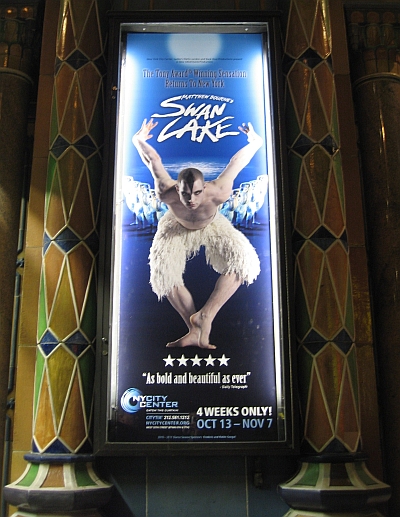
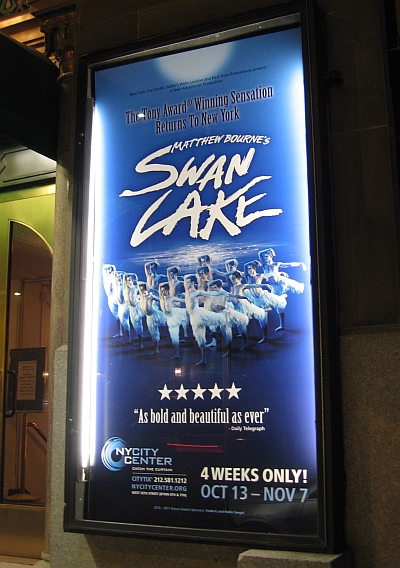
It was a Russian weekend in New York City, as Andy and I took the train down to see the return of Matthew Bourne’s Swan Lake at the City Center. Hotel rooms are insanely priced these days, and even with the combined bidding wars of Priceline, Expedia, Hotwire, and Kayak, the best I could do was $275 for a night at the Essex House on Central Park South. It actually worked out for the best though, as the hotel was in close proximity to the theater.

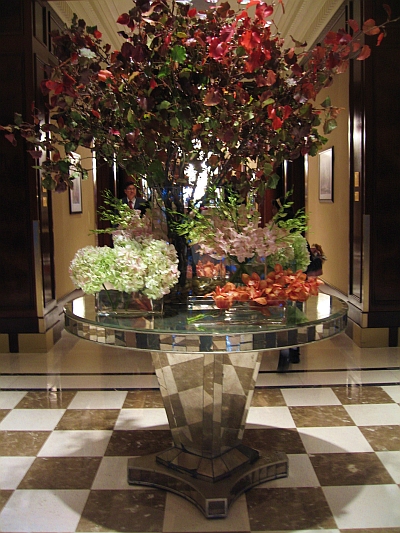
The Essex wasn’t bad, and the flowers in the lobby were certainly nothing to sneeze at (unless you’re allergic to that sort of thing).

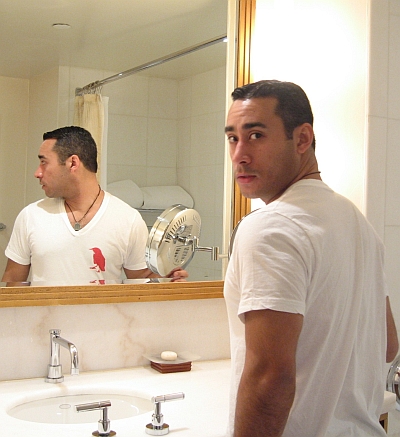
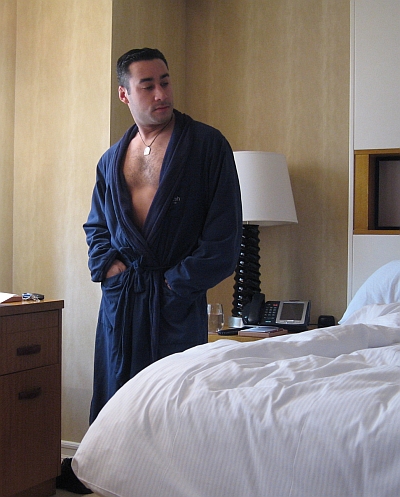
I wore the tree-of-life pendant that Andy got for me in Ogunquit this past summer. (I don’t know why this merits mention, other than for the photo below that I snapped in the bathroom, and the bartender at the Oak Room who complimented me on it.)

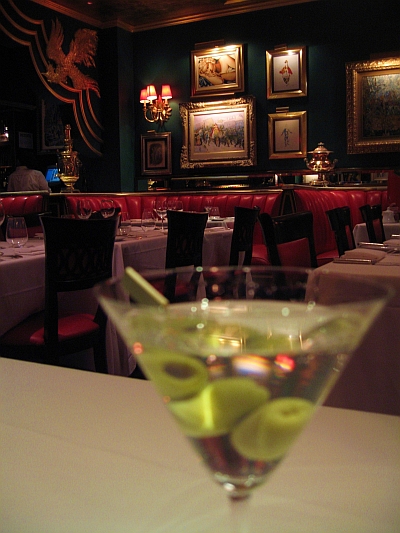
In keeping with the Russian theme, we had dinner reservations at the Russian Tea Room. I had eaten there many years ago with my parents, and the chicken kiev had been something to behold. They then shut down for a while, but re-opened, so we decided to try it (plus the online cocktail menu looked like heaven).

We probably should have stopped at the cocktails, because while dinner was passable, the prices were a bit on the ridiculous side. Also, after asking the wait-person for their smoothest Russian vodka (she recommended the Jewel Of Russia), I had a martini that was rather rocky going down.

The chicken kiev did still burst with butter, and the decor is as red-gold-and-green as ever, so we’ll leave it at that.

After dinner we walked around the block and looked in the windows of closed shops and galleries while waiting for show-time to approach.

Matthew Bourne’s Swan Lake joins the small pantheon of shows that my husband and I have seen together on Broadway. It began with Wicked (and that original, incomparable pairing of Kristin Chenoweth and Idina Menzel), and continued with Grey Gardens (and the uncanny and amazing Christine Ebersole), and now we have the return of Matthew Bourne’s Swan Lake. On their own, these shows were each great – seeing them with someone I love just made them that much more special and memorable.

I still recall the early November night we saw Wicked when it first opened (yes, I wore green that first time, though I’m a pink girl at heart) as well as the bitter cold of January’s Grey Gardens with a dinner at Gallagher’s steakhouse (that included a warming Manhattan and a seat by the gargantuan wood stove).

Swan Lake itself was spectacular. I knew I would like it; I did not know that I would absolutely fall in love with it. Having seen the DVD of the production a number of years ago, I knew the gist and the gimmick – but to see it in person gives it a life that can never be reproduced on screen.

It’s basically a gay fantasy brought to thrilling, and disturbing, life. I can only imagine what my own life might have been like had I seen this production as a young boy. How different would my journey have been, and what would it have meant? I will never know. That it exists today is a blessing, and an unforgettable night of theater. Seeing two men dance together is just as potent and powerful now as when it first opened over a decade ago – mostly because I just don’t get to see that very often – and partly because the world hasn’t changed all that much. As the curtain came down on the crushing final scene, I did not want it to end.

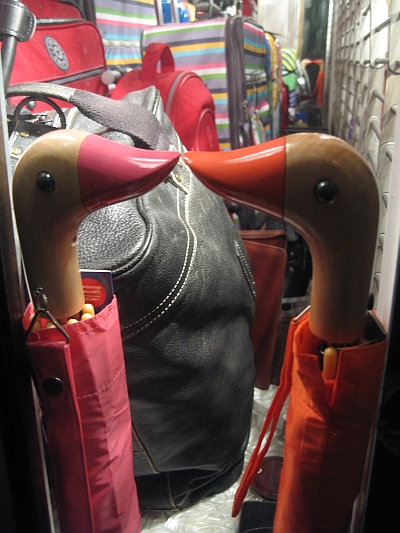
But there will be other curtains, and other shows, and yes, Suzie, even other swan umbrellas, so have faith.

The next morning we headed out for a brief (Andy would say interminable) shopping excursion, and then it was time to depart (without the $100 hotel robe).

Continue reading ...